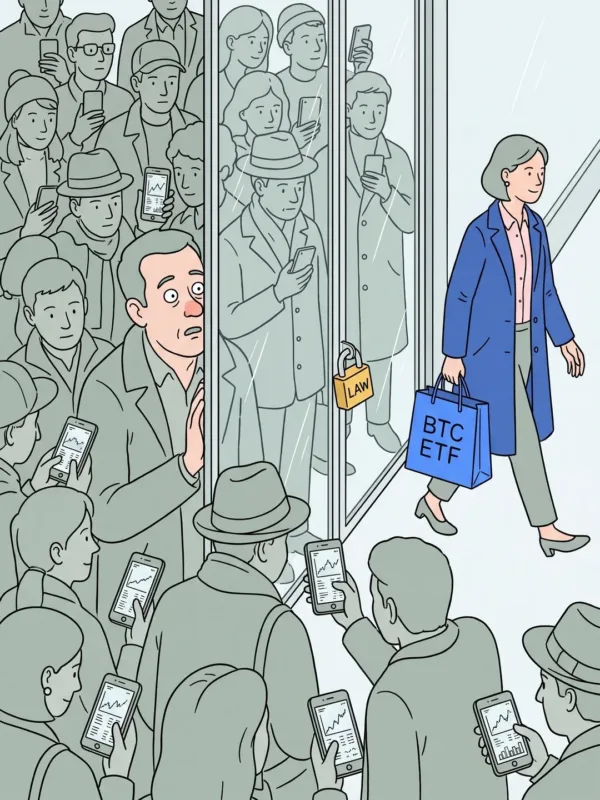
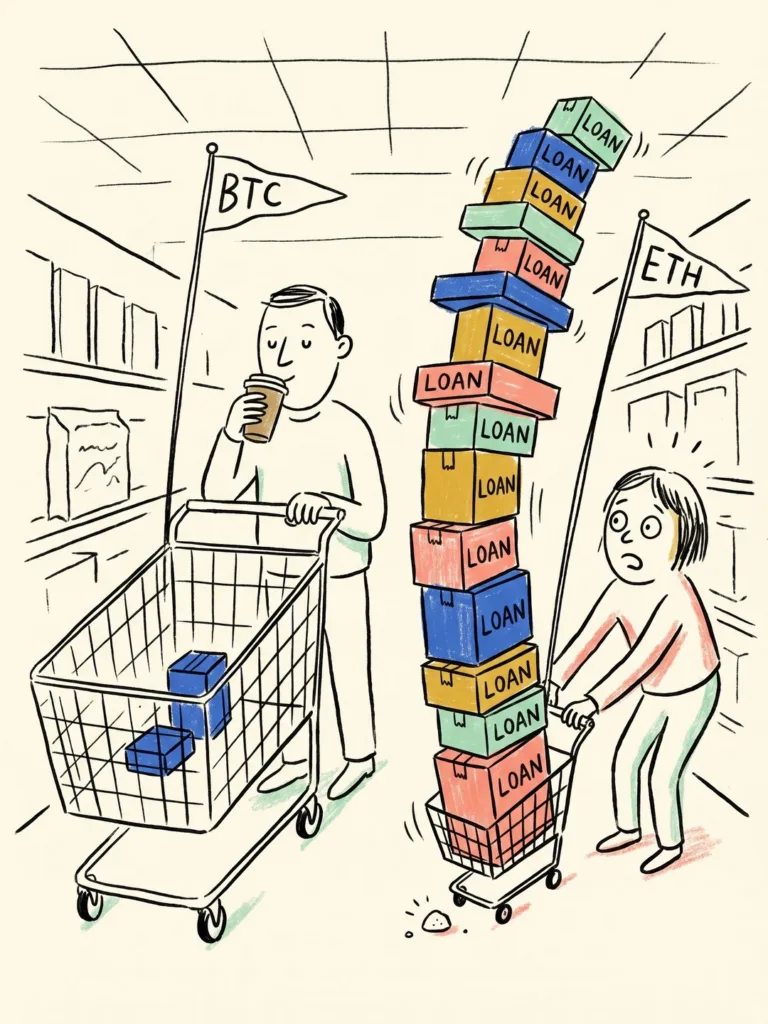
Over 24 hours, $356 million of Ether bets made with borrowed funds were forcibly closed. Bitcoin saw $298 million in the same window. Yet Bitcoin's market value (the total value of all its coins) is more than five times Ether's (CoinDesk data, Oct. 9).
The usual explanation is "Ether just fell more." It did: Ether dropped more than 3% to about $2,490, while Bitcoin lost about 1%. But the real point lies elsewhere. The size of the drop is only the trigger. How much can be force-sold isn't decided by how big a coin is, but by how much borrowed money is riding on it.
- Who sells in a liquidation, and why?
A liquidation happens when someone borrows to make a bigger bet and their losses eat through the deposit (collateral) they put up, so the exchange closes the trade automatically. The trader didn't press sell. The exchange sells for them before the loss grows bigger than the deposit.
Think of it like a loan with a safety deposit: if the deposit runs short, the lender sells your stuff right away. A crypto exchange does exactly that, automatically. That selling lands on a market that is already falling, pushing the price lower and draining the next trader's deposit too.
- At 30x, a 3% drop can wipe out everything
Say you put up $1,000 at 20x (trading with 20 times your own money), buying $20,000 worth of Ether (an example). A 5% drop costs you $1,000. Your whole deposit is gone.
With leveraged bets like this (bets made with borrowed funds), the higher the multiple, the smaller the drop you can survive. At 10x it's 10%; at 30x, a drop of about 3.3% wipes out the deposit (an example that leaves out fees and exchange-specific rules). Put simply, at 30x, a drop almost the same size as Ether's fall this time (more than 3%) would empty your deposit.
- How lopsided were the numbers?
Across the market, $1.19 billion was liquidated over 24 hours, and over $1 billion of it came from bets on rising prices. Ether led with $356 million, then Bitcoin with $298 million and Solana with $71 million.
Adjusted for size, the gap widens. For every $1 billion of market value, about $1.2 million of Ether was force-sold, versus about $180,000 for Bitcoin. That's about six times. The single biggest wipeout was also a nearly $20 million Ether position on Hyperliquid. Hyperliquid is a decentralized exchange (one where software, not a company, handles the trades) for leveraged crypto bets.
Put simply, relative to its size, the coin hit hardest this time was not the biggest one.
- Were there signs of borrowed money piling into Ether?
There was a warning two days earlier. On Oct. 7, about $608 million was liquidated, mostly from traders betting Ether would rise. Crypto Briefing reported that just before that, open interest in Ether futures (contracts that bet on whether prices rise or fall), meaning the total value of contracts not yet closed, was elevated.
It also noted that those betting on a rise were paying extra (a funding rate) to those betting on a fall just to keep their positions open. The stronger the belief that prices will keep climbing, the more borrowed money piles up on one side.
Borrowing was building on the Bitcoin side too. All week, as Bitcoin bounced between $83,000 and $87,000, traders added leverage. Then minutes from the Federal Reserve, the US central bank, showed most officials expected another rate hike before year-end, and Bitcoin slid from about $83,200 to roughly $80,400.
- When the direction flipped, who got force-sold?
The tables turned quickly. After President Trump ruled out a strike on Iran before the midterm elections, Bitcoin recovered to about $82,200. Of the roughly $25 million liquidated over four hours as the rebound continued, about 78% came from bets on further declines.
Whether you bet on a rise or a fall, a trade made with borrowed funds gets force-sold the same way when the price moves against you. What sets the size of the risk isn't your call on direction. It's your leverage.
- What happened on the same day a year ago?
This came a day before the anniversary of Oct. 10, 2025, when a record $19 billion was liquidated in a single day. That was about 16 times this Thursday's total.
The difference this time is size: this tally was in the $1 billion range. But the structure is the same: where borrowed money piles up, forced selling triggers more forced selling.
- BITPRESS Insight
For anyone buying crypto with borrowed money, "How far will it fall?" is the second question. The first is "How far can it fall before my deposit is gone?" At 20x, that's 5%. At 30x, about 3.3%. On a day that moves more than 3%, like this one, 30x leaves your deposit nearly empty.
This matters even if you hold crypto without borrowing. A coin with borrowed money piled on one side sees forced selling pour in on even a small drop, pushing its price down further. It shakes first not because it's small, but because the borrowing is concentrated there.
So the test is simple. Divide 100 by your leverage. If the price ever drops that many percent, your deposit is gone. With fees and exchange rules, it can be closed even sooner.
Sources
https://www.coindesk.com/markets/2026/10/09/ether-bets-were-wiped-out-at-six-times-bitcoin-s-rate-in-crypto-s-usd1-billion-flush
https://cointelegraph.com/markets/bitcoin-speculators-btc-exchanges-crypto-liquidation
https://decrypt.co/380599/bitcoin-rebounds-traders-predict-more-downside
https://cryptobriefing.com/crypto-liquidations-608-million-ether-longs/
https://www.mt.co.kr/economy/2026/10/08/2026100815360412966
Glossary
Forced liquidation — When losses on a trade made with borrowed money eat through the deposit, the exchange closes the trade automatically.
Leverage — How many times your own money you trade with; at 20x, $1,000 controls $20,000.
Market cap — The price of one coin multiplied by the number of coins, or the total value of the coin.
Open interest — The total value of futures contracts that are still open and not yet closed.
Funding rate — A regular fee one side of a no-expiry crypto futures contract pays the other; when bets on a rise crowd in, that side pays.
BITPRESS articles are information to help your investment decisions, not a recommendation to buy or sell any stock or coin. Investment decisions and their results are your own responsibility.