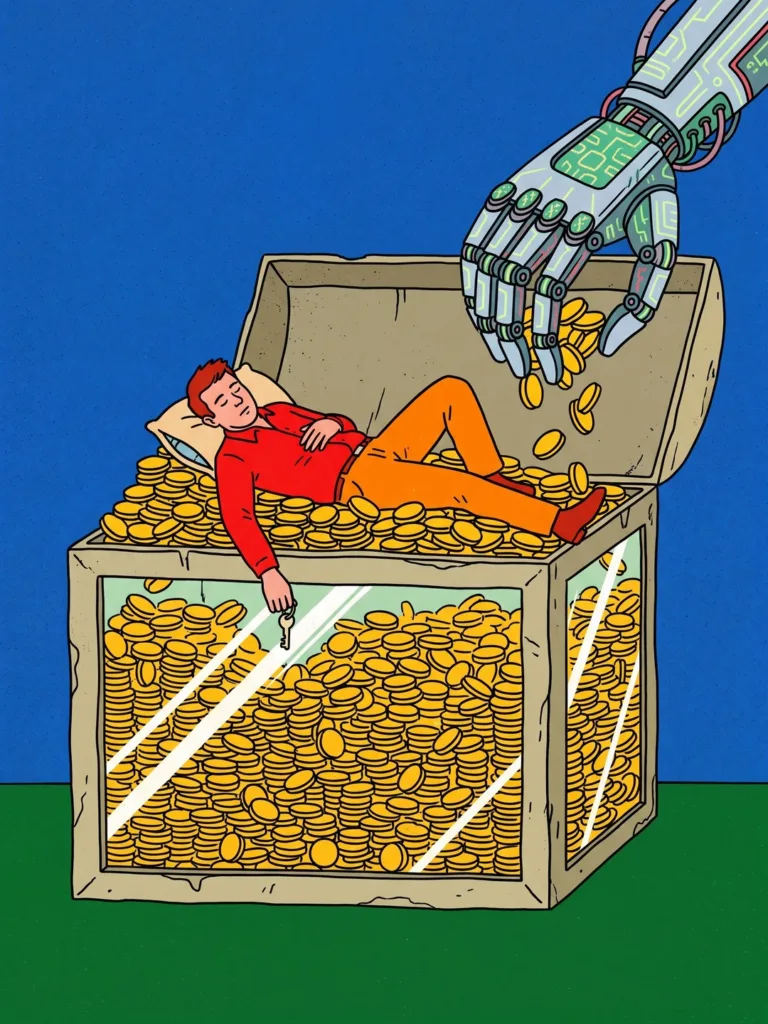
6.04 million bitcoin, 30.2% of all issued supply, already have their public key visible on the blockchain. That is the finding of an analysis released May 20 by blockchain analytics firm Glassnode. On Oct. 15, nine crypto organizations launched the "Quantum Alliance" to set standards for preparing against quantum computers.
Talk about quantum computers usually splits two ways: one side says every bitcoin will be stolen the moment such a machine appears, the other says it is still a distant concern.
But the key point lies elsewhere. The risk is not the same for every coin. Even among bitcoin, it is already divided by which address the coins sit in and how they were kept, and about two-thirds of the exposed coins got that way from reusing addresses, not from the address format.
- What quantum computers target is the public key that is already exposed
Bitcoin moves only when it is signed with a private key (a secret value only the owner knows). The public key is the value the network uses to check that the signature is genuine. With today's computers, knowing a public key does not let anyone calculate the private key, so it was fine for public keys to be seen.
Quantum computers shake that assumption. A large enough quantum computer running Shor's algorithm (a method for solving this calculation quickly on a quantum computer) could, in theory, recover a private key from a public key. Think of a machine that can carve a key just by looking at the shape of a lock. So the question narrows to one: is my coin's public key already visible on the blockchain?
If the public key is already visible, an attacker does not have to wait for the owner to move the coins. By this standard, Glassnode put 6.04 million BTC in the "exposed" group and the remaining 13.99 million BTC (69.8%) in the "not exposed" group.
- The size of the machine needed has shrunk to one-twentieth
In a paper published March 31, Google estimated that a machine with 500,000 superconducting qubits (a quantum computer's unit of computing) could break the encryption Bitcoin uses (secp256k1) in a few minutes. The previous estimate was about 10 million qubits, 20 times as many.
As of the March report, the most advanced superconducting quantum processor Google had built, Willow, has 105 qubits. Among the forecasts the Quantum Alliance cited, one model built jointly by two member companies gives March 2028 as an early window.
Put simply, the bar for a machine that could break Bitcoin has dropped sharply, but no such machine exists yet.
- Two-thirds of the 6.04 million were exposed by reusing addresses
Glassnode split the exposed coins into two groups. 1.92 million BTC (9.6%) is "structural exposure." These are cases where the address format itself shows the public key, such as early Satoshi-era addresses (P2PK; Satoshi Nakamoto is the anonymous creator of Bitcoin) and the newest format, Taproot (P2TR) addresses.
The other 4.12 million BTC (20.6%) is "operational exposure." These were originally addresses where the public key hides behind a hash (a value that scrambles the original so it cannot be read). But sending coins from them revealed the public key, and coins remain at the same address afterward.
Think of a padlock kept inside a box. At a fresh address the lock is inside the box, so its shape cannot be seen. To send coins you must open the box and show the lock. Keep using the same address and you are leaving coins with a lock whose shape is already known. For now, though, no machine exists that could look at that shape and carve the key.
- For coins kept at exchanges, the exchange's wallet management decides
Of the 4.12 million BTC of operational exposure, 1.66 million BTC (8.3% of all issued supply) is exchange-related, about 40% of operational exposure.
Exchanges also differ widely. Coinbase had just 5% exposed, but Binance had 85% and Bitfinex 100%. Glassnode drew a line, saying these figures are not an assessment of any company's safety or solvency, and its published text has no figures for Korean exchanges.
This exposure can be reversed. The share of safe forms in exchange wallets fell from about 55% in 2018 to about 45% now, but Glassnode said standard management, such as not reusing addresses and rotating change addresses, could reverse it.
- The industry has started building a path to new address types
The Quantum Alliance is an open standards group formed by nine organizations, including hardware wallet maker Keystone and security firm Hacken. There is no agreed way to prove that something is "quantum-ready," so the group says it will build a common way to verify it.
Coinbase urged Bitcoin developers to start migrating now, and said preparations could take years. One proposed fix, BIP-360 (Bitcoin Improvement Proposal 360), is a new address type (P2MR) that offers Taproot-like features while removing the part that is weak against quantum computers. It does not automatically move existing Taproot coins, though.
The problem is coins whose owners cannot move them. Coins that are lost or whose owners do not move them, such as those from Satoshi's era, cannot move themselves to a new address. An official proposal would freeze coins not moved by a deadline, but that is a contentious decision requiring the whole network.
- BITPRESS Insight
Quantum computers are not a switch that brings down all of Bitcoin at once. They go after coins whose public keys are already exposed first. Two-thirds of those 6.04 million came not from design but from reusing addresses and from exchange wallet management.
So this risk is less about price forecasts than about how coins are kept. Even if the industry builds new address types, moving the coins is up to the owner for a personal wallet and up to the exchange for coins held there.
Whether your coins are among the 6 million depends less on when quantum computers arrive than on whether you reused an address and how the exchange holding your coins manages its addresses.
Sources
https://insights.glassnode.com/measuring-bitcoins-quantum-exposed-supply/
https://decrypt.co/368721/nearly-500b-bitcoin-exposed-future-quantum-computing-attacks-glassnode
https://decrypt.co/381236/crypto-firms-launch-quantum-alliance-as-6-million-bitcoin-sit-exposed
https://siliconangle.com/2026/03/31/google-finds-quantum-computers-break-bitcoins-encryption-sooner-expected/
Glossary
Public key — The value the network uses to check that a Bitcoin signature really came from the owner. It is paired with the private key.
Private key — The secret value only the owner knows, which lets coins be moved. If it becomes known, others can take the coins.
Address reuse — Receiving at the same address again, or leaving leftover coins there, after sending coins from it. Coins then sit under a public key that is already exposed.
Taproot (P2TR) — Bitcoin's newest address format. It is widely useful, but the value equivalent to the public key is visible on the blockchain from the start.
BIP-360 — A Bitcoin improvement proposal to introduce a new address format (P2MR) that removes the part that is weak against quantum computers.
BITPRESS articles are information to help your investment decisions, not a recommendation to buy or sell any stock or coin. Investment decisions and their results are your own responsibility.