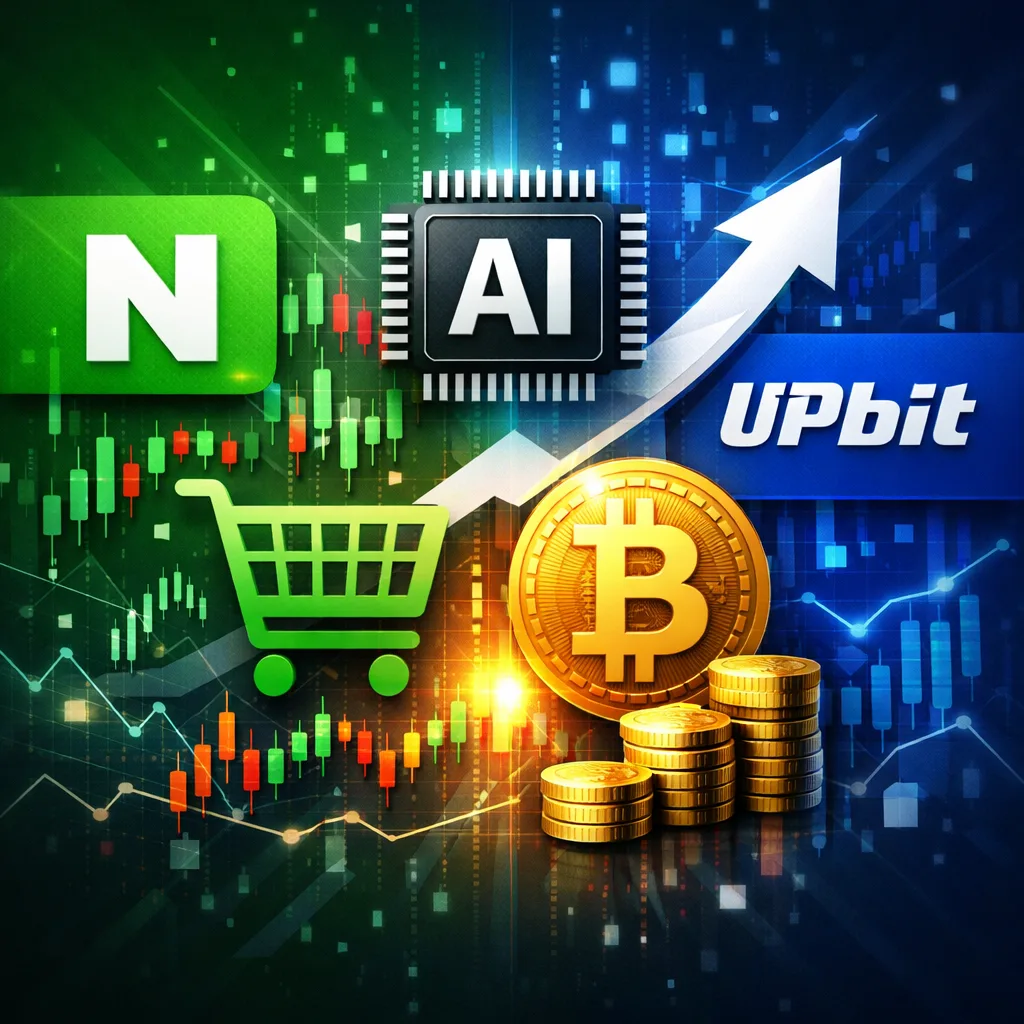
“What if Naver and Upbit merged?”
This question is not just imagining a corporate tie-up; what is the next stage for platformsit is closer to asking that.
The arrival of AI is changing the nature of search. At the same time, crypto is moving beyond speculation to become financial infrastructure. At the intersection of these two shifts, Naver and Upbit become very uncomfortable for each other, yet also what each needs most.
1. In the AI era, why is Naver search weakening?
For a long time, Naver's core was search.
Naver sat at the center of the flow of finding information, comparing it and turning it into purchases.
But with the arrival of AI, the role of search is changing.
- Users no longer want a “list of search results”
- A summarized answer, Organized context, Information they can use right away to make decisionsis what they want
- This is an area where, rather than search engines, AI interfacesdo far better
This is where the problem arises.
AI takes search traffic, but its link to advertising and commerce is weak.
In other words,
AI takes the search,
and Naver has yet to capture the money-making structure.
2. That's why Naver is moving into ‘shopping’
What fills this gap is Naver Shopping.
Naver has already set its direction.
- Search → content → shopping
- Information platform → transaction platform
Naver Shopping is not just a marketplace.
- Review data
- User behavior data
- Extending through payments, logistics and settlement, complete commerce infrastructure
Even in the AI era, ‘transactions’ do not disappear.
If anything, the more AI recommends “where to buy,” the more important transaction platforms become.
But there are limits here too.
- Naver Shopping is centered on physical goods
- Expansion into digital and financial assets is limited
This is where Upbit comes in.
3. Why Upbit needs Naver
Upbit is Korea's largest crypto exchange.
But Upbit's limits are also clear.
- An exchange always struggles to shake off its ‘speculation’ image
- User touchpoints are limited to ‘buying and selling’
- Time spent on the platform is short
What Upbit needs to reach the next stage is not just trading volume.
- Everyday touchpoints
- Information, content, community
- And above all trust
Naver already has all of these.
- Trust on the level of a national platform
- Everyday touchpoints through content, search and community
- Experience expanding financial services (Naver Pay)
On its own, Upbit will struggle to make “crypto part of everyday life.”
Without Naver, Upbit is still Exchanges.
4. So why does Naver need Upbit?
Flip the question and it gets clearer.
For Naver after AI, the most important question is this:
"Once search fades, what will we make money from?"
Upbit offers Naver three things.
① A new trading arena: digital assets
Physical goods have limits to growth.
Digital assets, and crypto in particular, global, intangible and scalableare all three at once.
② Financial data and a real-time market
What pairs best with AI is financial data.
- real-time prices
- investor sentiment
- trading patterns
Combined with search data, these become a powerful weapon.
③ The world "after payment"
If Naver Pay handles payment,
Upbit handles asset management and investing.
Naver can now go
- beyond "what to buy"
- to "where to keep your assets."
5. At its core, this pairing is "search × finance × AI"
What makes a Naver–Upbit combination meaningful is not simple business expansion.
The heart of the structure is this:
- AI summarizes information
- Naver keeps the everyday touchpoint
- Upbit becomes the final stop for trades and asset flowsin this structure
In other words,
AI takes the question,
Naver holds on to the user,
and Upbit makes the money move.
Once this triangle is complete,
Naver could return to the center of the platform world once again.
6. The merger is a question of "direction," not choice
Whether a merger actually happens does not matter.
What matters is direction.
- Naver is moving from a search company to a trading and asset platformand, at the same time,
- Upbit is moving from an exchange to everyday financial infrastructureas well.
The two are already looking in the same direction.
After AI, the platform race is no longer about
who holds more informationbut that
but who makes more "decisions" on your behalf.
And at the end of every decision there is always money moving.
If Naver and Upbit end up standing together
on the path that money flows along,
that would not be a merger, but the inevitable course of the times.