



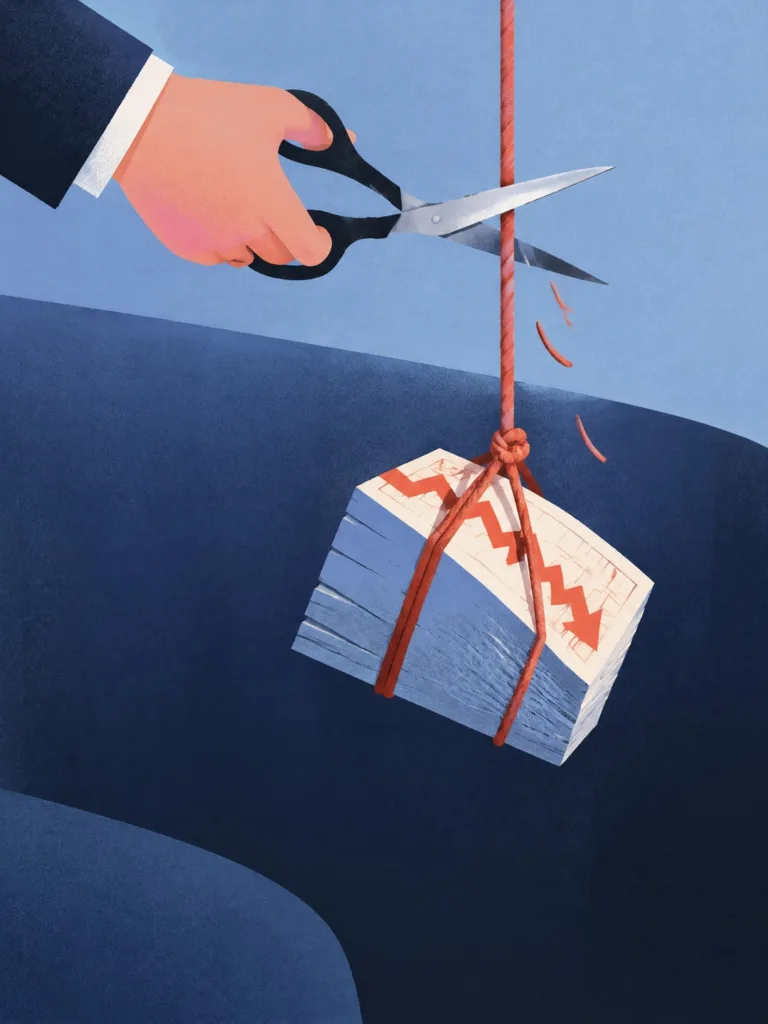
From Nov. 9 to 13, KRW 133 billion worth of shares were force-sold on the KOSPI, South Korea's main stock market. That is KRW 92.8 billion more than the KRW 40.2 billion the week before. On that very Nov. 9, the Financial Supervisory Service (FSS) waived for three months a rule requiring brokers to keep collateral on stocks bought with borrowed money at 140% or more.
The headlines make it sound as if regulators shielded individuals who borrowed to buy stocks. With the rule lifted, forced sales should have fallen. The numbers went the other way. The reason lies elsewhere. What was lifted was a duty on brokers, not a limit on investors, and trades where the buyer failed to pay on settlement day were never a collateral-ratio problem in the first place.
- Whose duty did the government lift?
The FSS waived brokers' duty to maintain the collateral ratio on credit they extend, starting Nov. 9, 2026, through a no-action letter (a document in which a regulator says in advance it will not penalize a firm for not following a rule). The waiver is scheduled to run through Jan. 31, 2027. Until then, brokers can set their own maintenance ratio based on the borrower and market conditions.
So the answer differs by firm. Mirae Asset Securities and KB Securities cut the threshold for Korean stocks from 140% to 130%. NH Investment & Securities applies 130% only if the client agrees in advance. Daishin Securities lowered its existing threshold by 10 percentage points. Korea Investment & Securities and Kiwoom delay forced sales by one business day, only for clients who apply.
It is like telling a shopkeeper he may set customers' credit limits however he likes. Whether he raises the limit is up to him, and some shops do so only when the customer asks.
- Is my account a margin loan or a deferred-payment trade?
A margin loan means borrowing from a broker to buy stocks and pledging those stocks as collateral. If the collateral falls below the threshold, you are asked for more the next day, and if you cannot supply it, the shares are usually sold before the market opens on the second business day after the shortfall (this can vary by broker). This easing changed that threshold.
A deferred-payment trade (misu in Korean) is different. You pay only part of the price when you buy and the rest by the settlement date, the second business day after the purchase, so it is a very short-term tab. If you cannot pay, a forced-sale order goes in before the market opens on the third business day after the purchase. It is a promise set by a date, not by a collateral ratio, so it is not a rule this waiver touched.
In secondhand-sale terms, a margin loan is leaving an item as a pledge and borrowing money, while a deferred-payment trade is taking the item now and promising to hand over the balance two days later. The standard for valuing the pledged item was relaxed, but the date the balance is due did not change.
- A week after the easing, how much did forced selling grow?
According to Money Today and BizWatch, forced sales on the KOSPI averaged KRW 26.6 billion a day from Nov. 9 to 13. That is 3.3 times the week before and above this year's daily average of KRW 25.1 billion. Sales caused by unpaid settlement balances alone came to KRW 37.9 billion on the 9th and KRW 63 billion on the 10th.
Pressure on the deferred-payment side is even clearer. Unpaid balances on brokerage trades rose 12.65%, from an average of KRW 903.6 billion in the first week of November to KRW 1.018 trillion from the 9th to the 13th. The share of those balances that was force-sold was 4.2% on the 9th and 5.7% on the 10th, more than double the year's average of 2.0%. Margin loan balances, by contrast, averaged KRW 26.46 trillion a day, down 8% from the week before.
Put simply, debt shrank on the margin-loan side, while on the deferred-payment side both debt and forced selling grew. On top of that, the KOSPI closed at 4,968.48 on the 17th, its first close in the 4,000s since Feb. 2. Even if the threshold is lowered a little, that cushion disappears quickly if prices fall further.
- If 140% drops to 130%, how much longer can I hold on?
Say you put in KRW 10 million of your own money, add a KRW 10 million margin loan, and buy KRW 20 million worth of stock. The starting collateral ratio is 200%. If the price falls 30%, the ratio drops to 140%, and if it falls 35%, to 130%. Even with the threshold at 130%, the drop you can withstand grows by only 5 percentage points, from 30% to 35%.
When shares are sold, the loss gets bigger. The number of shares to sell is calculated at a price discounted from the previous day's closing price or similar. If you are KRW 1.4 million short and the stock is at KRW 20,000, 70 shares would do, but at a 30% discount, KRW 14,000, 100 shares get sold. A deferral only buys one day. Korea Investment & Securities grants a deferral only once when the ratio is at least 120% and below 130%.
- When do postponed forced sales come back?
The same waiver took effect on March 16, 2020. As the KOSPI rose from 1,457.64 on March 19 to 2,108.33 at the end of June, average daily forced sales fell from KRW 17.9 billion in March to KRW 2.2 billion in June. But when the KOSPI slid about 7% in September, the daily average rose to KRW 4.6 billion, more than double June's.
What differs this time is the size of the debt. Margin loans stood at KRW 12.7 trillion at the end of June 2020, but last week's daily average balance was KRW 26.46 trillion. The waiver is due to end on Jan. 31, 2027. If prices have not recovered by then, the postponed sales could come out with a lag.
- BITPRESS Insight
This measure did not abolish forced selling; it handed brokers the power to decide when to sell. In return for taking on that risk, brokers tightened elsewhere. From the 9th, Korea Investment & Securities raised the deposit rate on new margin loans from 45% to 50% and cut the repayment period from 180 days to 90.
So in the same falling market, some investors hold on one more day and others are sold on schedule. What makes the difference is not the government announcement but the type of my debt and my broker's threshold.
When you see news that collateral rules were eased, you only need to apply one test. If my debt is a deferred-payment trade with a fixed due date, nothing has changed, and if it is a margin loan, the drop I can withstand has grown by only a few percentage points.
Sources
https://eiec.kdi.re.kr/policy/materialView.do?num=289219
https://supple.kr/news/cmwkdu1bfmrvpjkunmg3mf1rs
https://www.mt.co.kr/article/2026110619030119159
https://news.bizwatch.co.kr/article/market/2026/11/12/0026
https://www.tossbank.com/articles/liquidation
https://www.newspim.com/news/view/20261117000928
Glossary
Forced liquidation — What a broker does when a borrower fails to cover a loan or an unpaid settlement balance in time: it sells the investor's shares without the investor's consent.
MarginLoans — A transaction in which you borrow from a broker to buy stocks and pledge those stocks as collateral for the debt.
Margin trading — Buying stocks by paying only part of the price up front and the rest by the settlement date (the second business day after purchase), a very short-term tab.
Maintenance ratio — The value of the pledged shares relative to the amount borrowed; if it falls below the required level, the investor is asked for more collateral.
No-action letter — A document in which a financial regulator says in advance that it will not penalize a particular action even if it breaks the rule as written.
BITPRESS articles are information to help your investment decisions, not a recommendation to buy or sell any stock or coin. Investment decisions and their results are your own responsibility.





