



Bitcoin has fallen more than 15% in November, down to $64,600 on November 17. It has also broken below its 200-week moving average (about $68,000), a line traders treat as the long-term floor.
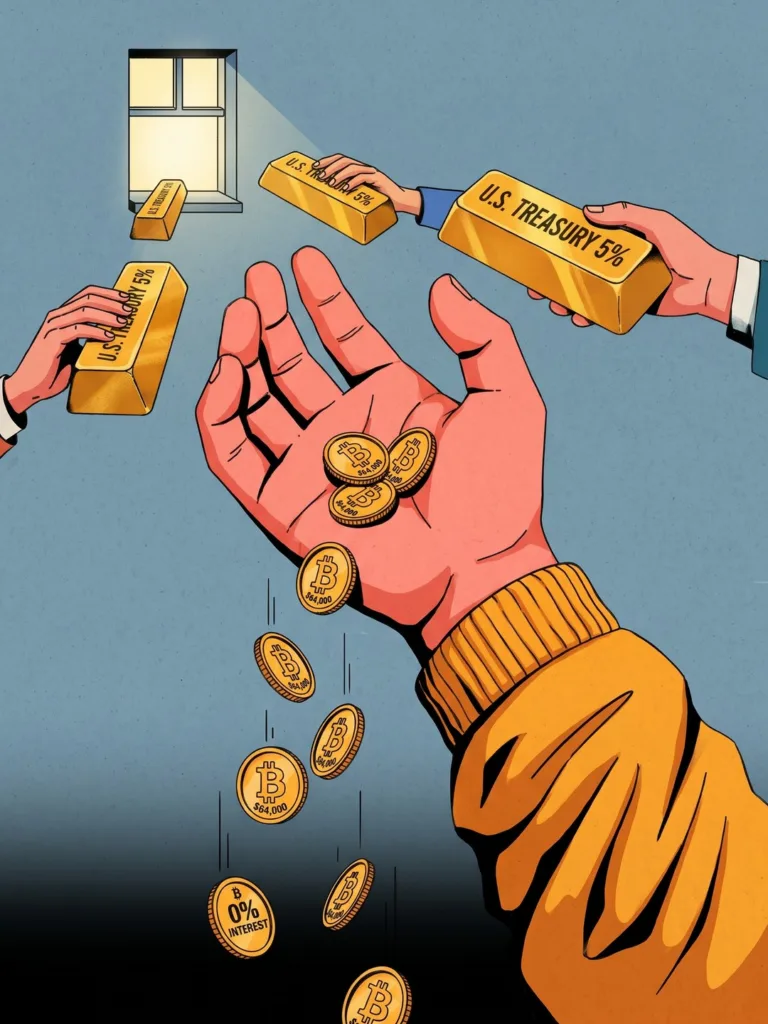
At this point someone usually says, "It has dropped so much that a bounce must be close." But what is weighing on bitcoin now is not the price. It is the flow of money. The US 10-year Treasury yield is back above 5%. A 5% yield means that buying a US Treasury today pays about 5% interest a year. Meanwhile, money is leaving bitcoin ETFs and stablecoins.
- Why the $68,000 line matters
The 200-week moving average is the average of weekly prices over about four years. Traders see it as a long-term floor, and bitcoin is now trading below it.
Wintermute, a market maker (a firm that keeps quoting buy and sell prices in the crypto market), named last Saturday's low of $62,000 as the first support level. Next is the $60,000 put option (a contract that pays off if the price falls below that level) crowded onto the crypto options exchange Deribit. More than $900 million in notional value rides on that contract. Wintermute said it expects "pressure into the $50,000s."
In short, once the line everyone trusted as a floor broke, the market began preparing for lower levels.
- Why higher rates weigh on bitcoin
After October US inflation came in above forecasts, the market now puts the odds of a December rate hike by the Fed, the US central bank, at about 92%. On that expectation, the 10-year Treasury yield is back above 5%.
Bitcoin pays no interest. A 5% Treasury pays about 5% a year on your money, while bitcoin pays nothing unless its price rises. It is like leaving money in a non-interest account when an interest-bearing deposit is available. The difference is that if bitcoin's price falls, even your principal shrinks.
Wintermute explained that because bitcoin pays no interest, it is the asset investors sell first to raise cash when they position for rate hikes, and the one that swings most when that call turns out wrong.
- Where the money is leaving
US spot bitcoin ETFs (funds that trade like stocks) took in $21 billion in 2025. So far in 2026 they have seen about $1.9 billion in net outflows. Money that was flowing in has turned around within a year.
Stablecoins are shrinking too. A stablecoin is a coin that can be swapped 1-to-1 for the dollar; investors convert dollars into it to buy crypto or post as collateral (margin). It works like swapping cash for chips at a casino. Total supply fell 5.3% in 30 days to $284.2 billion, the steepest drop since the 2022 collapse of Terra, a stablecoin.
Turning chips back into cash means leaving the table. The analytics firm CryptoQuant said, "Stablecoin growth funded every leg up this cycle. That fuel is draining."
- The line that held in June: will it hold again?
Bitcoin is now trading near its bull-market trend line. That line acted as a floor during the sharp drop in early June this year. If it breaks too, the decline could deepen.
What differs from June is how fast money is leaving. Outflows through stablecoins are the fastest since 2022, and ETFs have swung to net outflows this year. The same line is being tested again, but this time while the money that would support it is draining away.
- What has to change for a turn
Wintermute said, "This is not about trying to call a bottom or a low. That is impossible." Instead it offered two conditions that would make it less cautious.
First, bitcoin closes a day (by UTC) above $68,000 and ETFs take in net inflows the same day. In other words, the broken floor has to be recovered and money has to come back together. Second, this week's Fed minutes or the October inflation data erase the chance of a January rate hike.
The two signals ask whether the two forces pushing bitcoin down, ETF outflows and rate-hike expectations, are easing. A brief price rise is not the same as a rise with money flowing back in.
- BITPRESS Insight
The math of "it has fallen so much that it must be the bottom" looks only at price. But bitcoin's competitor today is not last month's bitcoin price. It is the US Treasury paying 5% a year. Money looking to buy a no-interest asset will not easily return while rate-hike expectations remain.
So what has to change is the money, not the price. For those who hold bitcoin and those who want to buy it, the test is the same. The starting point of a rebound is not 'how far has it fallen' but 'is money flowing back into ETFs, and have rate-hike worries lifted.'
Sources
https://www.coindesk.com/markets/2026/11/17/bitcoin-could-slide-into-the-usd50-000s-as-fed-rate-hike-bets-build-wintermute-says
https://www.coindesk.com/daybook-us/2026/11/17/crypto-s-casino-chips-are-disappearing-adding-to-pain-from-spot-etf-outflows
Glossary
200-week moving average — The average of weekly prices over about four years, which traders treat as bitcoin's long-term floor.
Put option — A contract that pays off if the price falls below a set level, bought to hedge against declines.
Stablecoin — A coin that can be swapped 1-to-1 for the dollar, used like a casino chip to buy crypto or post margin.
Spot Bitcoin ETF — A fund that holds actual bitcoin and trades like a stock.
Market maker — A firm that always quotes buy and sell prices so trading does not dry up.
BITPRESS articles are information to help your investment decisions, not a recommendation to buy or sell any stock or coin. Investment decisions and their results are your own responsibility.





