



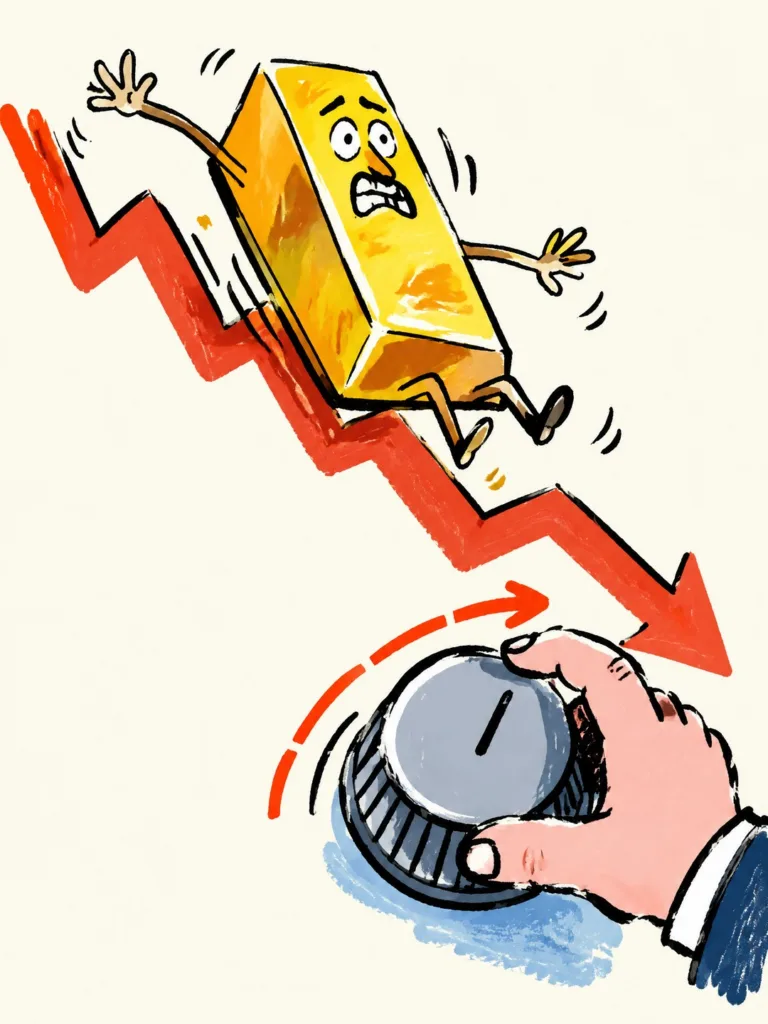
Gold is trading at about $3,851 an ounce as of November 17. That is 31.1% below the all-time high of about $5,590 set on January 28, and 293 days after that peak it has not come back close to it. To top the record again, gold has to rise 45.2% from here.
The common wisdom is that when stocks fall, gold, a safe-haven asset, rises. But the key point lies elsewhere. Gold pays no interest. The higher interest rates go, the more interest you give up by holding gold, so gold reacts to interest rates before it reacts to fear.
- Why having no interest is gold's weakness
A deposit earns interest, and a bond pays a fixed coupon. Gold locked in a vault earns nothing. In its latest report, Goldman Sachs said continued tightening by the Fed (the US central bank) will weigh on "no-yield gold" for a while.
The math is easy with 10 million won. In a 5% deposit it earns 500,000 won in interest in a year (illustrative calculation). Buy gold with the same money and it earns not a single won. At a 3% rate you give up 300,000 won; at 5%, 500,000 won.
Think of it as buying gold on an overdraft. Interest goes out every month, while gold pays you nothing back. The difference is that if the gold price rises by more than that interest, you can make up the loss.
- The rate gold watches is the 'real rate'
The rate that matters here is the real interest rate. The real rate is the nominal rate minus inflation. Even with a 5% deposit rate, if prices rise 5%, your money does not really grow. In that case, holding gold costs you almost nothing.
Conversely, if interest rates rise faster than prices, real rates go up. Deposits then beat inflation and grow your money, which weakens the reason to hold gold that pays no interest. Put simply, gold's rival is not fear but deposit interest.
The record points the same way. When gold set a new high of about $2,075 on August 7, 2020, Covid stimulus and a plunge in real rates came together. The Fed's rate cuts in 2025 lowered the real cost of holding gold and helped lift it.
- Tightening signals unwound January's gains
The January record was a price built on fear. Fears of a US-Iran war, a Fed rate hold and a weak dollar came together, pushing gold past $5,500 in late January and to about $5,590 on January 28.
Then the direction changed. As the Fed turned more hawkish and the premium attached to war fears drained away, gold fell sharply throughout the first half of this year. In effect, tightening signals and fading war fears took back much of what fear had added to the price.
- Why Goldman Sachs thinks it will take two years
In a report published on November 6, Goldman Sachs said it will take about two years for gold to regain its record. It cut its end-2026 target from $4,650 to $4,150 and its end-2027 target from $5,400 to $4,800. Even $4,800 is about 14% below the January record (calculation).
Goldman assumes a rate hike in December. If the Fed raises rates again in March 2027 or delays cuts, it sees gold at $4,660 at the end of 2027, $140 below its base forecast. It expects rate cuts from late 2027 to early 2028.
Put simply, when rates come down decides when gold gets back to its record.
- Why gold struggles even as central banks buy
Still, the reason the target sits above today's price is central banks. Goldman assumes central banks around the world buy 60 tonnes of gold a month in 2026-2027. That is more than 3 times the pre-2022 average of 17 tonnes a month. It said most of the gain it expects through the end of 2027 comes from this buying.
Goldman compared the present with 2022. That year, too, central banks kept buying gold and propped up the floor, but rising rates weighed on investors' holdings. It is a tug of war between central bank buying and pressure from interest rates.
The remaining variable is hedging demand. Goldman expects demand for gold as protection against policy risk (visible in call option trading) not to return to the high levels of early this year but to drift down toward its historical average.
- BITPRESS Insight
The rule "when stocks fall, buy gold" is only half right. Gold can rise when fear grows. But when rates are rising, gold that pays no interest can stay weak even as fear grows. January's record and today's 31.1% decline show the difference.
Goldman said the current pullback could be an entry point for investors with a long horizon. Put the other way, it also means this is a spot that needs time before rate cuts begin. What gold buyers are waiting for is not a spike in a crisis but the moment rates turn down.
When deciding whether to buy gold, look at the direction of interest rates before scary headlines. While rates rise, gold carries the weakness of being an asset with no interest, and that weakness eases when real rates fall.
Sources
https://metalcharts.org/gold-all-time-high
https://leprivatebanker.com/2026/11/16/goldman-sees-gold-needing-about-two-years-to-retake-its-record-as-fed-tightening-weighs-on-bullion/
Glossary
Real interest rate — The nominal rate minus inflation: the speed at which money really grows once prices are taken into account.
the Fed — The US central bank (the Federal Reserve), which sets the US benchmark interest rate.
Tightening — Central bank policy of raising rates or pulling money out of the economy to hold down prices.
Ounce — The unit of weight used to price gold; one ounce is about 31.1 grams.
Hawkish — A stance favoring higher rates, or keeping them high, to bring prices under control.
BITPRESS articles are information to help your investment decisions, not a recommendation to buy or sell any stock or coin. Investment decisions and their results are your own responsibility.





