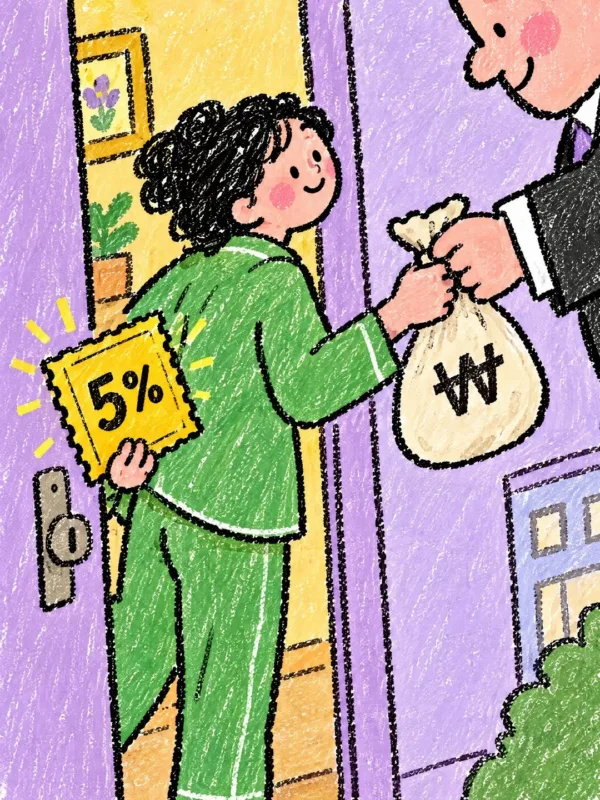
New home mortgages that Korea's five biggest banks made at rates of 5% a year or more grew from KRW 166.5 billion in December 2025 to KRW 2.3362 trillion in August 2026. That is 14 times as much in eight months. Loans above 5.5% grew about 40-fold, from KRW 18.8 billion to KRW 761.6 billion.
Seeing these numbers, it is easy to think, 'Rates went up, so my loan interest will rise starting next month.' But the real story is elsewhere. The 14-fold jump is about new loans. For loans people already have, each type has its own set date when the interest changes.
- Why did loans at 5% or more multiply 14 times in eight months?
The first reason is the Bank of Korea. As interest rates rose quickly around the world, it raised its policy rate in both July and August, and the Aug. 27 decision took the rate to 3.00% a year. It was the first back-to-back hike in three years and seven months.
The second is bank bond yields. Banks raise money to lend not only from deposits but also from bank bonds (bonds banks sell to borrow money). The five-year bank bond yield, the benchmark for fixed-rate mortgages, hit 4.655% on Sept. 15, its highest this year. September to November is when banks issue new bonds to replace maturing ones every year, and this year large deposits from chipmakers also came due at the same time.
Think of a convenience store's wholesale prices. When what it pays for goods goes up, what it charges goes up too. As a result, the share of new mortgages at 5% or more across 16 Korean banks more than doubled, from 14.7% in December 2025 to 32.5% this August. The difference is that, unlike store goods, a loan already sold is repriced on an agreed date.
- What rate do new borrowers pay now?
According to the Bank of Korea, the average rate on new bank mortgages in August was 4.66% a year, the highest since November 2022 (4.74%). Fixed-rate loans averaged 4.88% and variable-rate loans 4.53%. Five years earlier, in August 2021, the average was 2.88%.
Put simply, people borrowing to buy a home now pay far more for the money than they did five years ago.
Borrow KRW 300 million over 30 years with equal monthly payments (paying the same amount every month), and you pay about KRW 1.43 million a month at 4%, or about KRW 1.61 million at 5%. A 1-percentage-point difference comes to about KRW 180,000 a month (a hypothetical calculation).
- When does interest change on a variable-rate loan?
Variable mortgage rates are usually reset every six months (the interval differs by product). The benchmark is COFIX (the average rate eight banks pay to raise money). When the Korea Federation of Banks publishes COFIX around the 15th of each month, banks apply it to new loans as early as the next day.
It is different for people who already have a loan. Their rate changes to the COFIX of the day only when their loan's reset date arrives. If you took a six-month variable loan in April, for example, it would reset in October (an illustrative example). Even if the policy rate rises in between, this month's interest stays the same.
Think of renewing a lease. Even if rents nearby go up, you pay the same rent during the lease and meet the higher price on renewal day. The difference is that a variable-rate loan has that day every six months. If the rate on a KRW 300 million, 30-year loan goes from 4.5% to 5.0% on that day, you pay about KRW 90,000 more a month (a hypothetical calculation).
- Hybrid loans change all at once when the fixed period ends
A hybrid loan charges a fixed rate for a set period at first (for example, five years) and then switches to a variable rate. During the fixed period, the interest stays the same no matter how many times the policy rate rises. Instead, on the day the fixed period ends, the borrower meets all the increases at once.
Suppose you borrowed KRW 300 million in August 2021 at that month’s average of 2.88%, over 30 years with equal monthly payments, fixed for five years. You paid about KRW 1.25 million a month, and about KRW 266 million is left after five years. If this August’s average of 4.66% applies to that balance, the payment becomes about KRW 1.5 million a month, about KRW 250,000 more (a hypothetical calculation; the actual new rate differs from loan to loan).
A financial regulator said, "This is when the fixed-rate periods end on five-year hybrid mortgages taken out during the low rates of the pandemic, and since rates are rising quickly, measures are needed." Periodic loans (whose rate is reset at set intervals and fixed in between) face the same thing when their interval comes around.
- Will rates rise further, and what happened last time?
According to reports in early October, Citi economist Kim Jin-wook expects the Bank of Korea to raise rates again in November and next February, which could take the peak rate to 3.5% a year. That is 0.5 percentage point above the 3.00% set in August.
New loan rates also climbed fast in the last tightening cycle. The average rate on new mortgages, 2.88% in August 2021, reached 4.74% in November 2022. What is different this time is that the fixed periods on five-year hybrid loans taken out at those low rates are starting to end just as rates rise.
- BITPRESS Insight
The 14-fold figure hits people borrowing to buy a home now first. For people who already have a loan, what matters is not the day rate news breaks but the day their own loan’s rate is reset. For variable loans that day usually comes within six months; five-year hybrid loans taken out in 2021 reach it this year as their fixed periods end, depending on the month they were taken out.
New borrowers’ choices have shifted too. The fixed-rate share of new mortgages rose from 31.9% to 35.3% in August, the first increase in 10 months. Loans that lock in the rate for a set period now make up a bigger part of new lending.
One rule to remember: your interest goes up not on the day the policy rate rises, but on the day your own loan's rate is reset.
Sources
https://www.sedaily.com/article/20097720
https://m.sedaily.com/article/20097734
https://news.jkn.co.kr/post/1007301
https://biz.sbs.co.kr/amp/article/20000337490
https://biz.sbs.co.kr/amp/article/20000334772
https://kbthink.com/investment/deepdive/tip/260828.html
https://www.fnnews.com/news/202605151532546885
https://fsc.go.kr/po010103/81343
https://www.metroseoul.co.kr/article/20230514500222
https://www.newsis.com/view/NISX20210930_0001598315
Glossary
COFIX — The average rate eight Korean banks pay to raise money through deposits, bank bonds and the like; it is the benchmark for variable-rate mortgage rates.
Five-year bank bond — A 5-year bond that banks sell to borrow money; its rate is the benchmark for fixed-rate mortgage rates.
Hybrid loan — A loan that charges a fixed rate for an initial period (for example, 5 years) and then switches to a variable rate.
Periodic loan — A loan whose rate is reset at set intervals (for example, every 5 years) and stays fixed in between.
Equal monthly payments — Paying back a loan with the same combined amount of principal and interest every month.
Gangnam 3 districts — Gangnam, Seocho and Songpa, Seoul's priciest districts, where high-end apartments are concentrated.
Jeonse — Korea's lump-sum deposit lease. Instead of paying monthly rent, the tenant gives the landlord a large deposit and gets it all back when the contract ends.
Gangnam and Nowon — Two of Seoul's 25 districts: Gangnam is the wealthiest, south of the Han River, while Nowon sits on the city's northeastern edge.
BITPRESS articles are information to help your investment decisions, not a recommendation to buy or sell any stock or coin. Investment decisions and their results are your own responsibility.