On Oct. 14 (U.S. time), when U.S. consumer prices for September came in 3.7% higher than a year earlier, above the 3.6% forecast, the Bloomberg dollar index (the dollar's value against major currencies) rose to its highest level since May 2025. Yet right after the open on Oct. 15, the won-dollar rate was 1,341 won. That is more than 40 won lower than the 1,382.2 won of a month earlier, on Sept. 17.
A rising won-dollar rate means it takes more won to buy one dollar, in other words the won is losing value. It is a number that hits the wallet directly for anyone buying foreign stocks or exchanging money for a trip. By the usual reading, when the dollar strengthens worldwide, the won should lose value along with it.
But the real story is elsewhere. What is holding the rate in place is less how strong the dollar is than how many dollars are flowing into Korea. Currency traders point to exporters, led by chipmakers, as the ones putting those dollars on the market.
- How much stronger did the dollar get after the U.S. inflation data?
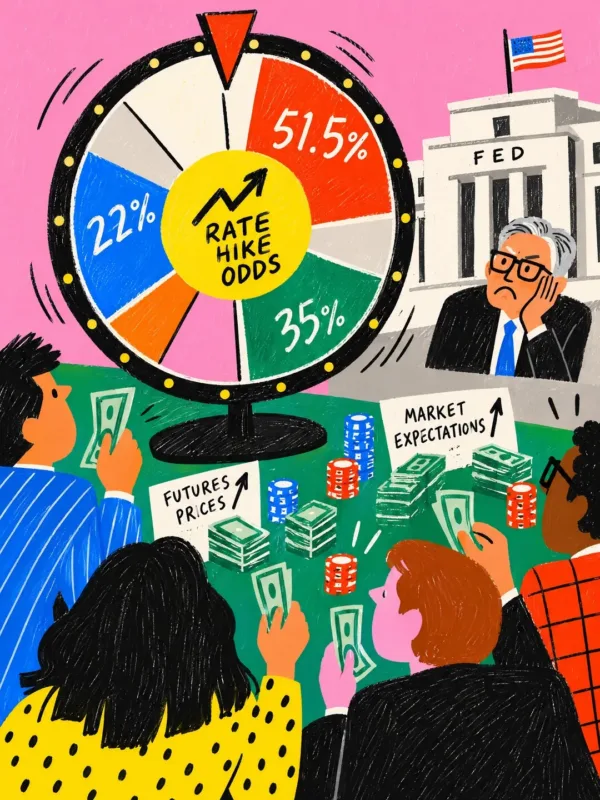
September's 3.7% U.S. inflation rate was higher than August's 3.4%, and core inflation, which excludes food and energy, was 2.6%, above the 2.5% forecast. The Fed (the U.S. central bank) raised its benchmark rate by 0.25 percentage point on Sept. 16, and markets have priced in more than 0.9 percentage point of rate increases.
Put simply, when U.S. inflation came in hotter than expected, there was more reason to hold dollars.
It is like deposits moving to a bank that pays higher interest. The Bloomberg dollar index rose as much as 0.4% that day. Andrew Hazlett of U.S. currency firm Monex said hotter-than-expected inflation pushed the dollar up as markets price in further tightening by the Fed.
- How did the won-dollar rate move while the dollar rose?
On Sept. 17, the day after the Fed raised rates, the won-dollar rate closed at 1,382.2 won. The dollar got stronger after that, but the rate came down 43.9 won to a day-session close of 1,338.3 won on Oct. 14.
Put simply, the dollar got pricier worldwide, yet buying dollars with won actually got cheaper.
Let's run the numbers on $1,000. At the Sept. 17 rate it cost 1,382,200 won; at the Oct. 14 rate, 1,338,300 won. The same $1,000 cost 43,900 won (about $33) less.
- Why did the rate rise into the 1,350s on Oct. 15?
At 10:07 a.m. on Oct. 15, the KOSPI was down 7.12% at 5,580.70, and foreign investors, net sellers for an eighth straight trading day, had sold 1.449 trillion won worth of shares by then. At 11:10 a.m., the rate was 1,350.7 won, up 12.4 won (0.93%) from the previous day-session close.
When foreign investors convert the money from selling stocks into dollars and leave, more people want to buy dollars and the rate rises. Even so, that day's level was still more than 30 won below Sept. 17. Cho Yong-gu, a researcher at Shinyoung Securities, said, "Risk aversion and foreign stock selling are short-term factors behind the rebound."
- Who is selling dollars?
Exporters are paid for their goods in dollars. Since they must pay employees and domestic suppliers in won, they sell the dollars they receive to banks for won. In the currency market, these dollar sales are called nego volume.
Think of a secondhand marketplace app. If listings selling the same item keep popping up, the price can't climb much even when many people want to buy. How much of their dollar income exporters actually convert to won, however, is not made public.
Min Kyung-won, a senior researcher at Woori Bank, said, "The fact that exporters' nego volume keeps coming regardless of timing is also a force pressing the rate down." Cho also said a "current account surplus that overwhelms overseas investment" (more money earned abroad than spent abroad) is holding the rate down.
- How many dollars are chips bringing in?
September exports rose 83.5% from a year earlier to $120.94 billion. Of that, semiconductors jumped 262.8% to $60.3 billion, topping $60 billion in a single month for the first time, and the trade surplus was $49.85 billion. From Oct. 1 to 10, chip exports were $12.2 billion, 46.7% of all exports.
Put simply, chips earned nearly half of the dollars Korea made from exports in September.
Think of a paycheck account. If the money coming in each month grows a lot, the balance holds up even if the card bill rises a bit. Unlike your account, though, the exchange rate only reflects those dollars when exporters actually sell them in the market.
- How is this different from the strong-dollar period of 2022?
On Sept. 28, 2022, the won-dollar rate closed at 1,439.9 won, and during the day it topped 1,440 won for the first time in 13 years and 6 months. That year Korea's trade deficit was $47.2 billion, the largest annual deficit on record.
Back then, Korea spent more on imports than it earned from exports. Now, September's trade surplus of $49.85 billion alone is larger than the whole 2022 deficit. Even with the same strong dollar, the strength of those selling dollars inside Korea is different.
- BITPRESS Insight
For people who spend dollars on foreign stocks, travel or study abroad, what matters is less whether the dollar is strong worldwide than how many dollars flow into and out of Korea. Right now it is a tug-of-war between chip export earnings coming in and foreign stock sales going out.
On days when stocks plunge, like Oct. 15, the rate can jump more than 10 won in a day. But as long as export dollars keep coming in, it is hard to say one piece of U.S. inflation news will send the rate soaring as in 2022. On the other hand, if chip exports weaken, the rate could move differently even with the same strong dollar.
There is one rule to remember when you see strong-dollar news. The exchange rate moves less on how strong the dollar is than on whether more dollars are coming into Korea or leaving it.
Sources
https://finance.yahoo.com/markets/currencies/articles/dollar-advances-highest-since-may-125240119.html
https://edaily.co.kr/News/Read?mediaCodeNo=257&newsId=02561686645613248
https://www.etoday.co.kr/news/view/2635941
https://etoday.co.kr/news/view/2636140
https://www.newspim.com/news/view/20261015000089
https://www.news1.kr/finance/market-exr/6320017
https://www.mt.co.kr/economy/2026/09/17/2026091716052429827
https://www.ebn.co.kr/news/articleView.html?idxno=1727907
https://www.segye.com/newsView/20261015508738
https://www.dailian.co.kr/news/view/1696599/
https://biz.sbs.co.kr/amp/article/20000339279
https://mobile.newsis.com/view/NISX20220929_0002030756
https://v.daum.net/v/20230101094726007
Glossary
Nego volume — The dollars exporters put up for sale in the currency market to convert the dollars they were paid for their goods into won.
Day-session close — The exchange rate as of 3:30 p.m., when daytime trading in the Seoul currency market ends.
Bloomberg dollar index — An index that expresses the dollar's value against major currencies as a single number; when it rises, the dollar has gotten stronger.
Current account — The money a country earns from exports, services and income from overseas investments, minus the money it spends abroad.
Core inflation — The inflation rate measured without food and energy, whose prices swing a lot.
BITPRESS articles are information to help your investment decisions, not a recommendation to buy or sell any stock or coin. Investment decisions and their results are your own responsibility.