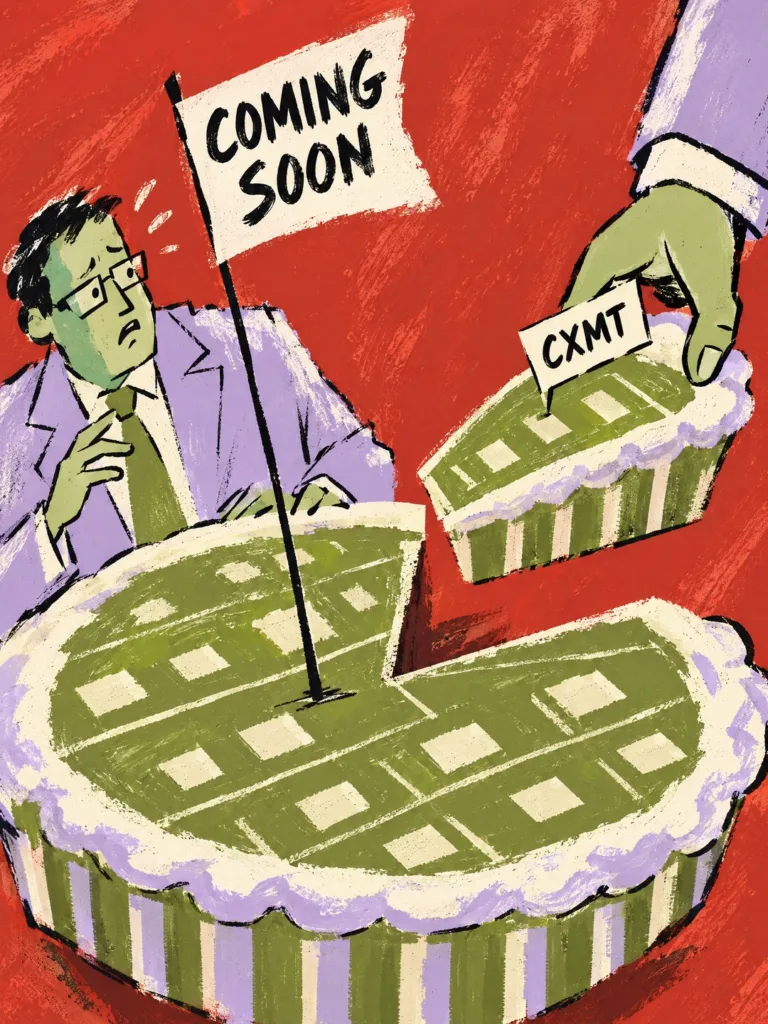
SK hynix shares closed down 10.09% at 1,443,000 won (about $1,073) on Oct. 13. Samsung Electronics fell 7.39%, and foreign investors were net sellers of 4.51 trillion won ($3.35 billion) of KOSPI stocks. Earlier, on Oct. 9-10, Cao Kanyu, president of CXMT (ChangXin Memory), China's largest DRAM maker, said the company would launch a server DRAM built on a next-generation design by the end of the year, remarks that were widely reported by Hong Kong's South China Morning Post on Oct. 12.
Samsung Electronics' reported target for mass-producing the same design is 2028. On announced dates alone, China is about two years ahead. So it is easy to conclude that Korean memory makers are about to lose the server market.
But the real story lies elsewhere. The announcement had a date but no speeds or capacities. The threat you can measure is not the announcement but a market share that is already rising.
- What exactly did CXMT announce?
At a chip conference in Shanghai on Oct. 9-10, Cao said CXMT would release server DDR5 memory (an RDIMM, a memory module that plugs into servers) built on a 4F² design by year-end. 4F² describes how much area each storage unit (cell) in a DRAM chip takes up. It shrinks the cell by about a third compared with the 6F² design in use today, so a chip of the same size can hold more data.
Think of building studio apartments more tightly on the same plot of land. But the smaller the rooms, the more "noise" leaks between them, in the form of current leakage and interference, so the biggest challenge is how many working chips a factory can get out of each batch (yield). Cao added that CXMT has more than 300 published patent families tied to the technology.
- Did SK hynix fall 10% only because of CXMT?
That is hard to argue. CoinDesk reported that the selloff followed a report that Broadcom CEO Hock Tan likened speculative AI investing to gambling in a casino, and that CXMT's progress added to worries about competition and margins. Han Ji-young, an analyst at Kiwoom Securities, pointed to concerns over OpenAI's revenue and the end of local chipmakers' share buybacks as weighing on tech stocks.
Someone holding 10 million won (about $7,400) of SK hynix lost about 1 million won (about $740) that day. Put simply, the CXMT news was one more piece of bad news piled onto chip stocks that were already shaky.
- What was missing from the announcement?
U.S. tech outlet Tom's Hardware noted that the announcement left out capacity, speed, process, customers and production volume. No product has yet been tested outside CXMT, and the company has not posted a release about the product on its news pages. Korean reports have also said CXMT's first products may use the 4F² design only in part.
Server memory faces a higher bar. It has to run 24 hours a day without stopping and pass hundreds of compatibility tests with other makers' CPUs and motherboards. The prevailing industry view is that even if a product arrives this year, it will take time to win server customers' approval and ship in volume.
It is like a new restaurant hanging a "Grand opening this winter" banner. You only know whether people line up once the doors open. Still, Tom's Hardware also reported that later Korean reports clouded Samsung's own 2028 target. The "two-year gap" is not a comparison between two confirmed schedules.
- So what threat is already happening?
The threat you can see in the numbers lies elsewhere. According to market researcher TrendForce, CXMT's share of global DRAM revenue rose from 7.6% in the first quarter of this year to 9.5% in the second. It ranks fourth. In the same second quarter, Samsung Electronics had 39.4%, SK hynix 24.9% and Micron 23.3%.
CXMT is also mass-producing G5, its fifth-generation DRAM technology announced in September. Put simply, China is gaining ground first in the DRAM that sells today, rather than in next-generation products that do not exist yet.
In a neighborhood shopping street, a shop that is already open and gained customers in a single quarter matters more to sales than news of a big store opening at year-end. Even so, CXMT's 9.5% share is still less than half of SK hynix's 24.9%.
- BITPRESS Insight
For anyone holding chip stocks, a share-price drop on the day China makes an announcement is not the same as actually losing sales. An announcement is priced in within a day, but the server memory market only changes after passing through slow gates: customer approval and volume supply.
That is why the size of the threat is better measured by numbers already on the table than by announced dates. CXMT's share rose from 7.6% to 9.5% in a single quarter. That figure is not a preview but the result of chips actually sold.
When news about Chinese memory chips comes out, the size of the threat is easier to see by asking "Were the specs disclosed? Has it passed server customer approval? Has its market share actually risen?" than by asking when it will launch.
Sources
https://www.tomshardware.com/pc-components/dram/cxmt-president-says-companys-first-4f2-dram-will-be-a-server-ddr5-rdimm-due-by-year-end-vertical-transistors-cut-each-memory-cells-footprint-by-a-third-on-paper-but-no-speeds-or-capacities-yet
https://www.g-enews.com/article/Industry/2026/10/20261013102619905327fa31d75c_1
https://www.etoday.co.kr/news/view/2634746
https://www.seoul.co.kr/news/economy/securities/2026/10/13/20261013500225
https://www.koreajoongangdaily.com/business/kospi-plunges-5-as-tech-stocks-tumble/12918482
https://www.coindesk.com/markets/2026/10/13/bitcoin-diverges-from-south-korean-stocks-as-ai-concerns-deepen-the-kospi-selloff
https://evertiq.com/news/2026-09-07-dram-industry-revenue-surges-595-in-q2-as-supply-lags-demand
Glossary
4F² — A design that describes the area of a single DRAM storage unit (cell); its cells are about a third smaller than those of the 6F² design in use today.
RDIMM — A memory module that plugs into servers; it must meet higher durability and compatibility standards than consumer memory.
Yield — The share of chips made in a factory that work properly.
Customer approval — The process in which a server company tests new memory in its own equipment to decide whether to accept deliveries.
DRAM revenue share — A company's share of global DRAM sales, reflecting both the volume sold and the price.
BITPRESS articles are information to help your investment decisions, not a recommendation to buy or sell any stock or coin. Investment decisions and their results are your own responsibility.