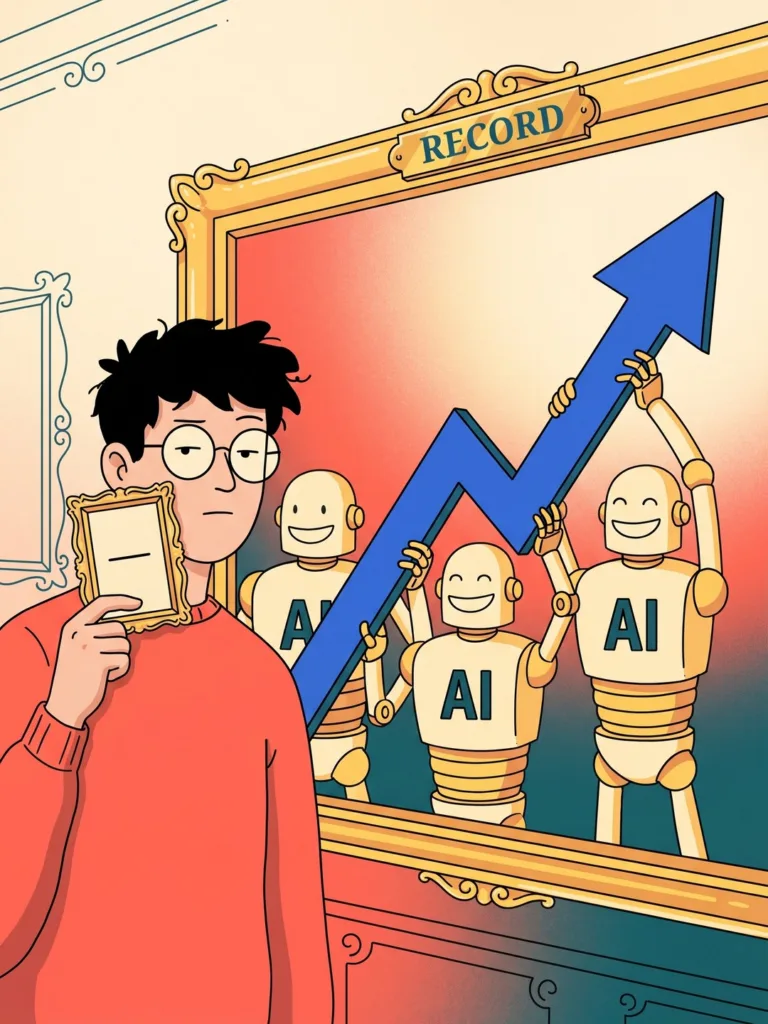
The S&P 500 (an index of 500 major US companies) closed at a record 7,818.93 on Oct. 6. That same week, the 10-year US Treasury yield briefly neared 5.37% on the morning of Oct. 7, its highest level in 24 years (an intraday level; it was around 5.29% by late afternoon).
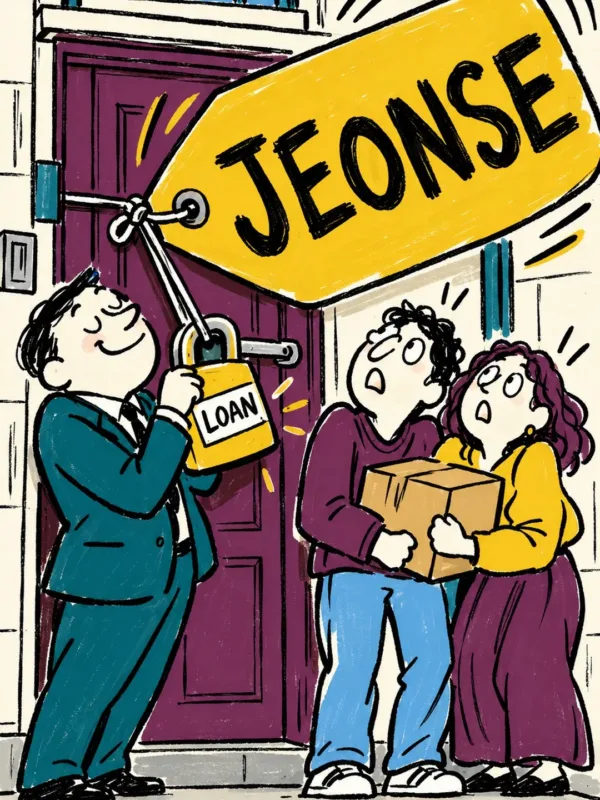
A higher Treasury yield means borrowing gets more expensive for the government, for companies and for people buying homes. That's why people say "when rates rise, stocks fall." Yet the index hit a record, so the common take is that "US stocks shrug off higher rates." But the real story is elsewhere. Big AI-related stocks held the index up, while most of the market beneath it was already sliding.
- How did the index reach a record?
In the S&P 500, the bigger a company is (its market value), the more it moves the index. The Oct. 6 record was led by chip and AI-related stocks. Bloomberg reported on Oct. 1 that the S&P 500 was "being held aloft at the index level by the artificial-intelligence trade."
Think of a class average. If a few students score 100, the average can rise even as everyone else's scores fall. But a stock index is even more lopsided than a class average: it's as if the biggest students' scores counted several times over.
- How far have the stocks beneath it fallen?
As of Oct. 1, the S&P 500 was less than 2% from its record, and five days later, on Oct. 6, it set a new one. But Dan Suzuki of the investment firm iCapital said on Oct. 1, "Most parts of the market are at least 5% off their highs." As of Oct. 1, the S&P 500 Equal Weighted Index, which holds every stock in the same amount, was heading for a seventh straight weekly loss.
The Russell 2000, an index of about 2,000 small US companies, was 8.5% below its Aug. 14 record as of Oct. 1. The S&P 500 utilities sector, made up of power and gas companies, had fallen about 17% from its February record. Put simply, the index headlines make it look like everything is doing well, but much of the market is actually down.
If you had put $7,500 (about KRW 10 million) into a US small-cap index at its Aug. 14 record, you'd have been down about $640 as of Oct. 1 (an example assuming a purchase at the record and the 8.5% drop; dollar figures use the Oct. 8 rate of KRW 1,338.5 per dollar).
- Why have rates climbed so much?
Brent crude (one of the main global oil price benchmarks) traded around $100 a barrel on Oct. 7 and settled at $100.20. Amid inflation pressure, the Fed, the US central bank, raised its benchmark rate by 0.25 percentage point to 3.75%-4.00% on Sept. 16. Mohit Kumar of Jefferies said worries about inflation, budget deficits and Treasury issuance keep weighing on the bond market.
- Who gets hit first by high rates?
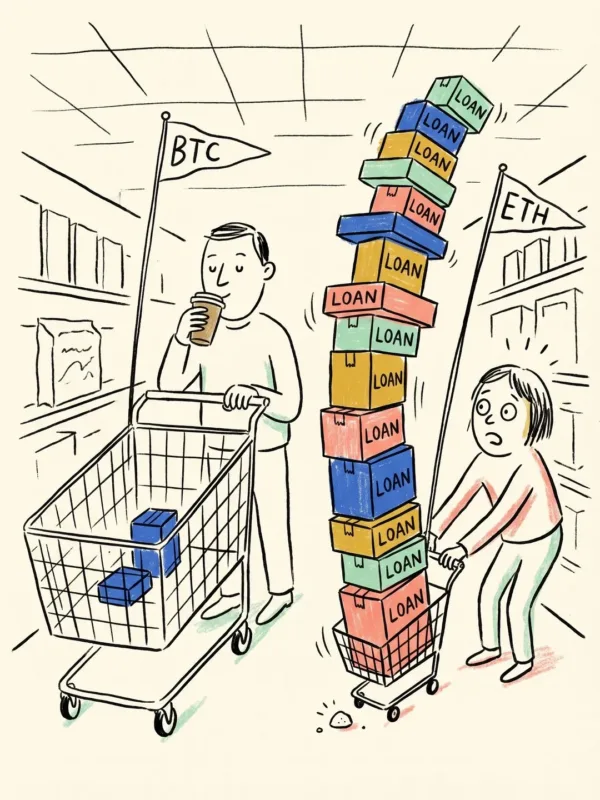
First, companies with lots of debt. Bloomberg noted that small companies "are typically more heavily indebted." When rates rise, interest costs go up and profits shrink. More than a third of the Russell 2000 are so-called zombie companies, which struggle to cover the interest on their debt from what they earn (Bloomberg).
Second, people trying to buy a home. The average 30-year fixed US mortgage rate was 7.4% on Oct. 8, the seventh straight weekly increase. A year ago it was 6.3%. On a $400,000, 30-year loan, the monthly payment goes from about $2,476 to about $2,770, roughly $294 more each month (an example calculation).
It's like what happens when credit line interest goes up: households with the most debt feel the squeeze first. Big AI stocks are different, though. The London Stock Exchange Group (LSEG) expects S&P 500 companies' third-quarter earnings to rise more than 30% from a year earlier. Companies whose profits grow fast can more easily handle higher interest costs.
- How do experts read this split?
Michael Purves of Tallbacken Capital Advisors wrote, "We do not look at today's distorted breadth as reason to be bearish on the SPX," and set a year-end S&P 500 target of 8,500. In his view, the index can keep rising even when market breadth (how many stocks are rising) is narrow. Still, the narrower the pillars holding up the index, the more the index can shake if those pillars wobble.
- BITPRESS Insight
The old rule that "stocks fall when rates rise" wasn't wrong. It just didn't show up in the index. High rates are already cutting into small caps, home loans and debt-heavy companies, while big AI-related stocks cover up the gap at the index level.
That's why October feels completely different for someone holding a US index ETF and someone holding individual stocks. A record-high headline is closer to a report card for big AI-related stocks. If your stock hasn't moved, start by asking whether the company carries a lot of debt and is sensitive to rates, and whether it's one of the big AI-related stocks holding up the index.
Sources
https://finance.yahoo.com/markets/stocks/articles/rising-yields-wreaking-havoc-stocks-203032620.html
https://finance.yahoo.com/markets/stocks/articles/markets-news-oct-7-2026-105717675.html
https://cryptodaily.co.uk/2026/10/sp-500-slips-oil-102-treasury-yield-october-7-2026
https://tradingeconomics.com/united-states/30-year-mortgage-rate/news/588887
https://news.sbs.co.kr/english/article.do?news_id=N1008784035
https://www.fnnews.com/news/202609241725426919
https://www.g-enews.com/article/Global-Biz/2026/10/2026100121255118329a1f309431_1
https://www.mt.co.kr/economy/2026/10/08/2026100815360412966
https://en.wikipedia.org/wiki/S%26P_500
https://en.wikipedia.org/wiki/Russell_2000_Index
Glossary
S&P500 — An index of 500 major US companies weighted by size (market value), so bigger companies move it more.
equal-weight index — An index that holds the same 500 stocks in equal amounts regardless of size, so it better shows how the typical stock is doing.
Russell 2000 — An index of 2,000 small US companies and the main gauge of US small-cap stocks.
Treasury yield — The interest rate the government pays to borrow; when it rises, rates on business loans and mortgages tend to follow.
Zombie company — A company that can't reliably cover even the interest on its debt from what it earns.
BITPRESS articles are information to help your investment decisions, not a recommendation to buy or sell any stock or coin. Investment decisions and their results are your own responsibility.