
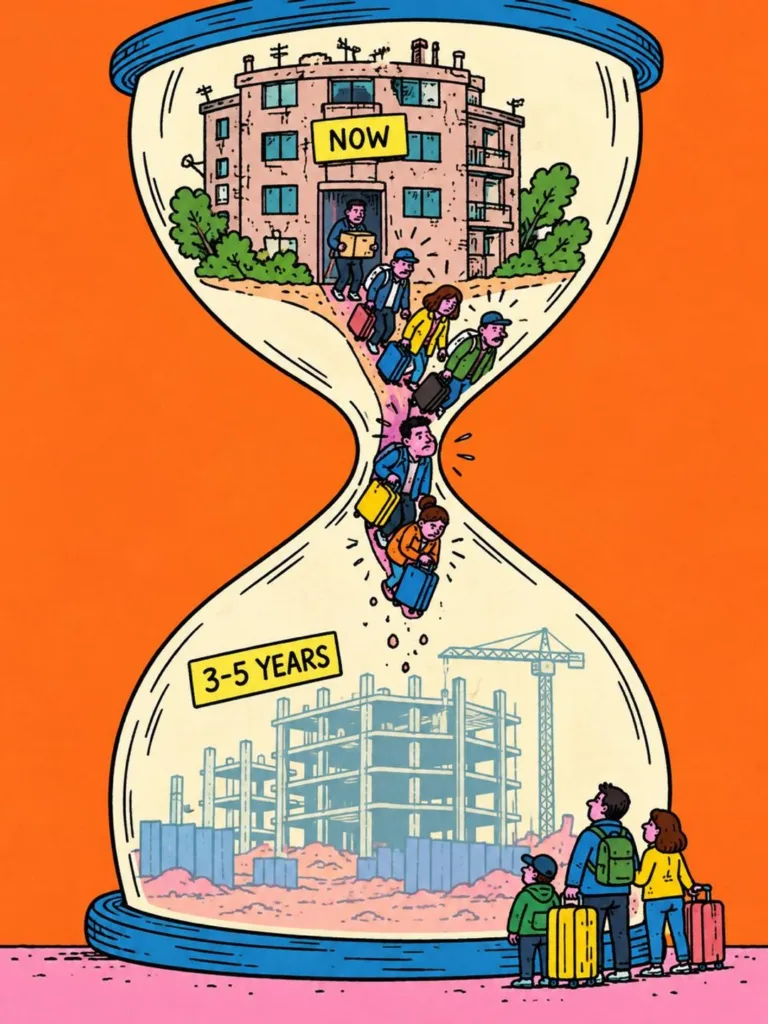
From 2026 to 2030, 179,310 households in 207 redevelopment and reconstruction zones in Seoul must empty their homes and move out. The figures come from data the Seoul city government submitted to the office of Jeon Yong-gi, a Democratic Party lawmaker on the National Assembly's land and transport committee. Eunma Apartments in Gangnam (4,424 households) is aiming to start moving residents out in the first half of next year.
Because reconstruction swaps old homes for more new apartments, it reads like good news for housing supply. That isn't wrong. But for people who rent on jeonse (a Korean lease where the tenant pays a large lump-sum deposit instead of monthly rent), what matters is less how many homes get built than when old ones disappear and when new ones appear.
- Does reconstruction really add homes?
It does. Daegyo Apartments in Yeouido will tear down 576 homes and rebuild them as 912 homes in towers of up to 49 floors. Once finished, that adds 336 homes.
The problem is the order. Daegyo's move-out runs from Oct. 1 to March 31 next year, and the redevelopment association aims to demolish and start construction by the end of 2027. The 576 homes empty out from this fall, while the 912 appear only after construction ends. The sequence is: homes torn down → construction period → new homes. Until construction ends, no one can live on that site.
It is like several neighborhood restaurants closing for remodeling at the same time. When they reopen there are more seats, but while the work goes on, the lines at the remaining restaurants get longer. The difference is that a restaurant remodel takes months, while at Daegyo the stretch from move-out to groundbreaking alone runs more than a year.
- When do the move-outs peak?
Planned move-outs by year: 24,844 households in 2026, 13,446 in 2027, 45,256 in 2028, 39,102 in 2029 and 56,662 in 2030. The three years from 2028 to 2030 account for 141,020 households, or 78.7% of the total.
By district, Yangcheon has the most at 31,112 households, followed by Songpa (24,708) and Gangnam (15,852). Put simply, the big wave of move-outs hasn't arrived yet; it builds from 2028.
- How many new homes arrive in the meantime?
Property data firm Real Estate R114 expects new apartment move-ins in Seoul to go from 37,103 in 2025 → 25,281 in 2026 → 18,682 in 2027 → 13,683 in 2028. The number falls every year.
Put the two numbers side by side for the same year and the gap is clear. In 2028, 45,256 households move out, while new apartment move-ins are expected at 13,683. Even using Real Estate 114's 2028 forecast excluding rental housing (13,279), move-outs are more than three times larger.
Not every household that moves out will look for a jeonse home in Seoul, though. Some will move to Gyeonggi Province, rent monthly, or already own another home. We could not find public data on how many end up in Seoul's jeonse market.
- How are jeonse prices moving now?
According to the Korea Real Estate Board, Seoul apartment jeonse prices rose 7.79% this year through the second week of September, about 4.7 times the rise over the same period last year. They have risen for 84 straight weeks since the first week of February last year.
If a $400,000 jeonse deposit at the start of the year rose by that average, it would be up about $31,000 (a hypothetical calculation). Actual increases at renewal vary by home and lease terms.
Choices have narrowed too. On Sept. 23, Seoul had 20,542 apartment jeonse listings, 13.1% fewer than a year earlier. No data splits out how much of this year's rise is due to move-outs. Kim Hyo-sun, a senior real estate expert at KB Kookmin Bank, said residents of school-district neighborhoods who move out are likely to crowd into similar areas, adding that "the jeonse supply-demand imbalance is a bigger concern than it is now."
- Would delaying move-outs fix it?
Not easily. Yoon Ji-hae, head of research at Real Estate 114, said that "if you delay groundbreaking to spread out relocation demand, the supply cliff could be prolonged." He described it as "the difference between designing policy for today's rental market or for three years from now."
Delay move-outs and new homes may come later; rush them and move-outs pile up at once. Either way, some burden remains. Lawmaker Jeon said redevelopment should move quickly but that "effective relocation measures must be prepared alongside it."
Seoul has 5,703 homes scheduled for move-in in October, the most of any month this year. A Real Estate 114 official said that while new supply can be "rain in a drought" in areas where it rises, it will have limits in easing supply worries across Seoul.
- BITPRESS Insight
The people whose judgment this news should change are those renting on jeonse in Seoul. The homes reconstruction adds appear only when construction ends, and the homes being torn down vanish before that. In between, households that moved out and look for jeonse nearby may compete with existing renters for the same listings.
Especially in 2028-2030, when move-outs peak, and near Yangcheon, Songpa and Gangnam, where they are largest, news that "more new apartments are coming" won't make your next jeonse renewal any easier.
When you look at a housing supply number, one question matters. Not how many homes get built, but when old ones disappear and when new ones appear.
Sources
https://www.newsis.com/view/NISX20260909_0003782374
https://www.seoul.co.kr/news/economy/2026/09/25/20260925500012
https://news.mtn.co.kr/news-detail/2026091016150219332
https://www.g-enews.com/article/Real-Estate/2026/09/2026092909363851602aa6f4cdad_1
https://www.heraldk.com/article/2026082319273432424
Glossary
Redevelopment and reconstruction — Projects that tear down old apartments or neighborhoods and build new apartments; residents must move elsewhere during construction.
Move-out (relocation) — Residents of a redevelopment zone emptying their homes and moving elsewhere before demolition.
Move-in volume — The number of new apartment units finished in a year that people can move into.
Groundbreaking — Actually starting construction of the new building after demolition is done.
Jeonse listings — The number of homes currently offered on jeonse, a lump-sum deposit lease, and looking for tenants.
BITPRESS articles are information to help your investment decisions, not a recommendation to buy or sell any stock or coin. Investment decisions and their results are your own responsibility.