
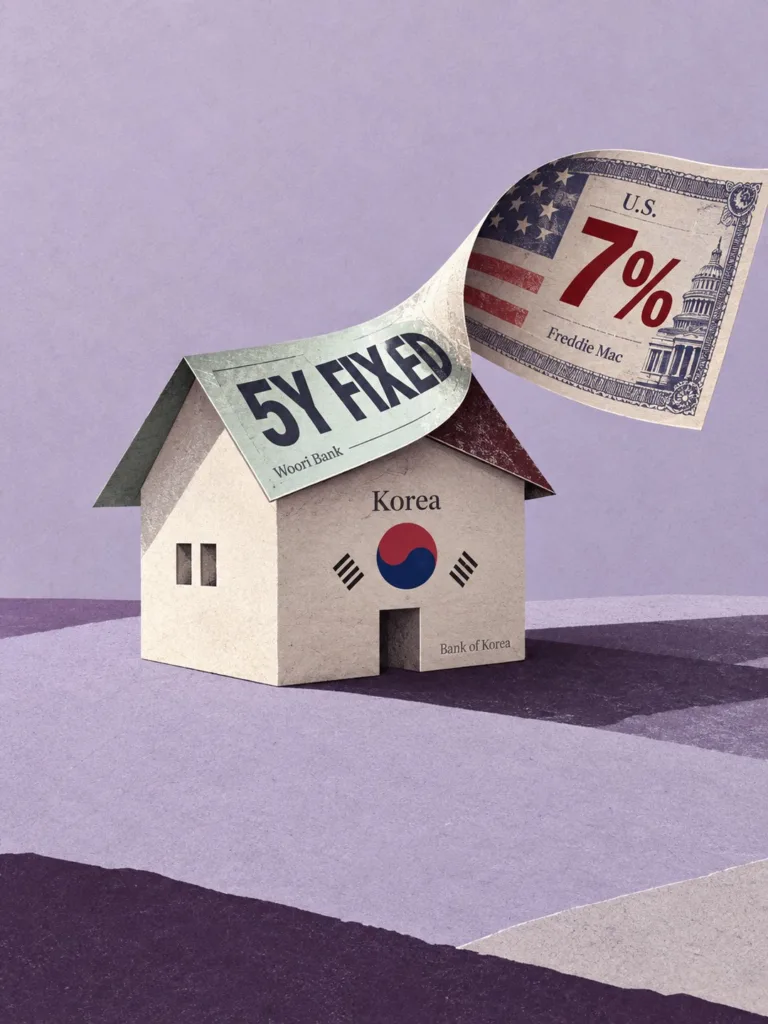
Five-year fixed mortgage rates at Korea's five biggest banks (KB Kookmin, Shinhan, Hana, Woori and NH NongHyup) stood at 4.95-6.92% a year on Sept. 17. The low end alone is 0.69 percentage point higher than at the end of May. People who took out 5-year fixed loans in 2021 are likely to be repriced at around today's rates when their fixed period ends.
The common explanation is that the Bank of Korea raised its base rate in July and again in August, so loan rates went up. That is not wrong. But trace the pricing of a 5-year fixed mortgage back to its source, and it leads not to the central bank's meeting room but to the bond market, and beyond it to U.S. Treasury yields.
- Fixed mortgage rates follow a 'wholesale price'
The money a bank lends does not simply come out of its vault. Banks raise it by taking deposits or by selling bonds (bank bonds). The benchmark rate for a 5-year fixed mortgage is the 5-year bank bond yield.
Think of the bank bond yield as the wholesale price and the mortgage rate as the retail price. The bank adds its own cut (the spread) on top of the wholesale price, then subtracts discounts it gives when borrowers meet certain conditions, to arrive at the retail price. When the wholesale price rises, the retail price follows.
- The wholesale price hit a 2-year-10-month high
According to Money Today's tally, the 5-year bank bond yield (unsecured, AAA) was 4.656% on Sept. 15, the highest in 2 years and 10 months, since Nov. 1, 2023 (4.733%). On May 28 it was 4.280%. By Financial News' count, it rose 0.273 percentage point in the first 15 days of September, seven times the gain for all of August (0.039 point).
The retail price followed. The low end of the big five banks' 5-year fixed rates rose 0.27 percentage point from the end of August and 0.69 point from the end of May, to 4.95%. The high end fell from 7.17% on Aug. 27 to 6.92%, because NH NongHyup Bank cut its rates on Sept. 16. At the other four banks, the high end rose.
- U.S. Treasury yields pushed the wholesale price up
The 5-year bank bond yield moves with U.S. Treasury yields. When the U.S. 10-year Treasury yield, the world's benchmark rate, broke above the psychological threshold of 5%, yields on Korean government bonds and financial bonds such as bank bonds rose one after another. If U.S. bonds pay higher interest, investors' money can move to the U.S. So when U.S. Treasury yields rise, Korean bond yields often rise with them so Korean bonds stay competitive. On top of that, foreign investors net sold KRW 839.7 billion of Korean bonds in August, their first monthly net sale since January 2023. Bond prices and yields move in opposite directions, so when sellers outnumber buyers, bond prices fall and yields rise. According to a Realtor.com economist, the U.S. 10-year yield jumped 0.15 percentage point on Sept. 23 to 5.11%, a 19-year high.
The Fed (the U.S. central bank) raised its benchmark rate by 0.25 percentage point to 3.75-4.00% on Sept. 16 (local time). The gap with Korea's base rate (3.00%) widened again to 1.00 percentage point. A wider gap raises worries that foreign money will leave and the won will weaken, and that worry pushes up Korean market rates.
U.S. mortgages rose from the same root. According to Freddie Mac (a government-sponsored company that buys U.S. mortgages), the average U.S. 30-year fixed mortgage rate was 7.03% on Sept. 24, above 7% for the first time since January 2025. Those loans track the 10-year Treasury yield more closely than Fed decisions, so the U.S. got the move directly through Treasuries and Korea got it one step removed, through bank bonds.
- Variable-rate loans are closer to the Bank of Korea
That does not mean the Bank of Korea is irrelevant. Variable-rate mortgages reset every 6 months based on COFIX (an index of banks' funding costs) or financial bond yields. COFIX is shaped by deposit rates, and when the Bank of Korea raises its base rate, banks raise deposit rates. July COFIX (new loans basis) was 3.18%, up 0.13 percentage point in a month, and variable mortgage rates were 4.35-6.79% on Sept. 17.
In effect, Korean mortgages answer to two bosses. Variable loans sit close to the Bank of Korea through deposit rates; fixed loans sit close to the bond market through bank bonds. Even this summer, while the Bank of Korea was raising rates in July and August, the 5-year bank bond yield fell from 4.531% on July 24 to 4.243% on Aug. 5. The two rates do not always move together.
- People who fixed their rate five years ago are getting a new rate
The borrowers who feel this gap most are those who took out 5-year fixed loans in 2021. A 5-year fixed mortgage does not lock the rate for life. A hybrid loan applies a fixed rate for the first 5 years and then switches to a variable rate, while a periodic loan resets to the going rate every 5 years. The big five banks lent KRW 20.3404 trillion in 5-year fixed mortgages in 2021, at 2-3% a year back then. The financial industry estimates that, excluding early repayments and refinancing, about KRW 10-12 trillion of that will be repriced at new rates. These borrowers are now more likely to pay 5-6% once their fixed period ends.
On a simple calculation for a KRW 300 million loan, yearly interest is KRW 9 million at 3% and KRW 18 million at 6%. The 6% sits inside today's 5-year fixed range (4.95-6.92%). One borrower who took a KRW 350 million 5-year fixed loan in 2021 saw monthly principal and interest payments rise from KRW 1.4 million to KRW 1.81 million.
- The year-end '8% mortgage' depends on bank bonds reaching 5%
In the financial industry, some expect the 5-year bank bond yield to rise to 5%. Park Hyung-joong, an economist at Woori Bank, said "bank bond yields will rise to around 5% by year-end" and that "the top of the range for some loan products could approach 8%." From 4.656% on Sept. 15, there are 0.344 percentage point to go to reach 5%.
The 8% refers to the top of the range on some products, not to all loans. But when loan demand surges, banks can manage rates by cutting discounts or raising their spread. If they do this while the wholesale price rises, the retail price rises more than the wholesale price.
- BITPRESS Insight
Read mortgage rates only through Bank of Korea news and you see half the picture. Variable-rate loans follow the central bank through deposit rates, but 5-year fixed loans are influenced by U.S. Treasury yields through bank bonds.
The common belief that a fixed rate is safe is only half right. A fixed rate doesn't remove rate risk; it postpones it five years. What sets the new rate five years later is that day's bank bond yield, which is why loans locked at 2-3% in 2021 are now more likely to be repriced at 5-6%.
So for fixed mortgages, the formula 'up when the Bank of Korea hikes, flat when it pauses' doesn't hold as is. Even the forecast of '8% mortgages' for some products by year-end rests on the premise of a 5% five-year bank bond yield more than on any central bank decision.
Sources
https://www.freddiemac.com/pmms
https://www.foxbusiness.com/economy/mortgage-rates-9-24-2026
https://www.mt.co.kr/finance/2026/09/17/2026091714272658569
https://www.mt.co.kr/finance/2026/08/27/2026082715543352452
https://www.wowtv.co.kr/NewsCenter/News/Read?articleId=A202609160489
https://www.thepublic.kr/news/articleView.html?idxno=319311
https://biz.heraldcorp.com/article/10758632
https://www.newspim.com/news/view/20260918000953
Glossary
Benchmark rate — The market rate a loan rate starts from. For a 5-year fixed Korean mortgage, it is the 5-year bank bond yield.
Bank bonds — Bonds a bank sells to investors to raise money to lend. For the bank, it is the wholesale price of money.
Credit spread — The bank's own cut added on top of the benchmark rate. It covers costs, risk and profit, and the bank can adjust it.
Preferential discount — A discount off the loan rate for meeting conditions such as salary deposits or card spending. When banks shrink it, the actual rate goes up.
COFIX — An index of the average cost banks pay to raise money, mainly through deposits. Variable-rate mortgages move with it.
Big-five banks — Korea's five largest commercial lenders: KB Kookmin, Shinhan, Hana, Woori and NH NongHyup. Their posted rates are the usual benchmark for Korean household loans.
Base rate (Bank of Korea) — The Bank of Korea's policy rate, 3.00% since Aug. 27, 2026. It moves deposit rates and variable loans more directly than fixed loans.