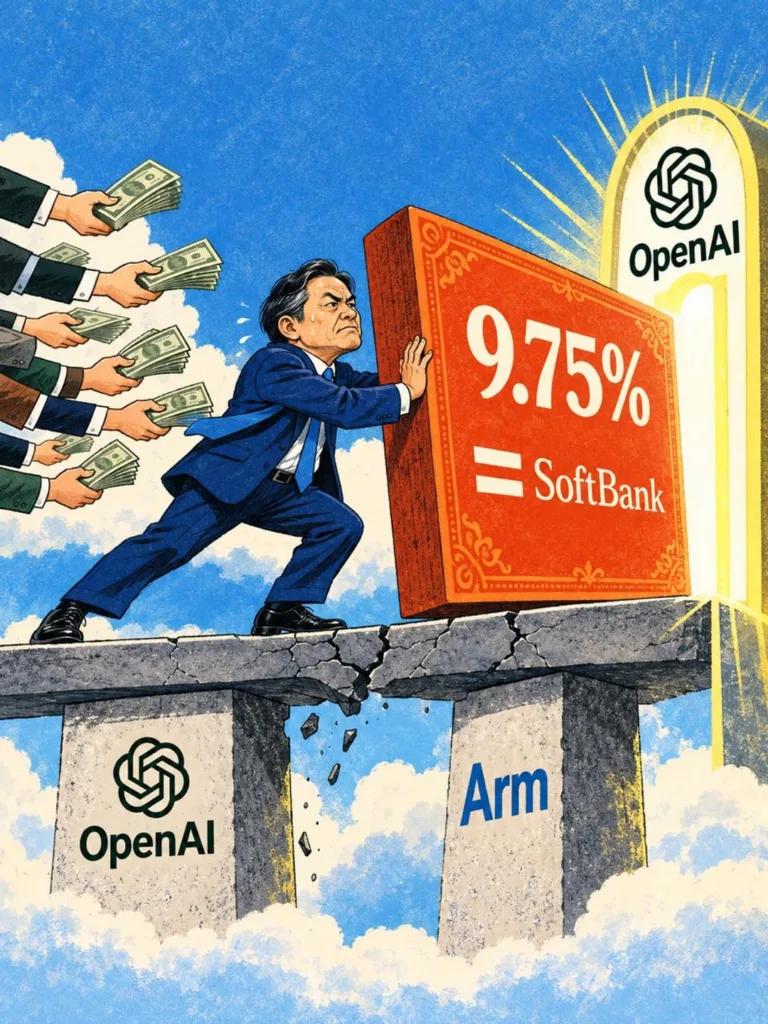
일본 소프트뱅크그룹(손정의 회장이 이끄는 기술 투자회사)이 9월 24일 111억 달러어치 채권을 팔았다. 챗GPT를 만든 오픈AI에 넣을 100억 달러를 마련하려는 빚이다. 가장 긴 7.5년짜리에 붙은 이자는 연 9.75%로, 소프트뱅크가 달러 채권에 약속한 이자 가운데 가장 높다.
From the numbers alone, you might wonder how desperate a company must be to pay that much. Yet the dollar bonds drew orders more than three times the amount on offer. A high rate is less proof of reckless borrowing than the price the market puts on the risk of not being repaid. Learn to read that price tag, and you can see where the money behind the AI investment boom comes from, and who carries which risk.
- A high-yield bond is debt from a company with a low credit score
A bond is an IOU a company writes when it borrows money. Credit rating agencies grade a company's ability to repay on time, from AAA down to D. BBB- and above is "investment grade"; anything below is "speculative grade." Bonds from speculative-grade companies are called high-yield bonds because they pay more interest, or junk bonds when people want to be less polite.
It works just like a bank loan. A person with a low credit score pays more interest to borrow the same amount, because the bank collects the risk of not being repaid in advance, as interest. The international rating agencies S&P and Fitch rate SoftBank BB+, one notch below investment grade.
- Just how expensive is 9.75%?
SoftBank sold three kinds of dollar bonds this time: $1 billion of 3.5-year bonds at 8.625% a year, $4.5 billion of 5.5-year bonds at 9.25%, and $4.5 billion of 7.5-year bonds at 9.75%. The longer the loan, the higher the rate, because the further out you go, the less anyone knows what might happen. It also sold two euro bonds of €500 million each. The $10 billion of dollar bonds plus these euro bonds make up the full $11.1 billion.
Put it next to a benchmark and the size becomes clear. At the time of the sale, the average yield on BB-rated dollar bonds in a Bloomberg index was 6.55%. On the longest bond, SoftBank is paying 3.2 percentage points more than companies with the same rating. The extra interest added on top of a base rate such as government bond yields to cover the risk of not being repaid is called a credit spread, and SoftBank is paying more of it than the average for its rating. Reuters said the reason SoftBank pays more than the average, despite sitting on the top BB rung, is the sheer size of its AI investments and of the money it is borrowing to fund them. Still, the 3.2 points compares the longest, 7.5-year bond, so it is hard to line it up directly against an average that also includes shorter bonds.
It is expensive against SoftBank's own past, too. A $7.3 billion bond sale in June 2021 carried rates of 2.125% to 5.25%. Even against the 3.5-year and 5.5-year bonds it sold this April (7.625% and 8.25%), the new ones pay 1 percentage point more each.
- If the interest is so high, why did money pour in?
According to Bloomberg, by the afternoon of Sept. 23 (Asia time), orders for $10 billion of dollar bonds had topped $30 billion. With orders overflowing, SoftBank set rates at or below the low end of the ranges it first offered. When many people want to buy, a company can pay less interest and still sell. The 3.5-year and 5.5-year bonds were priced below their offered ranges, and the 7.5-year bond, first pitched at 9.75% to 9.875%, was priced at the lowest point, 9.75%.
From the investors' side, the math works. On the longest bond, they earn 3.2 percentage points more than the average rate paid by companies with a similar credit rating. Money lined up because it judged that extra pay to be bigger than the risk of not being repaid.
The result was the largest high-yield corporate bond sale in history. According to LSEG data, the previous record was French telecom company Numericable's $10.9 billion sale in 2014.
- This money is headed to OpenAI
According to the bond term sheet seen by Reuters, the money will go toward a $10 billion payment into OpenAI on Oct. 1. It is the last part of SoftBank's $64.6 billion OpenAI investment commitment. Once it is done, SoftBank will own about 13% of OpenAI. This month SoftBank also sold ¥1 trillion of bonds to individual investors in Japan.
Where AI money comes from has changed, too. Satoru Aoyama, a senior director at Fitch, said, "Big U.S. cloud companies have been raising debt, but they have high credit ratings. Now AI-driven debt has reached the high-yield market at scale." According to Goldman Sachs, AI-related bond issuance has already topped $575 billion this year. SoftBank alone accounts for 63.4% ($14.6 billion) of this year's Asia-Pacific and Japan high-yield corporate bond market.
- Selling well does not mean the risk went down
In the same week the orders poured in, the price of insuring SoftBank's debt against default (CDS, the cost of insurance that pays out if a lender is not repaid) topped 400bp (4% a year) on a five-year basis as of Sept. 24 reports. In June it was around 280bp. As a simple calculation, the yearly cost to insure KRW 100 million of bonds rose from around KRW 2.8 million to more than KRW 4 million. Reuters said the growing size of SoftBank's AI investments and of the money it borrows for them pushed up its default insurance cost along with its interest rates.
What worries the market is concentration. Mark Chapman of CreditSights, a U.S. credit research firm, calculated that three-quarters of SoftBank's asset value is its stakes in chip designer Arm and OpenAI. That means the assets SoftBank would repay its debt with hinge on what those two companies are worth. SoftBank borrows to put money into OpenAI, and what it would repay that debt with depends, in turn, on the value of its OpenAI (and Arm) stakes. Chapman said the risks to SoftBank's credit have grown as that concentration has increased and its cash flow has come under heavy strain. The stock listings SoftBank had been counting on, for OpenAI and its subsidiary SB Energy, have also been delayed. S&P, on the other hand, said Arm's strong share price means the delay to OpenAI's listing does not immediately hurt SoftBank's creditworthiness.
- BITPRESS Insight
Three times the orders does not mean SoftBank has become safe. It means SoftBank paid enough for investors to take on the risk. In the very week the orders poured in, its default-insurance price was about 120bp higher than in June. Popularity and safety are two different numbers.
The AI boom looks the same through this lens. The AI debt of big U.S. cloud companies came with high credit ratings. Now money from investors paid 9.75% to take on risk is flowing into AI. If hopes for OpenAI waver, that worry could come back as the interest SoftBank has to pay the next time it borrows.
The rule fits in one line: a bond that sells well is not the same as a safe bond. If a company has to pay more the next time it borrows, the market already sees it as riskier.
Sources
https://www.freemalaysiatoday.com/category/business/2026/09/24/softbank-raises-us-11-1bil-in-world-s-biggest-high-yield-corporate-bond-sale
https://www.japantimes.co.jp/business/2026/09/24/companies/softbank-junk-bond-steep-price-pay/
https://en.sedaily.com/society/2026/09/24/softbanks-junk-bond-sale-draws-over-20-billion-for-openai
https://www.brecorder.com/news/40440461/softbank-group-launches-over-10-billion-in-bonds-for-openai-investment-term-sheet-shows
https://www.ebc.com/forex/softbank-bond-sale-openai-30-billion-demand
https://americanbazaaronline.com/2026/09/24/softbank-makes-history-with-record-11-1b-high-yield-bond-sale-488764/
Glossary
High-yield bond (junk bond) — A bond issued by a company rated below investment grade (BBB-); it pays more interest because the risk of not being repaid is higher.
Investment grade — A rating of BBB- or above, meaning a rating agency judges the borrower well able to repay; anything below is speculative grade.
Credit spread — Extra interest added on top of a base rate to cover the risk of not being repaid; the riskier a borrower looks, the bigger it gets.
CDS (credit default swap) — The price of insurance that pays out if a company fails to repay its debt; when it rises, the market sees the company as riskier.
bp (basis point) — A unit equal to 0.01 percentage point; 100bp is 1 percentage point.