
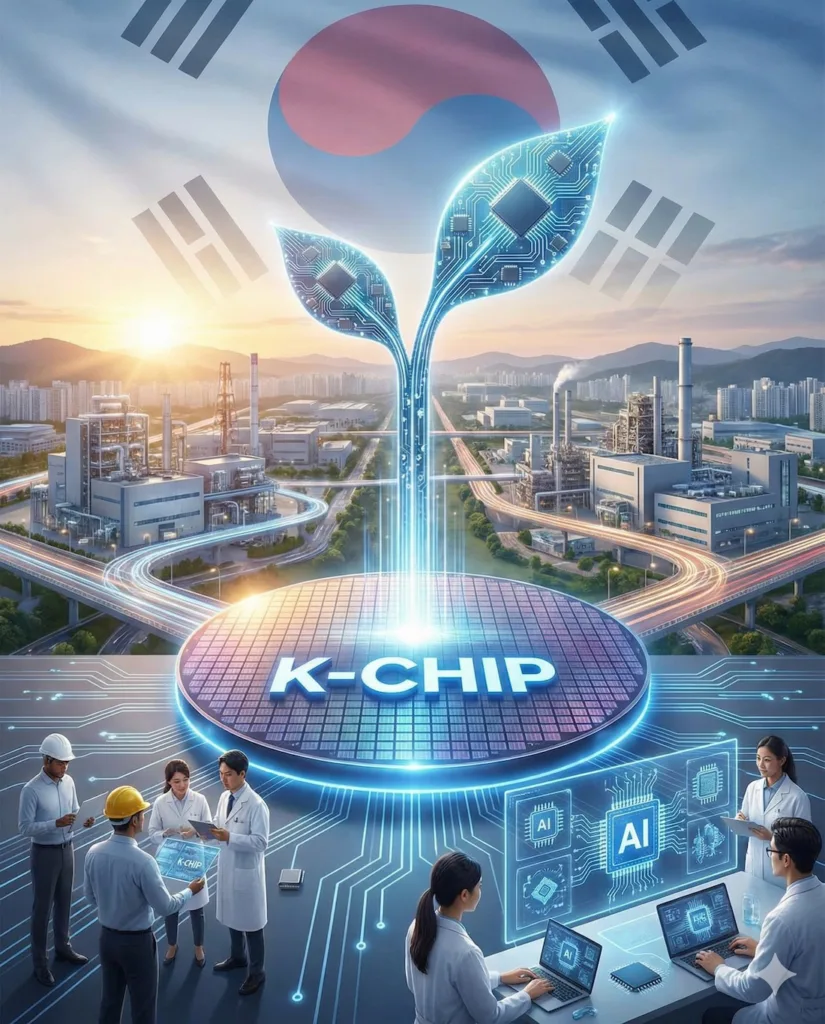
With the Semiconductor Special Act passing the National Assembly, a new wind is blowing through Korea’s chip industry. The law has the state strongly back the industry that makes ‘semiconductors’*, which go into every electronic device from smartphones to AI.
*Semiconductor: a tiny chip made from materials such as silicon that acts as the ‘brain’ of a computer or smartphone.
Key provisions of the law
The law designates semiconductor clusters (areas where factories are concentrated) and has the state support infrastructure such as electricity, water and roads. Companies get tax benefits and faster permits and approvals, making it easier to build factories. The preliminary feasibility study (an advance review of a project’s value) can also be skipped, saving money and time.
To put it simply for middle school students: it is like forming a special club at school where the teacher provides all the money and space. When a chip company builds a factory, the government quickly installs power lines and water pipes.
When it takes effect
It passed a plenary session of the National Assembly on Jan. 29, 2026. Once it is promulgated (officially announced by the president) and the subordinate regulations (detailed rules) are drawn up, it is scheduled to take effect from the third quarter of 2026 (July–September). The exact date has not been set yet, but the government is rushing preparations.
Impact on the industry
Korea is a global semiconductor powerhouse, but competition with the US and China is fierce. If clusters (such as Yongin and Pyeongtaek) are revitalized under the law, jobs will increase and production of AI and memory chips is expected to surge. With a lighter investment burden, companies gain a weapon to win the global fight. For example, a stable power supply keeps factories from stopping, which lifts output.
Beneficiary stocks and upside forecasts
Samsung Electronics and SK hynix stand to benefit the most. The two leaders gain directly from cluster investment and tax benefits. Recent brokerage forecasts: Samsung Electronics target price KRW 260,000 (up 63% from the current price), SK hynix KRW 1.5 million (up 88%). SK hynix, a leader in HBM (high-speed memory), is expected to post operating profit of more than KRW 38 trillion in 2026, so its upside could be large.
Among smaller companies, materials, parts and equipment stocks such as SFA Semicon and Hanmi Semiconductor also surged on the theme, but large caps are more stable. These are fact-based forecasts, and share prices may differ due to market volatility.
BITPRESS Insight
As semiconductor clusters are designated, non-capital regions such as Busan and Gwangju are emerging as candidates alongside Yongin and Pyeongtaek, and a reshuffling of regional materials, parts and equipment supply chains is expected. Beyond simple support, this extends to a special account worth KRW 100 trillion through 2036, and is likely to spur M&A among small and midsize companies in foundry (contract manufacturing) as well as HBM.