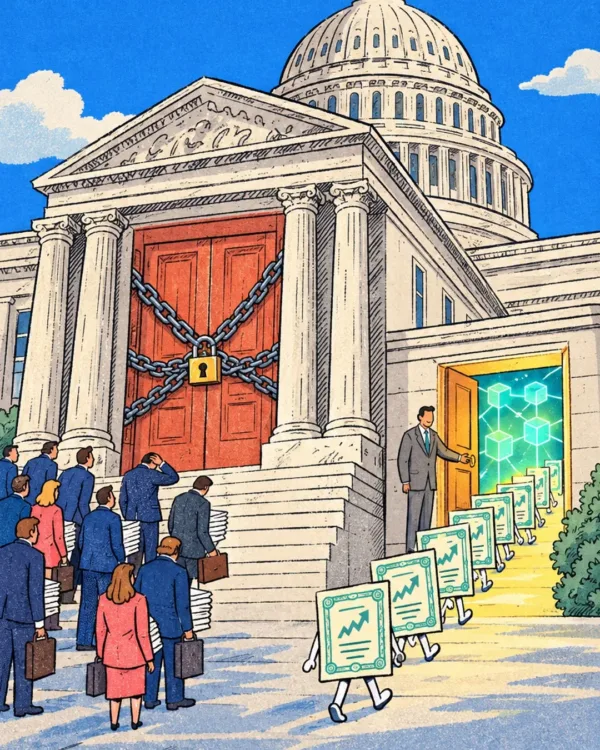
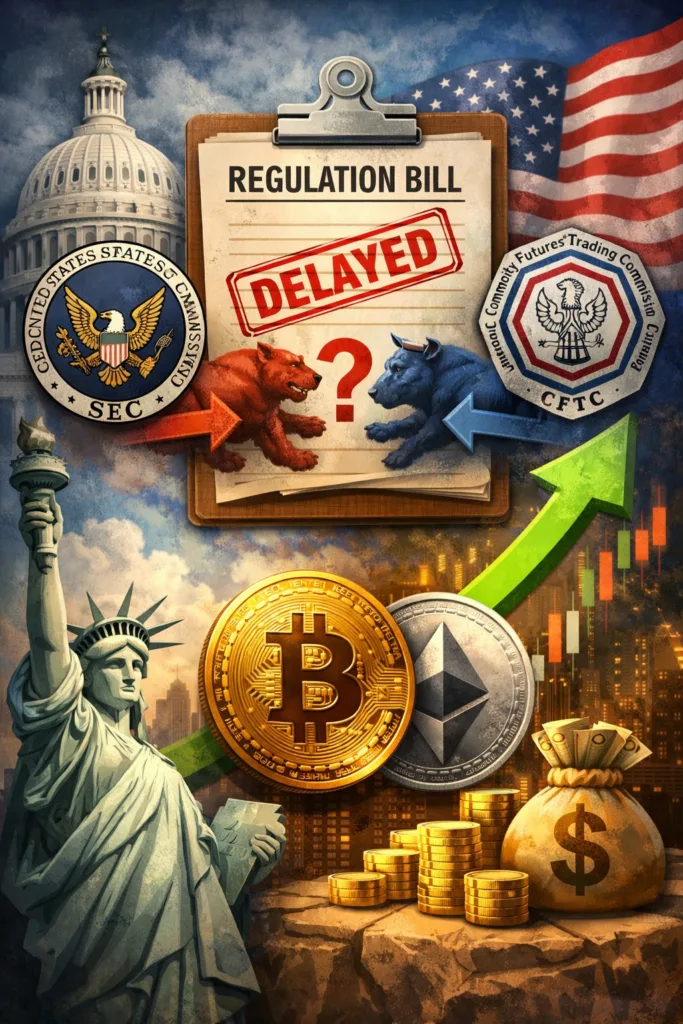
One of the keywords mentioned most often in the US crypto market lately is ‘bill delays.’ The market talked as if the US were about to bring crypto into the regulated financial system, but in reality the bill keeps getting pushed back and uncertainty is only growing. It is worth calmly laying out what this bill actually is, why it is taking so long, and whether it is really good news for the crypto market.
- What the US crypto bill is trying to settle
In a nutshell, the US crypto bill is a law to decide “how digital assets are classified and who oversees them.” Until now, it has not been clear in the US whether crypto is a security or a commodity. As a result, some coins have been treated like securities and regulated as such, while others trade like commodities, leaving the standards very vague.
The bill has three core goals.
First, it sets clear legal criteria for deciding whether a token is a security or a commodity.
Second, it creates a framework for the rules under which crypto exchanges and brokers must register and operate.
Third, it decides how to manage assets such as stablecoins that are already being used in everyday life.
Until now, regulators set standards after the fact through enforcement or lawsuits; this bill is significant as an attempt to write the rules down from the start.
- So why does it keep getting delayed?
The biggest reason the bill keeps being delayed is disagreement over “who will oversee crypto” and “how tightly it will be regulated.”
The core conflict is the difference in positions between the agency in charge of securities and the agency in charge of commodities. If the securities view is applied, crypto would be treated much like stocks: issuers would face stronger disclosure obligations, and exchanges would be regulated at the level of brokerage firms. In that case, many coins and services would struggle to meet the standards, and barriers to entering the market would rise sharply.
If the commodities view is applied instead, crypto would be classified as an asset traded like gold or crude oil. Regulation would then focus on preventing market manipulation and ensuring trading transparency, and the industry would keep relatively more autonomy. That is why the industry prefers commodity classification. Because this choice changes the very nature of the US crypto market, reaching agreement is not easy.
Another point of contention is a provision restricting certain service models. Some drafts of the bill include language limiting structures that pay interest on deposited stablecoins. This is meant to stop stablecoins from functioning like bank deposits, but exchanges and issuers oppose it, saying it “artificially blocks a legitimate revenue model.” There are also concerns that if the provision passes, it will be hard to keep running related businesses in the US.
On top of that, the political calendar and other legislative priorities have piled on, so the crypto bill cannot easily reach a conclusion and keeps getting pushed back.
- What are the bill’s key provisions?
Put simply, the bill currently under discussion looks like this.
The most important part is the token classification standard. The direction is that if a project is sufficiently decentralized and not controlled by a specific entity, it can be classified as a commodity rather than a security. Once this standard is finalized, the legal status of many coins will be settled for the first time.
Another part is regulation of exchanges and brokers. Until now, different rules have applied in each state, but a federal registration and supervision system is likely to be created. That means higher costs for companies, but greater credibility from the standpoint of mainstream finance.
For stablecoins, reserve requirements, issuer responsibilities and protections for holders are being discussed. In particular, whether to apply bank-like regulation is the key issue.
- So is the bill good news for the crypto market?
The short answer: it is likely good news in the long run, but the short term is highly uncertain.
Starting with the positives, clear rules would allow institutional investors to come in in earnest. Until now, big money has been cautious because of the risk that “it could become illegal later.” Once the law is settled, that barrier comes down. And if the US sets clear standards, other countries are likely to use them as a reference to overhaul their own systems.
There are clear negatives, too. Clearer regulation also means less room to operate freely. Some projects could be classified as securities and face trading restrictions, and some stablecoin or DeFi services may have to change their business models altogether. Above all, until the bill is finalized, uncertainty over “which way it will go” weighs on the market.
- How should investors look at it?
It is more sensible to see the US crypto bill as an event that changes the market’s structure than as a catalyst for short-term price gains. The longer the bill is delayed, the more short-term volatility may grow, but the chance of it being scrapped entirely is not high.
Rather than simplifying it as “automatically good news if it passes” or “bad news because it is regulation,” investors need to take a cool look at which assets have the structure best suited to the regulated system. The tighter regulation gets, the sharper the line between assets that survive and those that disappear is likely to become.
BITPRESS Insight
We judge this US crypto bill to be bad news in the short term, clearly good news in the medium to long term. The reason is simple. What the market expected was ‘regulatory certainty,’ but the reality is ‘regulatory delay + disputes over the content.’ Expectations ran ahead, and the result has not arrived yet. That gap weighs on prices in the short term.
It is especially important that the key reason for the delay is that “there is no internal agreement on how to regulate.” This is not a simple scheduling delay; it suggests that even if the bill passes, it may not be as loose as the market currently expects. What the market dislikes is not regulation itself so much as the uncertainty that it could be stricter than expected. So as talks on the bill progress, volatility and correction pressure are likely to recur in the short term.
From a medium- to long-term perspective, the story is completely different. Assuming the bill eventually passes, the US will move to officially recognize crypto not as ‘an asset it cannot ban’ but as ‘a manageable financial asset.’ That is a structural change that gives institutional investors, pension funds and large financial firms a justification to enter. It is not a catalyst for pushing prices up quickly, but it raises the market’s floor.
In short, this bill is not “a reason to buy coins right now.” But it is closer to a signal that “the chance of crypto disappearing from the regulated system is now almost gone.” In the short term, the market may keep getting shaken by news of delays, but in the medium to long term it is likely to work in favor of core assets such as Bitcoin and Ethereum. This bill is not a trigger for a rally; it is closer to an event that confirms the market’s survival.