



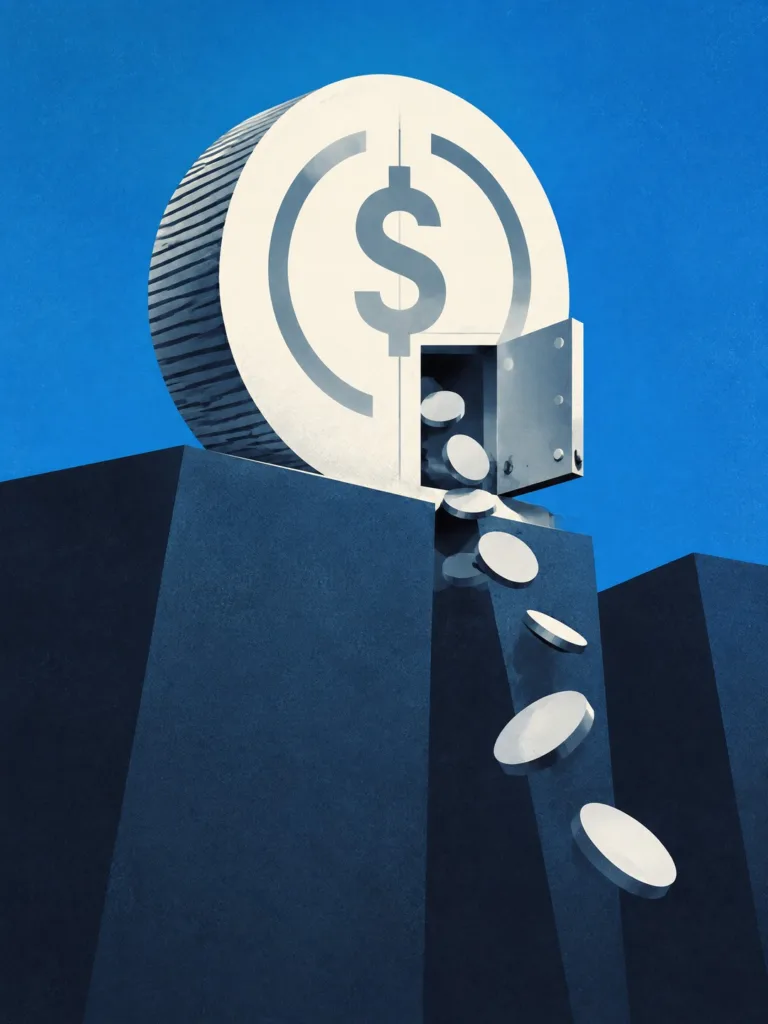
After the Nov. 19 report, within about a day, more than $1.5 billion in USDC (about 2 trillion won) left the reserves of USDS, a stablecoin (a coin designed to stay pegged to $1). USDS is issued by the decentralized protocol Sky, and its reserves are USDC set aside so holders can be paid back on request. USDS market cap (the total value of USDS in circulation) fell over 30% to $3.2 billion.
It is easy to assume the price would have broken if this much money left at once. But USDS held $1. What matters more than how much money left is whether reserves could be paid out on the spot to people asking for their money back. That appears to be one reason USDS held $1.
- Why about 2 trillion won left right after the report
The story began with a report published on the morning of Nov. 19. Crypto risk-analysis firm INCA Digital said $518 million in transactions passing through Sky's price stability module (PSM, the window that swaps USDS for USDC) were tied to wallets linked to hackers, sanctioned parties, and others. More than $100 million of that was linked to North Korea.
After the report, more than $1.5 billion in USDC left the PSM. Most of it was pulled out by one large holder, and that address is classified as belonging to the crypto exchange Poloniex. However, it has not been confirmed that Poloniex itself made the trades. Sky disputed the figures, saying the problematic share was about 0.03% of the $968 billion in cumulative PSM trades.
- How did the price hold at $1 as money left?
The PSM swaps one USDS for one USDC, and back again, at close to a 1-to-1 rate. USDC is a dollar stablecoin issued by Circle. If USDS drops below $1, anyone can buy it cheap and swap it at the PSM for $1 worth of USDC. That draws buyers in, and the price climbs back to $1.
Think of a 10,000-won gift card that someone sells for 9,900 won. Since the card can be used at the store for the full 10,000 won, someone will buy it soon. But if the store's safe is empty and it cannot hand over goods, the gift card may not sell even for 9,000 won. This time, Sky's reserves were not empty.
USDC in the PSM fell from $2.5 billion a day earlier to about $1 billion. That is a big drop, but USDC was still left to pay out.
- So when does the $1 price start to wobble?
March 2023 is one example, involving USDC. Circle could not withdraw $3.3 billion of its reserves from Silicon Valley Bank, which collapsed. That was about 8% of its total reserves. Redemptions, meaning exchanging a coin for dollars, then stopped over the weekend. Halted redemptions made selling pressure worse, and USDC fell to 86 cents at one point.
When Circle restarted redemptions on Monday, March 13, USDC returned to $1. When redemptions stop, handing in a coin will not get you dollars that day. What set this USDS episode apart is that USDC was still left in the PSM to pay out after the report.
- So is USDS safe now?
Risk remains. The PSM's USDC sits in one address (think of it as an account on the blockchain that holds coins), and it is a reserve shared by USDS and DAI, another stablecoin from Sky. If a court or investigators freeze this address (block it from moving funds), the entire remaining balance could be locked at once.
Sky founder Rune Christensen said USDS is backed by about $10 billion in collateral (assets pledged to support a coin's value), more than the amount issued, and that the protocol is operating normally. However, the available material does not confirm whether all of that collateral can be converted into USDC on the spot, the way the PSM can.
- BITPRESS Insight
News that money has left a stablecoin is usually read as a warning sign. But when the issuer can pay out right away what holders ask for, as with USDS this time, the coins that remain can help hold the $1 price even as the supply shrinks.
In contrast, in 2023 part of USDC's reserves was tied up at a bank and redemptions stopped over the weekend, which helped pull the price down. Even among $1 coins, what makes the difference is whether reserves can be withdrawn right now or could get locked up somewhere.
If you hold a stablecoin, judge it not by how much money has left, but by whether the reserves can be paid out in cash on the day you ask for your money back.
Sources
https://www.coindesk.com/business/2026/11/19/sky-s-usds-stablecoin-shrinks-35-as-usd1-5-billion-exits-reserves-after-illicit-finance-report
https://sky.money/blog/what-is-usds
https://www.federalreserve.gov/econres/notes/feds-notes/in-the-shadow-of-bank-run-lessons-from-the-silicon-valley-bank-failure-and-its-impact-on-stablecoins-20251217.html
https://biz.kebhana.com/cont/hanafx/file/Daily261120.pdf
Glossary
Stablecoin — A coin designed to stay pegged to a reference such as $1. The issuer keeps reserves and pays out what holders ask for when they redeem.
PSM (price stability module) — Sky's window that swaps USDS and USDC at close to 1 to 1. When USDS drifts from $1, trades through this window push the price back.
Depeg — When a stablecoin's price falls away from its $1 target.
Overcollateralization — Holding more collateral than the amount of coins issued.
Freeze — Blocking an address from moving its coins, by court or investigator order.
BITPRESS articles are information to help your investment decisions, not a recommendation to buy or sell any stock or coin. Investment decisions and their results are your own responsibility.





