



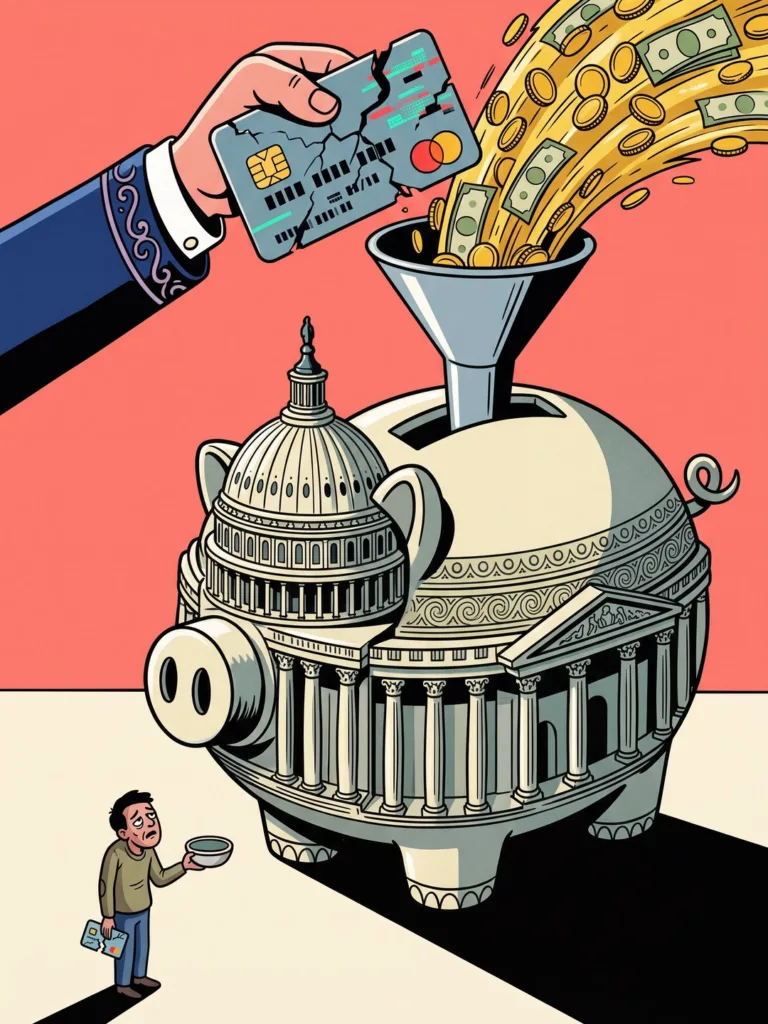
Personal data of 2.97 million customers was stolen in a hack at Lotte Card. The Financial Services Commission (the government agency that oversees financial companies) set a fine (money the government charges a company for breaking the law) of 5 billion won on July 31, 2026, the maximum the Credit Information Act allows for hacking. Separately, the Personal Information Protection Commission fined the company 9.62 billion won in March for violating personal data protection rules.
A bill to amend the Electronic Financial Transactions Act, which would raise the hacking fine cap to 3% of a company's total sales, has been submitted. As of the Nov. 19 report, the National Assembly's Political Affairs Committee (the standing committee in charge of financial policy) plans to take up the bill at its subcommittee next week. Many people read this news as: "Card companies will pay much more now, so victims will get more too." But the key point is different. Fines and victim payouts come from different pockets. Even if the fine cap rises, that money will not reach the bank accounts of customers whose data was stolen.
- Why did the fine stop at 5 billion won after 2.97 million people were exposed?
The Credit Information Act (the law that sets rules for how financial companies such as card firms handle customers' credit information) caps fines for data leaks at 3% of total sales as a general rule. But there is a condition. If a third party breaks in illegally, as in a hack, the fine can be no more than 5 billion won.
Lotte Card was exactly this case. The Financial Services Commission gave the company a 1.5-month business suspension (a ban on parts of its business, such as taking new customers, for a set period), the first such penalty for a hack. But the fine could not exceed the 5 billion won cap. Divide these 5 billion won among 2.97 million people, and each person gets about 1,700 won. Put simply, no matter how many customers are hit, a hacking fine cannot go above its set ceiling.
- How much would the cap rise at 3% of sales?
The law lawmakers want to change is not the Credit Information Act but the Electronic Financial Transactions Act (the law that sets rules for electronic payments such as card payments and internet banking). Article 46 of this law also allows fines of up to 5 billion won on companies that leak financial transaction information. The amendment, introduced by Rep. Yoo Dong-soo in November 2025, would widen the fine to cover hacking leaks of financial transaction or personal credit information, and raise the cap to 3% of total sales.
Assuming Lotte Card's 2024 sales were 2.7 trillion won, 3% comes to about 81 billion won (a BizWatch estimate; the figure depends on how sales are counted). Under this assumption, the cap would be about 16 times the current 5 billion won. However, a National Assembly review report said more work is needed to decide whether to count total sales or only sales related to the violation. If only related sales are counted, the cap could be lower than this.
- Why don't fines reach victims?
A fine is money a company pays the government for breaking the law, and all of it goes into the national treasury (the government's money pot for public spending). It flows from the company to the government, not from the company to victims. That is why critics have repeatedly asked, "My data was stolen, so why does the fine go to the treasury?" Rep. Lee Hae-min raised the same point at the National Assembly's briefing on July 28.
A traffic accident makes this easy to picture. A driver who runs a red light may pay a traffic ticket, but that money does not pay to fix your car. Repair costs have to come separately from the other driver's insurance or compensation. But card data leaks differ from car accidents: the harm is hard to see, so getting paid separately is harder.
In May 2026, the Personal Information Protection Commission decided to study a plan to pool fines into a fund (money set aside for a specific purpose) to support victims. As of May reports, the plan was still in a study stage through year-end. At the July 28 briefing, the commission said it was in talks to add a victim support plan to a fund run by the Ministry of Planning and Budget, but said direct payouts would be hard in reality. Under current law, there is no channel for fines to reach victims.
- Hacked customers have two ways to get money back
If fines are not theirs, where can victims get money? There are two routes.
The first is the company's own compensation. Right after the incident, Lotte Card said it would fully cover any unauthorized card use caused by this leak. You receive it only if your card was actually used without permission. If only your data leaked and no money was taken, the promise does not apply.
The second is a damages claim. Damages mean filing a lawsuit asking a court to make a company pay for losses it caused. The Personal Information Protection Act (the law that protects personal information) also allows punitive damages, which are payments above actual losses when a company leaks data intentionally or through gross negligence.
- Why do lawsuits pay out so little?
Even with punitive damages, the money people actually receive has been small. Under the Personal Information Protection Act, emotional distress payouts (compensation for mental harm) in data leak suits have been about 100,000 won per person, and critics point out that even with five times the amount, the maximum is only about 500,000 won.
On top of that, only people who take part in the lawsuit receive this payout. Among the 2.97 million customers, those who do not file suit get nothing.
- BITPRESS Insight
Raising the fine cap pushes companies to spend more on security. If the fine could reach 81 billion won, card firms would first pay for security measures that cost less than that. But this law does not put a price on information that has already been stolen.
In the end, victims' money comes from only two sources. One is the compensation the company offers on its own; the other is the damages you claim yourself. The bigger the fine news gets, the easier it is to expect "my share will grow too," but the two are recorded in different ledgers.
Here is a simple rule of thumb. In hacking news, the fine figure shows the size of the punishment the company faces, while the amount you can get depends on the company's compensation promise and your damages claim.
Sources
https://fnnews.com/news/202611191649163133
http://www.newstomato.com/ReadNews.aspx?no=1319415
https://www.dailian.co.kr/news/view/1711811
https://www.newsis.com/view/NISX20260731_0003732146
https://biz.sbs.co.kr/amp/article/20000325983
https://news.bizwatch.co.kr/article/finance/2025/09/22/0030
https://biz.sbs.co.kr/amp/article/20000309734
https://www.newstomato.com/ReadNews.aspx?no=1294170
https://www.newsis.com/view/NISX20260728_0003726799
Glossary
Fines — A fine the government charges a company for breaking the law. All of it goes into the national treasury, not to the people who were harmed.
Business suspension — A regulator's order that bans a company from parts of its business, such as taking new customers, for a set period.
Punitive damages — Damages set above the actual loss, imposed on a company that caused harm intentionally or through gross negligence.
Emotional distress payment — Compensation for mental harm. Critics say that in personal data leak lawsuits it has been set at about 100,000 won per person.
Bill review subcommittee — A small committee inside a National Assembly standing committee that goes through a bill's wording line by line. A bill must pass here before it moves on to the full committee meeting.
BITPRESS articles are information to help your investment decisions, not a recommendation to buy or sell any stock or coin. Investment decisions and their results are your own responsibility.





