News that Samsung Electronics is now more likely to supply HBM4, its next-generation high-bandwidth memory, to Nvidia has set the market abuzz. This is more than a simple parts supply deal; it is a major turning point that will show whether Samsung Electronics can regain leadership in the AI chip market. Here is an easy-to-follow rundown of why this news matters, how the HBM market landscape is changing and where Samsung Electronics stands today.
- What exactly are HBM and HBM4?
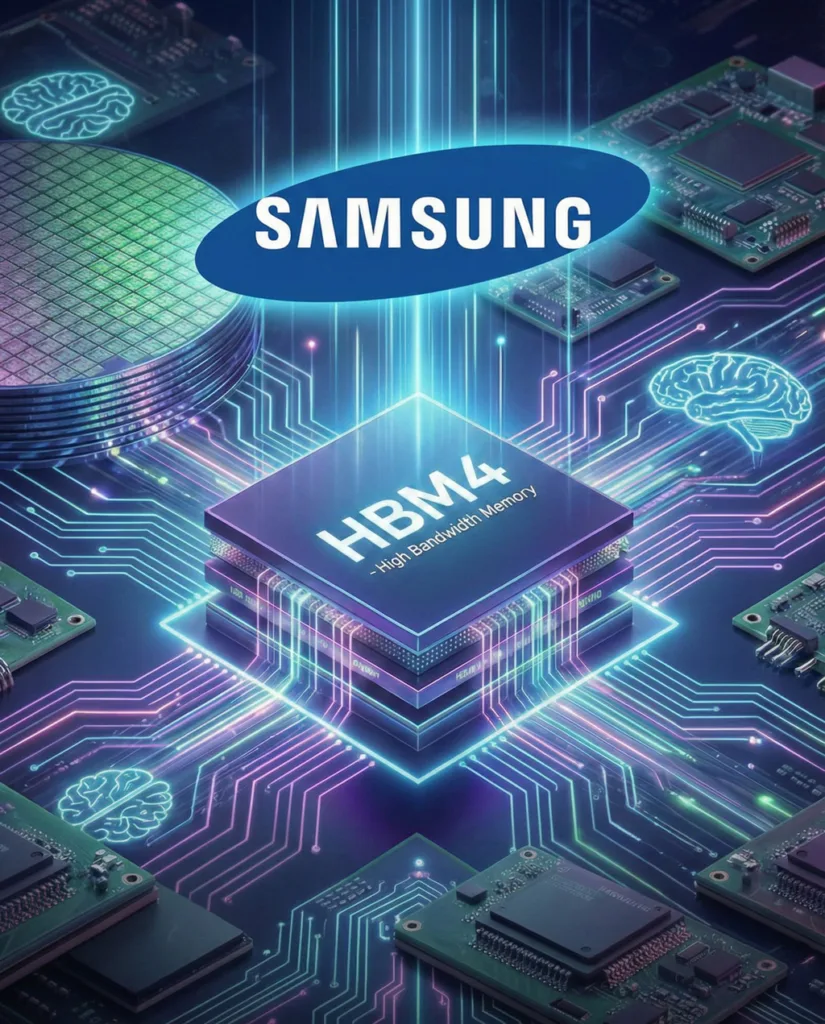
HBM stands for High Bandwidth Memory. Put simply, it stacks DRAM chips in multiple layers to dramatically widen the paths that data travels through. If conventional DRAM is a one-lane road, HBM is a highway with dozens of lanes, which makes it an essential component for AI chips that must process huge amounts of data at once. HBM4 is the sixth generation of HBM. The first generation was HBM, the second HBM2, followed by HBM2E, HBM3 and HBM3E, leading up to HBM4. HBM4’s biggest feature is that it applies a foundry process to the base die at the very bottom of the memory stack, adding computing functions. Previous generations focused only on storing and sending data, but from HBM4, custom functions can be built in to meet customer needs, making it far more technically demanding and valuable.
- Is this Samsung Electronics’ first time supplying HBM?
This is not Samsung Electronics’ first time making HBM. Samsung once showed off its technology by leading the HBM2 market. But in the third-generation HBM3 and fourth-generation HBM3E markets, where the AI boom really took off, it completely ceded leadership to rival SK hynix. That is because SK hynix effectively had a monopoly on supplying HBM3 for Nvidia’s graphics processing units (GPUs). At the HBM3 and HBM3E stage, Samsung Electronics struggled to pass Nvidia’s quality tests, a blow to its pride. So the HBM4 supply issue is not about whether Samsung is making HBM for the first time; it is a second attempt that will decide whether Samsung gets back in as a main supplier for the latest flagship products of its biggest customer, Nvidia.
- The market share war with SK hynix, and a third competitor
SK hynix is currently the overwhelming leader in the HBM market. In the HBM3 and HBM3E markets that dominate today, SK hynix takes most of Nvidia’s volume, while Samsung Electronics is playing catch-up as a latecomer. But the landscape could change in the HBM4 market, which takes off in earnest from 2025. That is because from HBM4 onward, foundry capability, meaning contract chip manufacturing, matters as much as memory technology. Samsung Electronics has the advantage of being an integrated chipmaker with both memory and foundry businesses. SK hynix, by contrast, is responding by working with its foundry partner, Taiwan’s TSMC. SK hynix is estimated to hold well over half of the market, but Samsung Electronics aims to use HBM4 to win a significant share of Nvidia’s supply and create a two-way race. Beyond these two, U.S.-based Micron has also jumped into HBM4 development, but it still trails the Korean companies in production capacity and yield, so the market is expected to remain a two-horse race between Samsung and SK hynix for now.
- Why this news is good for Samsung Electronics
Supplying HBM4 to Nvidia would be a strong signal that Samsung Electronics has passed technology validation. Until now, Samsung’s share price has struggled amid assessments that it was left out of the AI chip rally. If the HBM4 supply is confirmed, a sales channel for high-margin products will open, greatly improving the operating margin of its chip business. Securing Nvidia as a solid reference would also widen its chances to supply other Big Tech companies such as Google and Amazon. Above all, it carries great symbolic meaning: restoring its lost image as a technology leader and returning as a core player in the AI chip supply chain.
- Beyond HBM: Samsung’s other best-sellers
All eyes are on HBM, but other products are what fill Samsung Electronics’ coffers: enterprise SSDs (eSSDs) and commodity DRAM. As AI data centers multiply, demand for storing and retrieving data quickly has exploded, and orders for high-capacity eSSDs are pouring in. In particular, high-capacity eSSDs based on quad-level cell (QLC) technology are in such demand that Samsung can’t make enough of them, generating huge sales mainly from North American server companies. DDR5 DRAM, a long-time cash cow, is also seeing steady price increases and rising sales thanks to the server replacement cycle. If HBM is the growth engine of the future, eSSDs and DDR5 are the pillars that firmly support Samsung Electronics’ earnings today.
BITPRESS Insight
The key to the HBM4 supply issue is whether Samsung Electronics’ turnkey strategy has worked. Samsung’s unique weapon, the ability to handle both memory and foundry under one roof, finally has a chance to shine in the HBM4 era. Investors should watch not only for supply contract disclosures in the near term but also closely monitor Samsung’s production capability, that is, its yield: how reliably it can turn out products without defects. In the end, the contest will be decided by who can make chips cheaper, faster and in greater volume.