
On Oct. 8, US time, the Nasdaq Composite closed down 1.3% at 27,193.34, its biggest drop since mid-August. The slide deepened after a British business newspaper reported at midday that "OpenAI (the company behind ChatGPT) told investors its annualized revenue (revenue from a period stretched to a full year) was nearing $50 billion at the end of September." That is about $20 billion less than the $70 billion figure that had been circulating in the media.
At first glance it looks like a sign that the AI bubble is bursting, since an AI company earned less than expected. But the real point lies elsewhere. OpenAI's revenue did not shrink. What was wrong was the "$70 billion" expectation the market had set too high. When that expectation broke, shares of AI chip and data-center companies, whose revenue comes from the contract payments OpenAI makes, were shaken too.
- If revenue didn't fall, what went wrong?
Annualized revenue takes the revenue from a certain period and stretches it to a full year, for example by multiplying one month's sales by 12. Investors first estimated that OpenAI's annualized revenue had reached about $40 billion in August. Then, when OpenAI said it had "grown more than 70% since the third quarter began," they put that 70% straight on top of $40 billion, arriving at $68 billion to $70 billion.
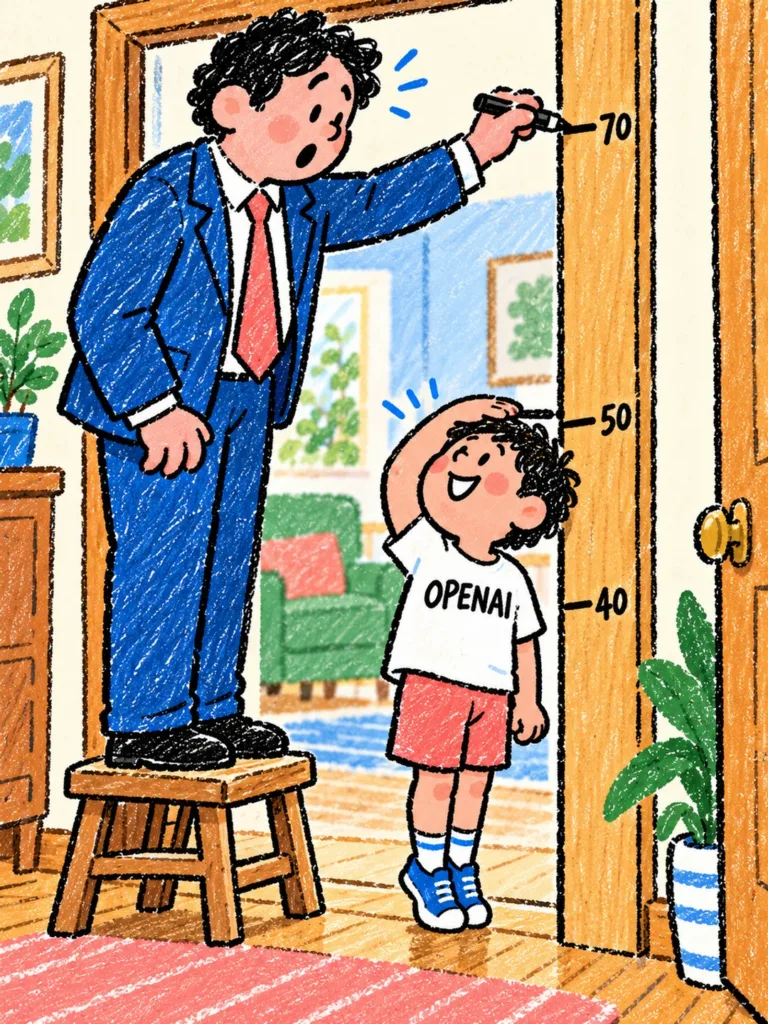
The problem was the starting point. The 70% was growth measured from July, but it was, in effect, stacked on an estimate that had already grown through August. The end-of-September figure that came out this time was about $50 billion. The gap between the two numbers did not come from falling sales. According to a person who saw the investor materials, OpenAI highlighted 77% annualized revenue growth in the third quarter, and 107% in its business-customer segment. Put simply, the child didn't shrink; the grown-ups had drawn the mark on the door frame too high in advance.
- Where did the $70 billion expectation come from?
There was a second reason for the $70 billion figure: a difference in counting. Rival Anthropic (the company behind the AI chatbot Claude) counts the full value of sales made through cloud companies such as Amazon and Google. OpenAI leaves out those partners' share. Anthropic's $65 billion in annualized revenue is counted that way, so it can't be compared directly with OpenAI's $50 billion.
Think of two restaurants that each sell a $15 chicken dinner through a delivery app. One records the full $15 the customer paid as revenue; the other records only what's left after the app's cut. They sold the same chicken, but their books show different numbers. AI companies' books are more complicated than this, though. Some investors added partners' share to OpenAI's figure to put the two companies on the same basis, and that is how numbers of $68 billion to $70 billion spread.
- Who fell harder on the Nasdaq?
The same day, the S&P 500 (an index of large US companies) fell 0.5% and the Dow (an index of major US blue chips) rose 0.1%. Chip and cloud companies fell harder. Oracle (a business-software and cloud company) dropped 5.5%, Broadcom (an AI chip company) 4.4%, and AI chipmakers AMD 3.9% and Nvidia 2.9%.
The Philadelphia Semiconductor Index (a gauge of US chip stocks) fell 3.4%. If you held $10,000 of Oracle stock, you lost about $550 in one day (a simple example). Still, higher oil prices and US Treasury yields at their highest level in decades also weighed on stocks that day. The index opened lower, and the decline deepened from midday, when the report came out.
- Why would a company that isn't even listed move other companies' stocks?
Oracle and CoreWeave (a company that rents out data centers for AI) have cloud-computing contracts with OpenAI. Nvidia and AMD also have business ties to OpenAI. The chain works like this: OpenAI's revenue needs to grow fast → so it can pay for its future computing contracts → and those payments become revenue for chip and data-center companies. When the number at the first link wobbles, the links after it come under suspicion too.
It has happened before. In late April, after a US newspaper reported that OpenAI had missed its sales and user targets, Oracle fell 4.1% and CoreWeave 5.8% on April 28. That report, citing unnamed people, also said OpenAI's chief financial officer had told colleagues internally she was worried the company might not be able to pay for future computing contracts if revenue didn't grow fast enough.
What's different from April is that this time the news was not about missing a target. Revenue grew; what was wrong was an expectation built from the outside. Even so, stocks moved in the same direction. "This has become a much narrower market that's dependent on the AI names to keep it afloat," said Ross Mayfield, investment strategist at the US investment firm Baird, adding, "There are going to be tremors throughout all of the related sub-industries."
- BITPRESS Insight
The people whose decisions change with this news are those holding US AI stocks such as Nvidia and Oracle, or Nasdaq funds heavy in them. Even if their own results stay the same, these companies can be shaken, as they were this time, when the numbers of a big customer that supports their sales change.
The number that shook the market this time was not one OpenAI had announced publicly. It was a high expectation built from stacking 70% on a $40 billion estimate and from matching a rival that counts differently. Because OpenAI has not yet gone public, its revenue comes out in pieces through investor materials and news reports, which leaves plenty of room for estimates to creep in.
There is one rule of thumb. When you look at an AI stock, look beyond the company's own results: ask who the customer paying the money is, and whether that customer's numbers were stated by the company itself or estimated by someone else.
Sources
https://finance.yahoo.com/technology/article/openais-annualized-revenue-20-billion-lower-than-prior-investor-estimates-174058048.html
https://finance.yahoo.com/markets/stocks/articles/openai-corrects-annualized-revenue-figure-183756345.html
https://krdo.com/money/cnn-business-consumer/2026/10/08/tech-stocks-drop-after-report-that-openais-revenue-is-lower-than-expected/
https://finance.yahoo.com/markets/live/stock-market-today-thursday-october-8-dow-sp-500-nasdaq-080537884.html
https://investing.com/news/stock-market-news/us-stock-futures-steady-after-nasdaq-slides-on-openai-revenue-concerns-4940052
https://www.taipeitimes.com/News/biz/archives/2026/04/29/2003856411
Glossary
Annualized revenue run rate — Revenue from a certain period stretched to a full year (e.g., one month's sales × 12), used to gauge the size of fast-growing companies.
Nasdaq Composite — An index of the stocks listed on the US Nasdaq exchange, with a heavy weighting in tech stocks.
Cloud-computing contract — A deal in which an AI company rents computers in a data center, paying usage fees instead of buying them.
Net revenue vs. gross revenue — Gross revenue is everything the customer paid; net revenue is what's left after a partner in the middle takes its share.
BITPRESS articles are information to help your investment decisions, not a recommendation to buy or sell any stock or coin. Investment decisions and their results are your own responsibility.