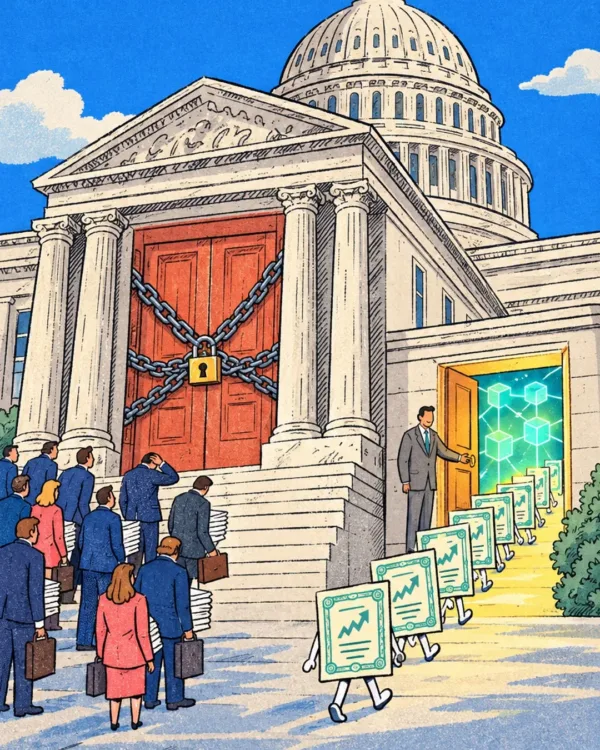
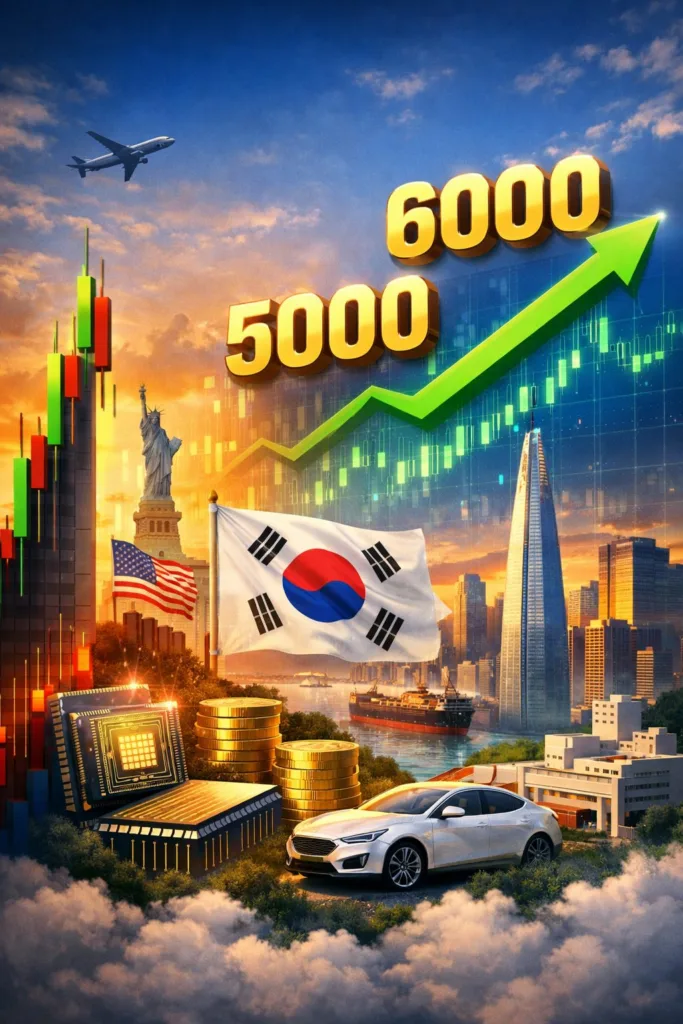
KOSPI breaking 5,000 and entering territory where 6,000 can be discussed is better seen not as a simple technical rally but as the result of three things overlapping: “eased global risk triggered by Trump’s tariff reversal + the Lee Jae-myung government’s KOSPI 5,000 pledge becoming reality + a fundamentals-based rally built on chip and auto earnings.” As long as this combination holds, the Korean market can be read as having upside open all the way to a 6,000-point discussion over the medium term, even if a short stretch of fatigue comes.
KOSPI breaks 5,000: what was the trigger
- On Jan. 22, KOSPI topped 5,000 points intraday, climbing to a high of about 5,019.
- It extended its rally after breaking 4,000 three months earlier, and is up more than 90% from just a year ago.
- The direct catalyst was the easing of the Greenland standoff, along with President Trump withdrawing his planned 10% tariffs on eight European countries (Denmark, Norway, Sweden, Germany, France, the U.K., the Netherlands and Finland) and shifting to rule out the use of military force.
- With tariff and military risks switched off at once, U.S. stocks rebounded across the board, and that warmth passed straight to Korean large caps, lifting KOSPI up a level.
The Lee Jae-myung government’s “KOSPI 5,000” pledge: when and how it came about
- Since his presidential campaign, President Lee Jae-myung has publicly vowed to resolve the “Korea discount” and open the era of KOSPI 5,000.
- In April 2025, as the leading presidential contender, he promised to “double the KOSPI and open an era above 5,000 points,” repeatedly stressing the goal of reducing the concentration of wealth in real estate and making the stock market a trustworthy way to build assets.
- After taking office, he reportedly reaffirmed his commitment to the “KOSPI 5,000” pledge at meetings such as one with brokerage research heads in the second half of 2025, saying he would push a package of measures including better corporate governance at listed companies, more dividends, an overhaul of short-selling rules and stronger protection for retail investors.
- In other words, this breakthrough of 5,000 is highly symbolic because it was less a chance market rally than “an event in which an index target presented as a campaign pledge was realized as policy, earnings and the global environment came together.”
After breaking 5,000, is the upside open
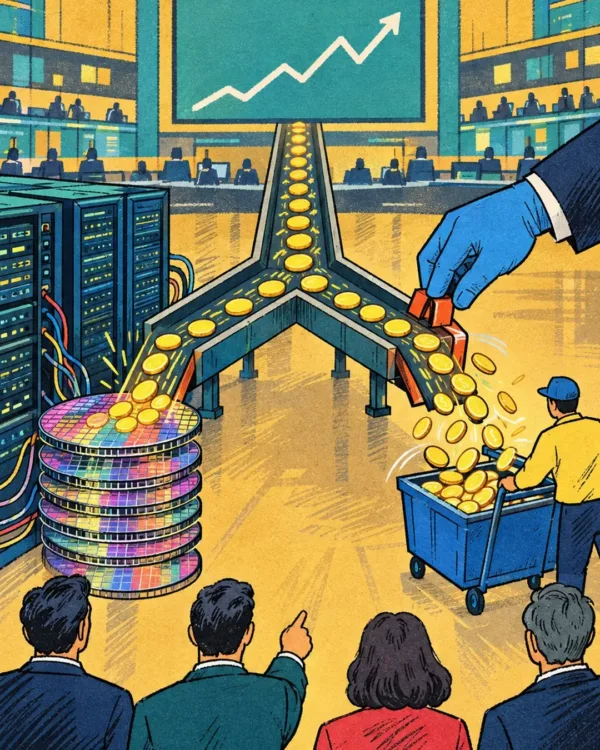
- The direct force behind 5,000 is improving profits at large caps, including Samsung Electronics and SK hynix riding chip and AI demand, and Hyundai Motor Group with its robotics and EV story.
- In particular, as demand for AI servers, HBM and foundry services shows up in earnings, profit estimates for the chip sector are being raised, creating a structure where the index level is supported by earnings growth rather than a “valuation bubble.”
- Add the government’s policies to resolve the Korea discount and a stronger shareholder-friendly push for bigger dividends and share buyback cancellations, and a P/E re-rating alone could reset the index’s upper range.
- With tariff and Greenland risks temporarily calmed, if U.S. stocks keep up an earnings-driven market and global liquidity is not pulled back sharply, the market may come to see “the mid-4,000s to low 5,000s as the new floor of the trading range” rather than “5,000 as the peak.”
What else is needed to talk about 6,000
- To treat the 6,000 range as a realistic scenario, two pillars are needed.
- If the Lee Jae-myung government pushes through, as pledged, stronger board accountability at listed companies, expanded minority shareholder rights, tough penalties for unfair trading and stock manipulation, and tax incentives for dividends and share cancellations, a “policy premium” could attach to valuations as a constant.
- Even if U.S.-driven tariff and Greenland risks flare up again, a market that has already hit 5,000 once carries the memory of rebounding after corrections, making a strategy of “adding Korean large caps on dips” more persuasive for foreign investors.
BITPRESS Insight
Brokerage reports from the KOSPI 5,000 breakout (as of Jan. 22) show room for fundamental upside in Samsung Electronics, SK hynix and Hyundai Motor.
Consensus targets: Samsung Electronics KRW 160,000–180,000 (currently 140,000), SK hynix KRW 800,000–900,000 (currently 764,000), Hyundai Motor KRW 490,000–580,000 (currently 569,000), confirming 10–25% upside.
Structure your investment approach as follows:
- 1. Reconfirm the fundamental upside: Verify earnings upgrades (Samsung foundry, SK HBM, Hyundai robotics) through IR materials and consensus.
- 2. Prepare for short-term profit-taking: Against selling after sharp gains, use regular fixed-amount buying(DCA¹) to lower your average cost.
- 3. Adjust to market conditions: Adjust weightings while monitoring interest rates, exchange rates, tariffs and policy (resolving the discount).
¹Regular fixed-amount buying (DCA): buying a fixed amount at regular intervals to spread out volatility.
This strategy captures leading-stock growth and policy effects amid index swings and secures steady returns.