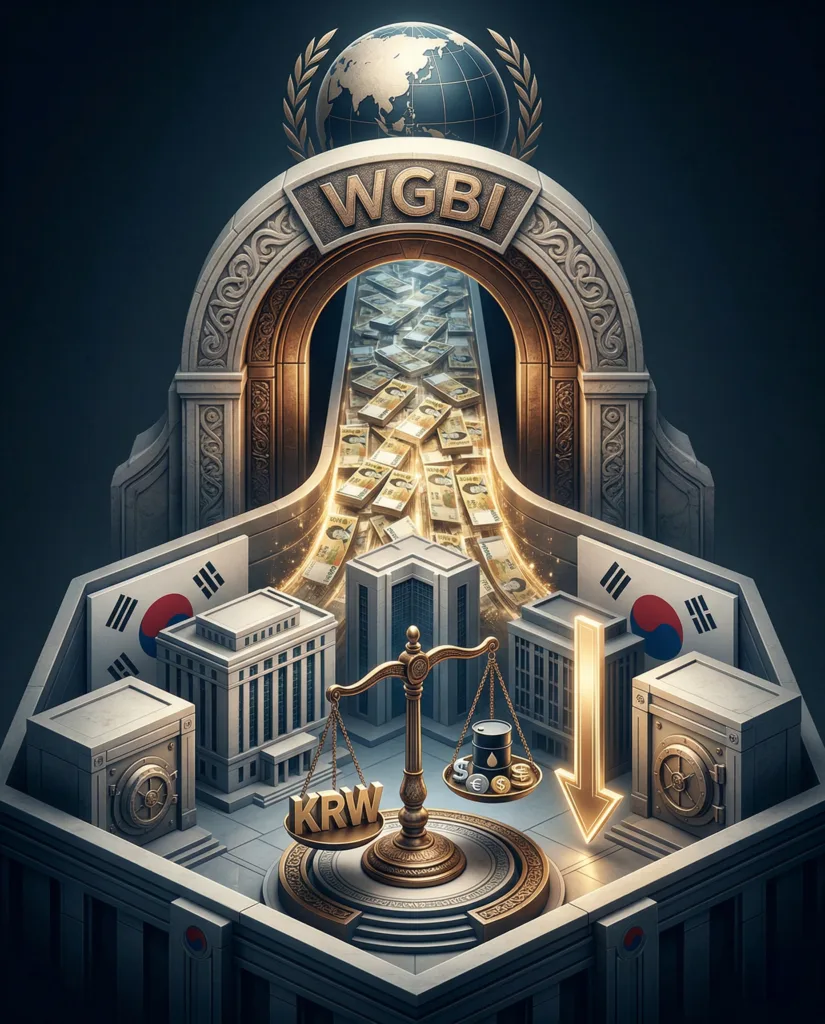
On April 1, 2026, Korean government bonds officially joined the World Government Bond Index (WGBI). It came after four attempts and nearly 15 years of preparation. The government expects the inclusion to bring up to KRW 90 trillion in foreign money into the domestic bond market. But it is worth asking what exactly the WGBI is, why it matters, and whether reality is as rosy as the expectations.
What is the WGBI?
WGBI stands for World Government Bond Index. Compiled by the UK’s FTSE Russell, it is a global government bond benchmark and, along with the Bloomberg Barclays Global Aggregate Index (BBGA) and the JPMorgan Government Bond Index-Emerging Markets (GBI-EM), is considered one of the world’s three major bond indexes.
※ Benchmark index: an index used as the standard for comparing and measuring investment performance. Institutional investors build their portfolios around it.
It currently includes government bonds from 26 advanced economies, including the U.S., Japan, Germany, the UK, France and China. The key is the amount of money tracking the index. Institutional money worldwide that tracks the WGBI is estimated at about $2.5 trillion to $3 trillion, or roughly KRW 3,500 trillion to 4,000 trillion. Major pension funds, central banks and large asset managers around the world use this index as their benchmark when building bond portfolios.
What inclusion means is simple. Once a country’s government bonds enter the WGBI, institutions that track the index are required to buy those bonds in line with their weight in the index. This creates a structure in which so-called ‘passive money’ flows in automatically.
※ Passive money: money managed by tracking a market index as it is. Managers don’t pick individual securities; they buy and sell automatically according to the index weights.
Why did it take 15 years?
Korea’s push to join the WGBI goes back further than you might think. The need for inclusion was raised as early as the early 2010s, and Korea was officially put on FTSE Russell’s watch list in September 2022, but it failed three times in a row, in March 2023, September 2023 and March 2024. Then, on Oct. 8, 2024, on its fourth attempt, its inclusion was confirmed.
The reason for the repeated rejections is clear. The WGBI has three main requirements: the amount of government bonds outstanding, the sovereign credit rating, and market accessibility. Given the size of its economy and its credit rating, Korea had little trouble meeting the first two. The problem was market accessibility.
For foreign investors, Korea’s bond market had high barriers to entry. Buying government bonds required opening a separate local account, and the foreign exchange market closed at 3:30 p.m., out of step with global trading hours. Settlement was also inconvenient. FTSE Russell repeatedly pointed this out and held off on inclusion until the Korean government addressed it.
From the first half of 2024, the government overhauled the system in earnest. In June 2024, it launched an omnibus account for government bonds so foreigners could invest through international central securities depositories (ICSDs) such as Euroclear and Clearstream without opening a local account. From July, it extended the closing time for won-dollar trading in the Seoul foreign exchange market all the way to 2 a.m. the next day. These improvements changed FTSE Russell’s assessment, and inclusion was confirmed on the fourth attempt. In other words, Korea hadn’t been ‘shut out’; it simply ‘hadn’t yet met all the requirements.’
How much money is actually coming in?
Korea’s weight in the index is about 1.89–2.08%. It starts at 0.24% in April and rises in monthly steps, reaching about 1.89% when inclusion is complete in November 2026. Applying that weight to $2.5 trillion in WGBI-tracking money gives an estimated $47.2 billion to $60 billion, or about KRW 70 trillion to 90 trillion, flowing in gradually over eight months from April to November. That works out to roughly KRW 8.5 trillion to 9.5 trillion coming in mechanically each month.
The weight of these numbers becomes clearer next to past data. Foreign bond inflows have topped KRW 50 trillion in a year only twice: KRW 63.9 trillion in 2021 and KRW 70.2 trillion in 2025. If WGBI-driven inflows go as expected, there is a good chance of an annual record above KRW 75 trillion for the first time ever.
Who is investing matters too. Most WGBI-tracking money comes from long-term institutional investors such as pension funds, central banks and large asset managers. That is different from hot money that chases short-term gains and quickly pulls out. Even after inclusion is complete, it creates a base of long-term demand that structurally has to keep holding Korean government bonds.
The impact on exchange rates and interest rates
The reason these inflows help stabilize the exchange rate lies in the currency conversion mechanism. Foreign institutional investors hold dollars. To buy Korean government bonds, they have to convert dollars into won. In the process, the supply of dollars rises and demand for won increases, easing the pressure from a strong dollar, that is, a rising won-dollar exchange rate.
On April 1, the first day of WGBI inclusion, government bond yields reacted immediately. The 3-year yield fell 8.7bp from the previous trading day to 3.465% a year, and the 10-year yield dropped 8.4bp to 3.795%.
※ bp (basis point): a unit of interest rate change. 1bp = 0.01 percentage point, so 8.7bp means a drop of about 0.087 percentage points.
Lower rates have significant ripple effects. The interest cost the government pays when it issues bonds goes down. So does the cost for companies to issue corporate bonds or take out loans. If market rates stabilize at lower levels across the board, some of the burden on households can ease as well.
It isn’t all upside
The changes WGBI inclusion brings can’t be seen as purely positive. Market experts raise these main concerns.
First, the effect is temporary. Once the eight-month phased inclusion is complete, the mechanical buying pressure from passive money ends too. Shinhan Securities said that “the rate-stabilizing effect of WGBI inclusion will be limited to the inclusion period,” and analyzed that the drop in rates could reverse toward year-end.
Second, external variables could overwhelm the WGBI effect. Korea’s economy is currently exposed to a mix of macro risks: rising oil prices in the wake of the U.S.-Iran war, fears of reignited inflation and a weak won. The Hyundai Research Institute said that “WGBI inclusion can help stabilize the exchange rate somewhat, but interest rates and the exchange rate will depend more on how the Middle East war unfolds.” Many experts think WGBI inclusion is more likely to act as a ‘buffer’ that restrains rising rates than as a ‘game changer.’
Third, if the won stays weak, Korea’s weight in the index could actually shrink. Index weights are calculated by converting bond amounts into dollars, so if the won-dollar exchange rate spikes, the dollar value of Korean government bonds falls, which can lead to a smaller weight in the index. Eugene Investment & Securities warned that “if the won weakens further, the index weight could fall into the 1% range.”
Fourth, some point out that the risk of capital outflows grows structurally. As more foreign money flows in, the chances that shocks in global financial markets spread to the domestic market faster and harder also rise.
Lessons from other countries
WGBI inclusion doesn’t automatically guarantee economic success. After Israel joined in April 2020, its foreign direct investment (FDI) rose more than 30% in three years and the shekel gained value. But in Israel’s case, strong economic fundamentals, such as the rise of high-tech startups and a current account surplus, were also behind it.
South Africa, by contrast, joined in 2012, but a string of sovereign credit rating downgrades completely wiped out the benefits of WGBI inclusion, and it was eventually removed in 2020. The exchange rate, around 6 to 7 rand per dollar at the time of inclusion, shot up to 18 rand. What decided the outcome was not inclusion itself, but how steadily the economy’s fundamentals were maintained afterward.
BITPRESS Insight
This WGBI inclusion means Korea’s bond market has officially joined the ranks of advanced markets. It is the starting point of a structural change that eases the so-called ‘Korea discount’ and broadens the global investor base over the long term. But experts agree it should be seen less as a short-term fix and more as an opportunity to build long-term trust.
iM Securities explained that “actual WGBI inclusion will prime the pump for better supply and demand, but external conditions such as the war are too negative for it to immediately drive a sharp fall in rates or a stable exchange rate,” adding that “it is reasonable to read it as a structural floor that broadens the base of the won bond market over the long term.”
WGBI inclusion is not ‘the end’ but ‘the beginning.’ For this structure to work, it needs steady support from institutional trust and economic fundamentals that let foreigners trust the Korean market and stay for the long term. Money coming in and money staying are two different things.
Sources
https://www.ajunews.com/view/20260401143026967 https://www.newspim.com/news/view/20260331000163 https://www.khan.co.kr/article/202603291606001 https://www.dt.co.kr/article/12054722 https://biz.heraldcorp.com/article/10708321 https://www.fnnews.com/news/202604011019148951 https://m.joseilbo.com/news/view.htm?newsid=527293 https://kbthink.com/main/economy/issue_and_news/KB-reads-issue/2024/KB-reads-issue-241010.html https://www.g-enews.com/article/General-News/2025/10/202510080835545501e30fcb1ba8_1