



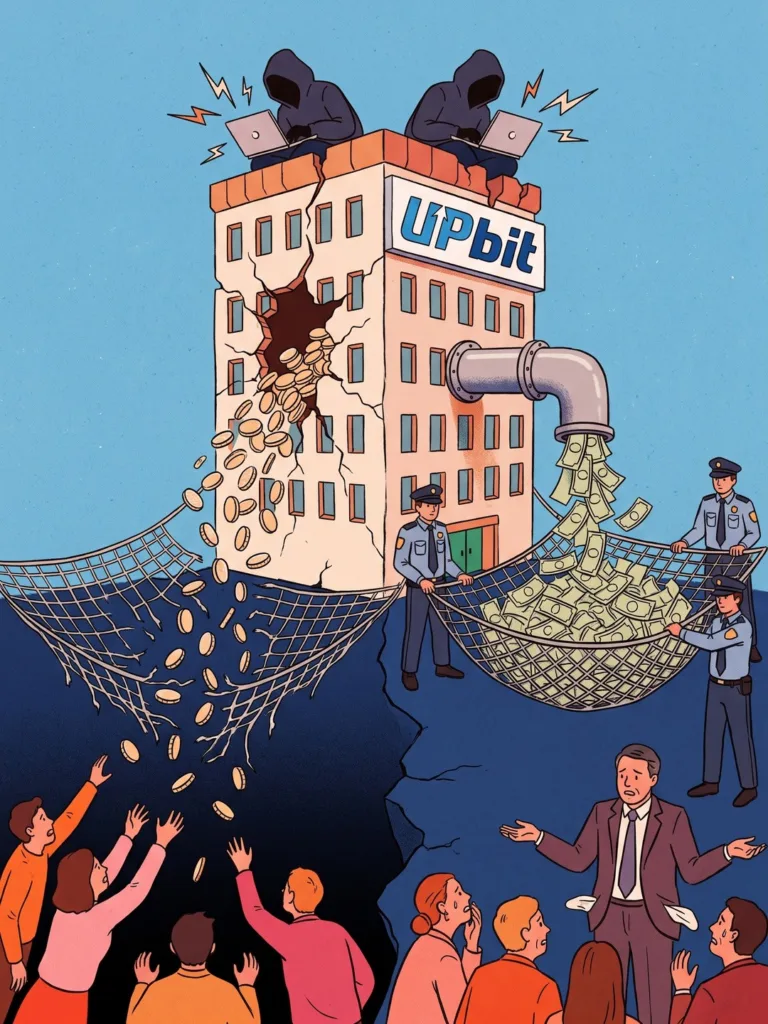
In the early hours of November 27, 2025, about $33 million (44.5 billion won) of Solana-network coins left Upbit's hot wallet (the internet-connected wallet used for deposits and withdrawals) and went to a wallet no one recognized. Of the $33 million taken, about $29 million belonged to customers, and Upbit said it would cover all of that from its own assets.
Many people conclude that money left with a big exchange will be protected in the end. But the safeguards for cash and for coins held at an exchange are different, and no law yet requires an exchange to cover hack losses.
- Is cash left at an exchange covered by deposit insurance?
No. The deposit insurance law protects money placed with financial firms the law names, such as banks, insurers and savings banks, and crypto exchanges are not among them. Bank deposits have been protected up to about $75,000 since September 1, 2025, but cash in an exchange account carries no such promise.
Instead, the Virtual Asset User Protection Act, in force since July 19, 2024, created a different safeguard. An exchange must keep customers' cash (the deposit balance) at a bank, apart from its own money. The law bars anyone from seizing that money or offsetting it against debts (cancelling what two parties owe each other), so even someone the exchange owes money cannot touch it.
Think of the escrow payment on a secondhand marketplace. The money is held by a middleman, not the seller, so it stays put even if the seller disappears. What comes back, though, is the very cash you deposited; no other agency steps in to repay you, as deposit insurance would.
- If the exchange goes bankrupt, the bank pays your cash back directly
The law says that if an exchange goes bankrupt or its registration is cancelled, the bank holding the deposits must pay each customer first, on that customer's claim. The bank announces when and where it will pay in newspapers and on its website, then pays customers directly.
- Why are coins treated differently?
The bank repayment scheme covers cash only, not the coins themselves. Coins are not deposited at a bank; the exchange holds them itself. The law requires an exchange to keep customers' coins separate from its own, but it names no one to hand the coins back if the exchange fails.
So the law puts its weight on preventing accidents. An exchange must keep at least 80% of its customers' coins in cold wallets, which are disconnected from the internet. The rest sits in hot wallets, and for those it must buy insurance or set up a reserve (money set aside for accidents) worth at least 5% of their value.
If a hot wallet holds $75 million of coins, insurance or a reserve of $3.7 million is enough. That is a minimal cushion, not enough to cover a major theft.
- Who said they would cover the losses after a hack?
Upbit has been hacked twice. On November 27, 2019, 342,000 Ether (about $43 million at today's exchange rate) left its hot wallet, and Upbit said it would cover the loss from company assets. Six years later, after a hack on the same date, it again said it would cover customers' losses the same way.
Of the roughly $29 million customers lost in 2025, about $1.7 million, a little over 6%, was frozen. On November 21, 2024, police said North Korean hackers were behind the 2019 theft, but the only amount recovered, confirmed as Upbit's with Swiss prosecutors and police, was 4.8 bitcoin.
The problem is that this promise is not a legal duty. The Virtual Asset User Protection Act has no rule on what liability an exchange bears, or how far it extends, when coins are stolen in a hack. The Electronic Financial Transactions Act, which in principle makes financial firms cover hack losses even when they were not at fault (no-fault liability), does not apply to crypto exchanges either.
- If an exchange collapses outright, what do customers get?
FTX, then the world's third-largest crypto exchange, went bankrupt in November 2022 and has generally been repaying customers 118% to 142% of the value of their holdings at the time of the collapse (as of March 2026 reports). It has been criticized, though, for not paying back in the original coins.
Even 118% leaves customers worse off because the benchmark is the price at the bankruptcy filing. Bitcoin was $16,080 then, and about $62,675 on May 7, 2024, when the repayment plan became known. Someone who held 1 bitcoin gets about $19,000 even at 118%, and misses the gain in between.
- Will exchange liability be written into law?
After Binance, the world's largest crypto exchange, was hit by a hack of about $6 billion and said it had covered roughly 95% of the resulting customer shortfall with company funds and a user protection fund, calls grew in Korea to write exchange responsibility into law.
Lawmakers' bills with damages provisions are pending before the National Assembly's Political Affairs Committee, and one by Rep. Park Sang-hyuk puts the burden of proof for damages (the duty to show who was at fault) on the exchange. Financial regulators are also considering no-fault liability, which would make exchanges cover losses even without fault. Unlike today's user protection act, which has no compensation rule, the Digital Asset Basic Act, watched to see whether it will include one, is still being prepared by the government. Until the law changes, hack losses on coins are made good only if the exchange decides to cover them from its own assets.
- BITPRESS Insight
The cash and the coins shown side by side in an exchange app are protected by different parties. Cash is held separately at a bank, so the law provides a way for the bank to pay it back even if the exchange fails. For coins, the law sets only how they are stored, and after an accident everything depends on whether the exchange covers the loss from its own assets.
So Upbit's two pledges to cover losses should be read not as legal protection but as a statement that the company can afford to.
Cash at an exchange is protected by the bank; coins are protected by whether that exchange can cover a loss from its own assets.
Sources
https://casenote.kr/법령/가상자산_이용자_보호_등에_관한_법률
https://fsc.go.kr/no010101/83127
https://www.bokjiro.go.kr/ssis-tbu/cms/pc/news/promotion/1308414_1118.html
https://view.asiae.co.kr/article/2024062519442063637
https://zdnet.co.kr/view/?no=20231211170225
https://news.bizwatch.co.kr/article/mobile/2024/07/24/0010
https://mobile.newsis.com/view/NISX20251128_0003421862
https://byline.network/2025/11/1127/
https://www.newsis.com/view/NISX20241121_0002967631
https://www.itworld.co.kr/article/3555943/
https://zdnet.co.kr/view/?no=20261103125608
https://biz.heraldcorp.com/article/10922679
https://www.straightnews.co.kr/news/articleView.html?idxno=314572
https://okcfox.com/news/nation-world/ftx-returns-money-to-most-customers-less-than-2-years-after-catastrophic-crypto-collapse-ceo-changpeng-zhao-cryptocurrency-exchange-creditors-proprietary-investments
https://www.theblock.co/news/business/2026-03-18-ftx-distribute-2-2-billion-creditors-march-31-394237
Glossary
Customer deposits — Cash you put into an exchange account to buy coins; by law it is held at a bank, not by the exchange.
Hot wallet — A coin wallet connected to the internet and used for everyday deposits and withdrawals; convenient, but a target for hackers.
cold wallet — A coin wallet kept offline, hard to reach from outside and used for long-term storage.
Set-off — Cancelling what two parties owe each other; it is barred for deposit balances held at the bank.
No-fault liability — Responsibility to cover the losses from an accident even if the company did nothing wrong.
BITPRESS articles are information to help your investment decisions, not a recommendation to buy or sell any stock or coin. Investment decisions and their results are your own responsibility.





