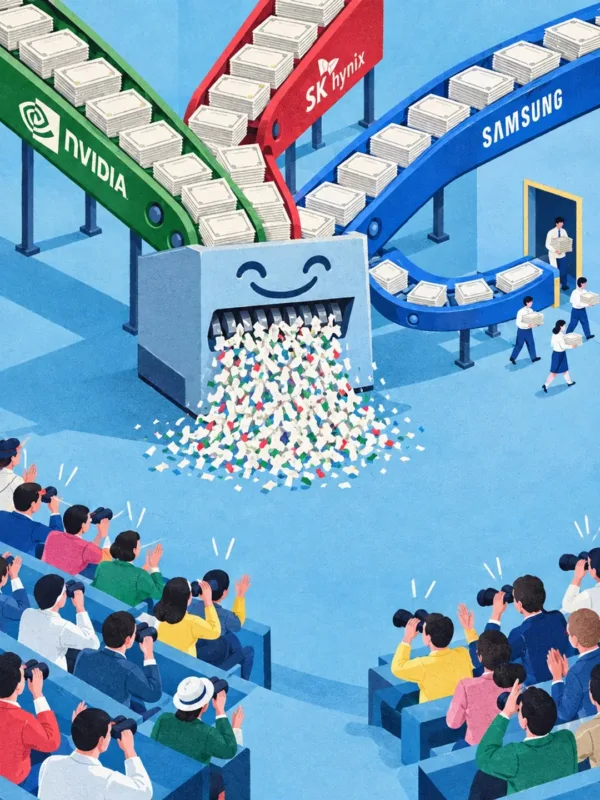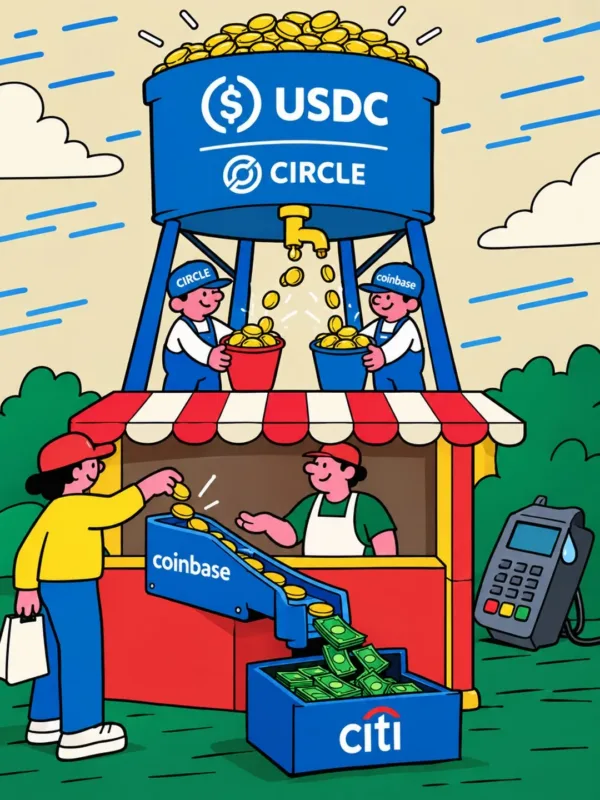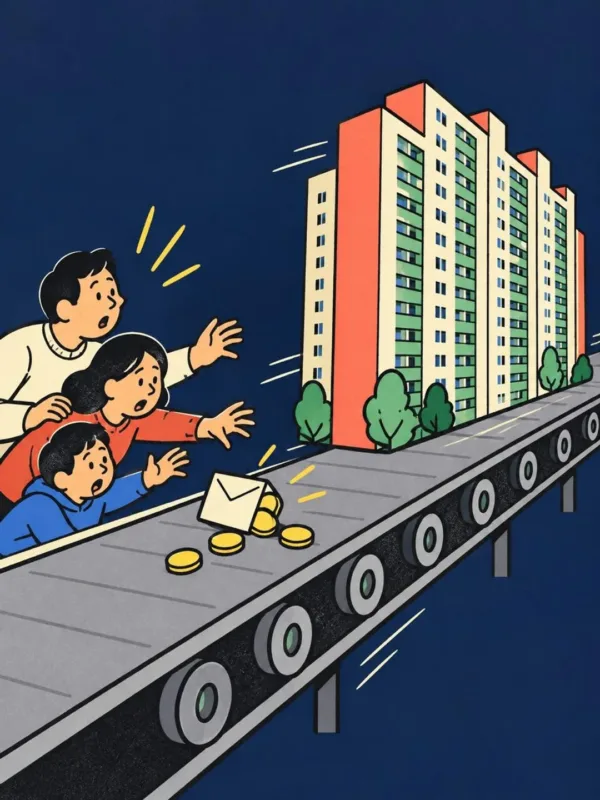
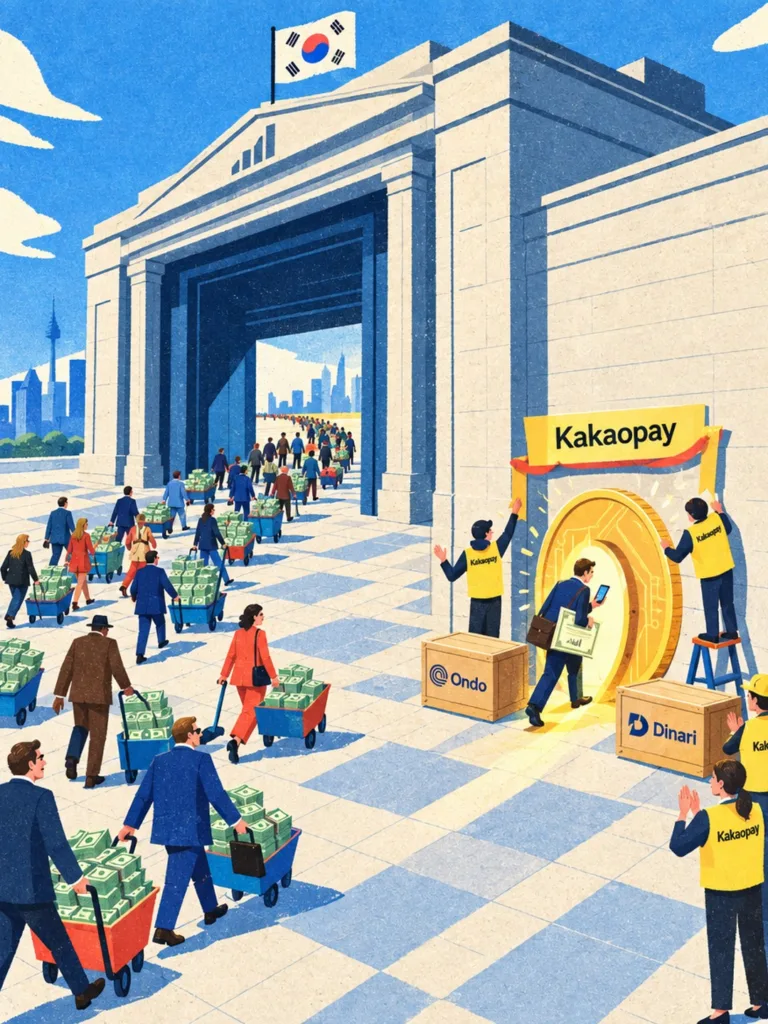
On Sept. 29, foreign investors made net sales of KRW 3.08 trillion (about $2.27 billion) of stocks on the KOSPI in a single day (the amount sold minus the amount bought, excluding the KOSDAQ). The same day, Kakaopay Securities, the brokerage arm of Korea's Kakao group, said it had signed a memorandum of understanding (MOU) with US tokenization firm Dinari, a day after signing one with Ondo Finance on Sept. 28. Both companies turn US stocks into tokens and distribute them to overseas investors. The agreements are about jointly researching a structure that would turn Korean-listed stocks into tokens on a blockchain (digital receipts tied to one share each) and distribute them to overseas investors.
At first glance, it looks like a brokerage signing a deal to ride the crypto trend. But the point is to test whether a 'new door' is possible, one that lets foreigners buy Korean stocks without a Korean account. That door matters to Korean stock investors because of foreign flows. On Sept. 29, individuals made net purchases of KRW 1.5 trillion, yet the KOSPI fell 0.27% as foreigners made net sales of KRW 3.08 trillion. That leaves one question: how much foreign money could come in through this door?
- Researching a structure with real Korean shares behind each token
Here is the structure under study. Once Kakaopay Securities sets up a way to source underlying Korean-listed shares through an omnibus account (a single account that pools orders from many overseas investors), the partners will examine whether a structure in which tokens are issued and redeemed 1:1 against those shares can work for Korean-listed stocks. It is not a settled structure yet; it is what the proof of concept will test.
Think of it like a gold warehouse receipt: there has to be gold in the vault before a receipt can be issued. But shares come with dividends and voting rights, so how to carry those rights over to the token is also part of the research. Dinari CEO Gabe Otte proposed a model that uses actual Korean-listed shares as the underlying assets, rather than tokens that merely track their prices.
- The two firms play different roles
Dinari is a transfer agent (a firm that keeps a company's shareholder register) registered with the US Securities and Exchange Commission (SEC). It runs dShares, which offers 724 US stocks and ETFs as tokens, in more than 85 countries and regions. With Kakaopay Securities, it will run a proof of concept (PoC, a small-scale test of whether something actually works).
Ondo Finance expanded from tokenized US Treasuries into stocks. Deposits in Ondo Stocks, its tokenized US stocks and ETFs, passed $1 billion this May. This agreement focuses first on setting up a framework to source and hold Korean shares. Kakaopay Securities plans to form joint task forces with each of the two firms within the year.
- Why this deal, and why now
At a press briefing in July, Kakaopay Securities said it would build a 'K-stock global gateway' with Siebert Financial of the US so that US retail investors could trade Korean stocks. Since signing an MOU in May, the two companies have also been exploring tokenizing Korean stocks and 24-hour trading to bridge the time difference between Korea and the US.
The rules have moved too. According to foreign media reports, Korea's National Assembly passed amendments in January that recognize distributed ledgers (blockchain records) as securities registers and allow token securities to be issued and traded, with the framework scheduled to take effect in February 2027. Still, whether and when tokenized stocks will be launched has not been decided. That will depend on the proof-of-concept results, domestic and overseas regulations, and the policy direction of financial regulators. In other words, without regulators' approval, no tokens will be issued.
- By the numbers, the door is still narrow
The global tokenized stock market was worth about $3.2 billion at the end of September, according to data firm RWA.xyz (based on tokens actually distributed to investors). Most of that is US stocks such as Nvidia and Tesla, and US ETFs; there are no Korean stock tokens yet. At the Sept. 29 exchange rate of KRW 1,356.7 per dollar, that is about KRW 4.3 trillion.
Put simply, there are no Korean stock tokens yet, and the entire global tokenized stock market, mostly US stocks, adds up to only about 1.4 times foreigners' net KOSPI selling on a single day (KRW 3.08 trillion). The token figure is an outstanding balance, while net selling is one day's flow, so the two are different in nature. Still, when the whole world's balance is about the size of one day of selling in Korea, this door is still small.
- The door opened in 2017, but went unused for years
Korea introduced omnibus accounts for foreign investors in 2017. But because overseas brokers had to report each end investor's trades right after settlement, no one used them. In December 2023, Korea scrapped its foreign investor registration system and eased reporting to once a month. After those rules were eased, brokerages stepped up competition in 2026 to offer omnibus account services with overseas financial firms (as reported in July 2026).
Lowering the barrier brought more accounts. According to a review by the Financial Services Commission, 1,432 foreign accounts were opened with passports or corporate identifiers in the six months after registration was scrapped (Dec. 15, 2023 to June 12, 2024): 1,216 by companies and 216 (about 15%) by individuals. The FSC said openings reached 300-400 a month from March 2024, compared with an average of 105 foreign investor registrations a month in 2023, and judged that access had improved.
Still, most of the new accounts belonged to companies. This deal takes a different direction. Instead of bringing individual foreign investors to Korean brokerages, it explores putting Korean stocks into the token apps and wallets foreigners already use.
- BITPRESS Insight
Will more foreign money come in? The answer has two layers. There are no Korean stock tokens yet, and even the entire global tokenized stock market is only about 1.4 times foreigners' net KOSPI selling on a single day, too small to change short-term flows. But if the product launches and underlying shares are sourced 1:1, every token issued would require buying the real shares first, so overseas token demand could turn into actual buy orders in the Korean market.
So if this business becomes real, the battleground is distribution more than technology. How often Korean stocks show up on the app screens of overseas individuals who have no Korean account could determine how many underlying shares get bought.
The rule of thumb fits in one line. Read stock-token news not by how many stocks were turned into tokens, but by how many real Korean shares are piled up behind those tokens. That number appears in brokerage and issuer disclosures.
Sources
https://www.mt.co.kr/stock/2026/09/29/2026092916273597892
https://cointelegraph.com/news/kakaopay-securities-dinari-ondo-tokenized-korean-stocks-push
https://m.sedaily.com/article/20096085
https://www.newspim.com/news/view/20260929000900
https://www.ajunews.com/view/20231213180737906
https://fsc.go.kr/no010101/82508
https://m.news.nate.com/view/20260712n14295
Glossary
Tokenization — Moving ownership of a real asset, such as a stock, onto a digital token on a blockchain so it can be bought and sold.
Omnibus account — A single account in which one overseas broker pools and trades orders from many foreign investors, so the investors do not need their own accounts at a Korean brokerage.
Underlying shares — The actual shares listed on the Korea Exchange, not a token or a depositary receipt.
Transfer agent — A firm that keeps the shareholder register on a company's behalf, recording who owns how many shares.
Proof of concept (PoC) — A small-scale test to see whether an idea actually works.
BITPRESS articles are information to help your investment decisions, not a recommendation to buy or sell any stock or coin. Investment decisions and their results are your own responsibility.