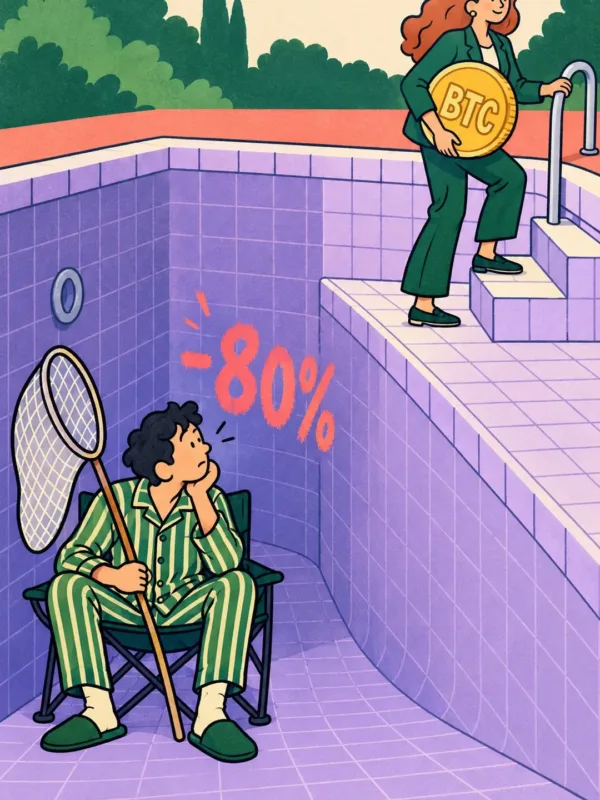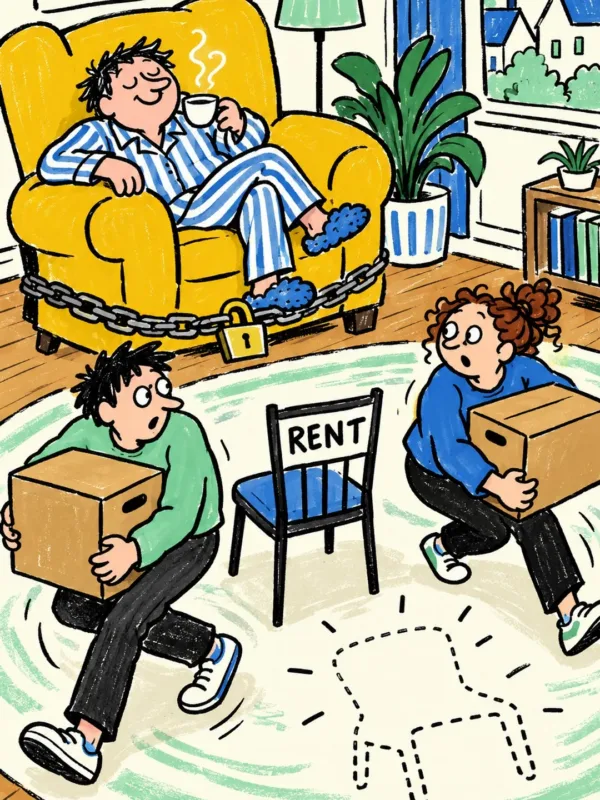
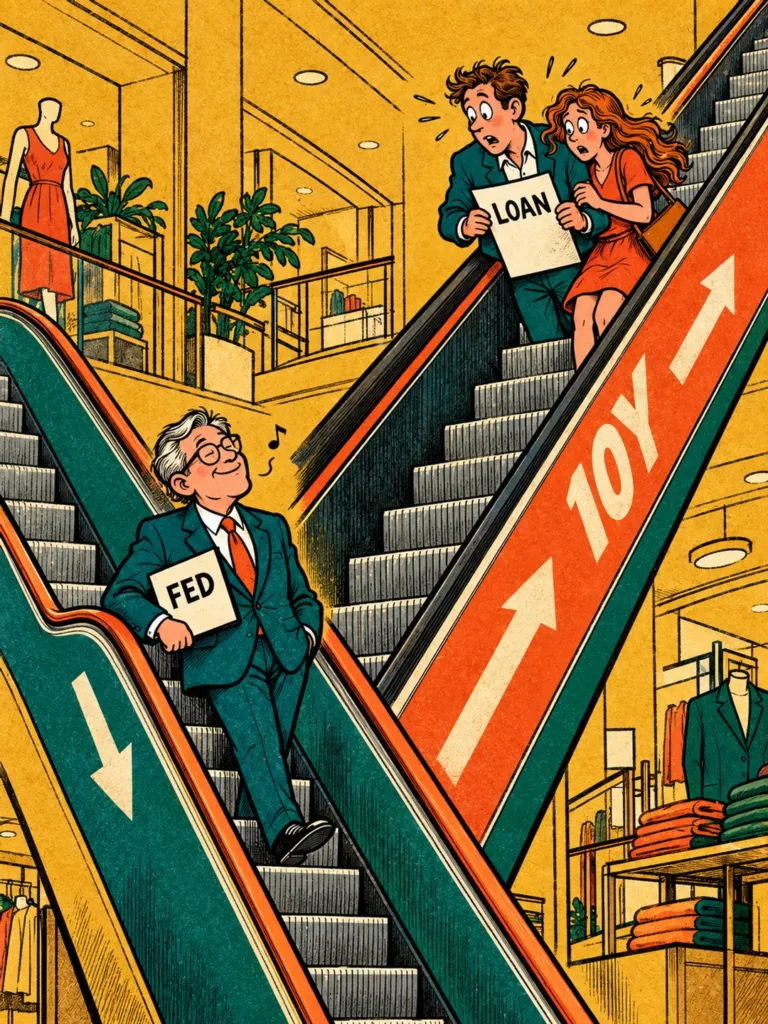
The 10-year U.S. Treasury yield closed at 5.31% on Oct. 5, its highest since May 2002 (5.32%), 24 years ago. A rising Treasury yield means the price of bonds already sold is falling, and anyone borrowing new money pays more interest.
It is tempting to blame the Fed (the U.S. central bank), which raised its benchmark rate by 0.25 percentage points on Sept. 16, its first hike since July 2023. But the benchmark rate now sits at 3.75% to 4.00%, one percentage point lower than two years ago on Oct. 1, 2024 (4.75% to 5.00%). Over the same stretch, the 10-year yield rose 1.57 percentage points, from 3.74% to 5.31% (Oct. 5).
The real story is elsewhere. The interest on 10-year money is set by the bond market, not the central bank.
- Why do the Fed's rate and the 10-year yield move apart?
The benchmark rate is the Fed's target for what banks charge each other to borrow overnight. The 10-year Treasury yield is the interest you earn for lending to the U.S. government for 10 years.
The 10-year yield has two parts: the average benchmark rate investors expect over the next 10 years, plus a term premium on top (the extra pay for tying up money for a long time).
Think of a one-day gig versus a 10-year job contract. For 10 years you'd ask for extra, because nobody knows how much prices will rise in the meantime. The difference: in bonds, that extra isn't fixed. It swings with the market's mood. Two years ago it was 0.17%; now it is above 1%.
- Of the 1.54-point rise, 0.91 points was the price of locking money up
The Fed Board's estimate of the 10-year term premium rose from 0.17% on Oct. 1, 2024 to 1.08% on Oct. 2, 2026, the highest since April 2010. Over the same period the 10-year yield rose 1.54 percentage points, from 3.74% to 5.28%.
The remaining 0.63 points or so reflects where markets expect the benchmark rate to go. The 2-year Treasury yield climbed from 3.61% to 4.83% (Oct. 2), above the top of today's Fed range (4.00%). In other words, markets think the Fed may raise rates further.
Put simply, if this estimate holds, about 60% of the rise in the 10-year yield came not from rate expectations but from lenders saying, "If I'm locking this up for 10 years, I want more."
- Why did long-term lending get more expensive?
The borrower's debt is growing fast. The Congressional Budget Office (CBO, the agency that tallies the federal budget for Congress) now expects a $2.1 trillion deficit for fiscal 2026, $200 billion more than it projected in February. Gross U.S. national debt recently reached $40 trillion.
Here's the chain markets worry about: more debt → the government must borrow more → it has to offer more interest to attract buyers. That interest then adds to the debt. In the first 11 months of the fiscal year, interest costs on the debt rose $111 billion (12%) from a year earlier. The CBO pointed to the larger debt and higher long-term rates.
Inflation matters too. In its September statement the Fed said "inflation remains elevated." If lenders fear rising prices will shrink the value of the money they get back in 10 years, they demand more interest.
- Why didn't yields fall when the government bought back bonds?
On Sept. 9 the Treasury Department (which runs federal finances and issues Treasury bonds) announced it would buy back $6 billion of 10- to 20-year bonds. The idea: fewer bonds in the market would lift their price and push yields down.
On the day of the announcement, the 10-year yield instead climbed as high as 4.85% during trading, its highest since November 2023.
In a resale market, pulling a few items off the shelf won't hold prices up if new stock keeps piling into the warehouse. The difference: unlike used goods, new Treasury bonds are created every time the government borrows. Brian Rehling, co-head of global fixed-income strategy at Wells Fargo, said long-term rates "will continue to move higher until the market believes inflation is being brought under control."
- When long-term rates rise, who pays more?
The average U.S. 30-year fixed mortgage rate rose from 6.12% on Oct. 3, 2024 to 7.28% on Oct. 1, 2026. While the Fed's rate ended up one point lower than two years ago, mortgage rates rose 1.16 points.
Borrow KRW 300 million (about $223,000) for 30 years with fixed monthly payments of principal and interest, and the monthly bill goes from about KRW 1.82 million ($1,354) to about KRW 2.05 million ($1,525), roughly KRW 230,000 ($171) more (hypothetical calculation).
People who already own bonds lose too. Say you hold KRW 10 million (about $7,400) of a 10-year bond paying 4% a year, and new bonds pay 5%. You'd have to sell yours for about KRW 9.22 million (about $6,850) (hypothetical calculation). It's like the resale value of your phone dropping once a new model comes out.
- Two years ago, too, long rates went the other way
From September to December 2024 the Fed cut its rate by one percentage point. Yet the 10-year yield rose from 3.65% on Sept. 17, 2024 to 4.79% on Jan. 13, 2025.
What's different this time is that the Fed has started raising rates again. Now both parts are pushing yields up together.
- BITPRESS Insight
For anyone who saw headlines about Fed rate cuts and waited for loan rates to fall, the past two years went the other way. The Fed's rate is one point lower than two years ago, yet the U.S. 30-year mortgage rate is 1.16 points higher. The longer the loan, the more market worries about government debt and inflation weighed on the rate.
The same goes for holders of long-term bonds. Even when the Fed cuts, a rising term premium can push your bond's price down.
The test is simple. Is your money short money, whose rate resets within a year, or long money, locked in for 10 years or more? Short money follows the Fed's rate. Long money follows the bond market, which also weighs government debt and inflation.
Sources
https://fred.stlouisfed.org/series/DGS10
https://fred.stlouisfed.org/series/THREEFYTP10
https://fred.stlouisfed.org/series/DGS2
https://fred.stlouisfed.org/series/DFEDTARU
https://fred.stlouisfed.org/series/DFEDTARL
https://fred.stlouisfed.org/series/MORTGAGE30US
https://www.federalreserve.gov/newsevents/pressreleases/monetary20260916a.htm
https://www.thefiscaltimes.com/2026/08/10/Deficit-Will-Top-2-Trillion-Year-CBO-Says
https://www.fox5ny.com/news/federal-budget-deficit-hits-2t-cbo
https://www.nbcnews.com/business/economy/bessent-treasury-bonds-repurchase-rcna596819
https://www.nbcnews.com/business/markets/bond-yields-oil-treasury-buyback-bessent-rcna599604
Glossary
Benchmark rate — The central bank's short-term rate target; in the U.S., the range for what banks charge each other to borrow overnight (the federal funds rate).
Government bond yields — The interest rate earned by lending to the government; it rises when the price of existing bonds falls.
Term premium — The extra interest investors demand for locking up money in one long loan instead of lending short again and again.
Equal monthly payments — A repayment method in which you pay the same amount every month for the whole loan term, covering principal and interest together.
Fiscal year — The 12-month period used for the government's budget; in the U.S. it starts Oct. 1 and ends Sept. 30.
BITPRESS articles are information to help your investment decisions, not a recommendation to buy or sell any stock or coin. Investment decisions and their results are your own responsibility.