



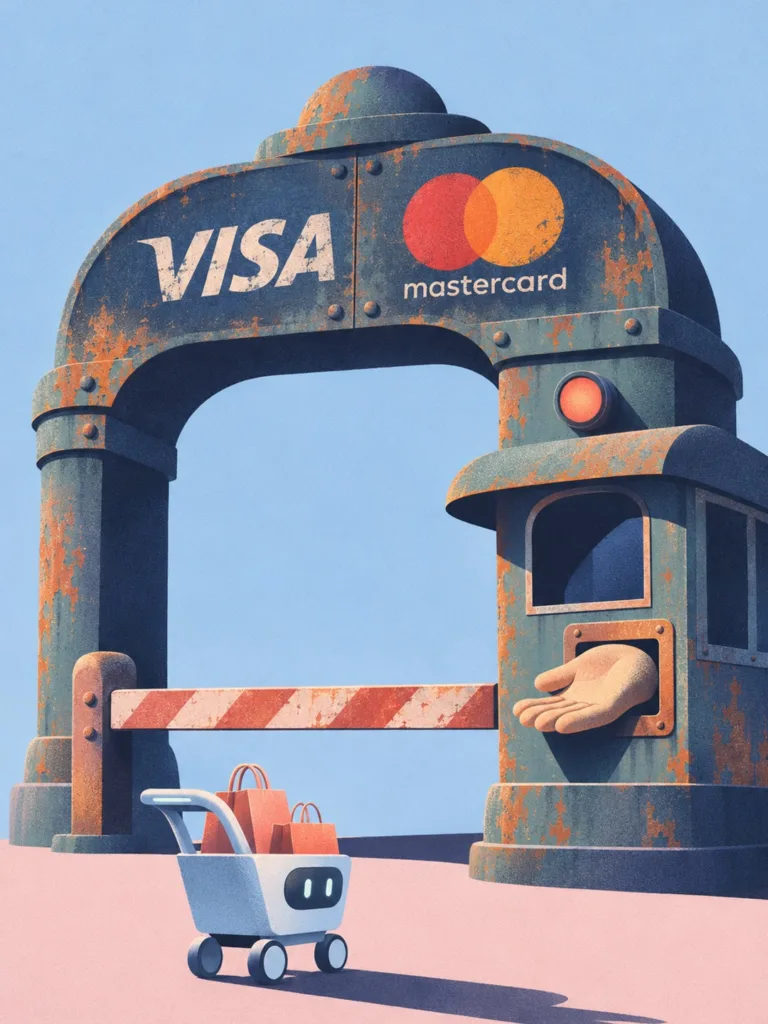
On Nov. 13 (U.S. time), OpenAI opened a payment wallet inside ChatGPT that lets the AI pay for goods on a user's behalf. It starts with U.S. ChatGPT Pro (the paid ChatGPT plan) users who hold a U.S.-issued card the wallet supports.
Two readings are common. One is that AI handling payment makes shopping easier. The other is that once AI starts buying groceries, new payment tools like crypto will skip the card companies. But the key point is elsewhere. OpenAI built this wallet on the existing card networks, not on a new payment network.
- ChatGPT's payment wallet pays through the existing card networks
OpenAI built the feature together with the card companies (Visa, Mastercard and American Express). American Express is a U.S. card company. The road these three use to move money is called a card network, and in this article 'card network' and 'card company' mean the same side. Users approve a payment with biometric authentication such as face recognition or a fingerprint.
OpenAI said it will work with payment processors and fraud-prevention firms so that AI purchases go through the online checkout used today. From the store's side, an order sent by AI arrives through the same card payment route it always receives. OpenAI said it plans to let payments go through without per-purchase approval, within a spending limit set in advance.
It is like handing your card to someone running an errand for you. The difference is that you don't hand over the whole card.
- The card network creates the token that stands in for the card number
For each approved payment, the card network creates new tokenized card information. A token is a substitute number used in place of the real card number. OpenAI explained that the merchant and the AI receive only this token and never see the actual card number.
In order, it goes like this. The user approves with a fingerprint → the card network creates a token for this payment → the merchant gets paid with that token. The card network sits at the center of the arrows. In this wallet, even the price of an item the AI picked must pass through the card network to be paid.
Think of a one-time exit ticket you get at a parking lot entrance. The difference is that the card network owns the machine that prints that ticket.
- Crypto is building a different road with stablecoins
Other roads are being laid too. Coinbase (a U.S. crypto exchange) released a payment standard called x402 in 2025. It lets an AI pay for digital services on its own with stablecoins (coins whose value moves in step with the dollar).
Crossmint (a company that builds stablecoin payment infrastructure) chose to link stablecoin wallets with the existing card networks.
Big companies are cutting their own paths, too. Google released an agent payment protocol (the rules AI agents use when they pay) in 2025, and Visa and Mastercard have each started moves to support AI-initiated payments. Put simply, AI payment roads are being laid in two directions, card networks and stablecoins, and this time OpenAI picked the card network side.
- By the numbers, AI shopping is still a small market
An April report from market research firm Juniper Research, as relayed by Cointelegraph, estimated global agentic commerce (commerce that AI carries out on people's behalf) at about $8 billion in 2026. The report projected $1.5 trillion by 2030.
Dividing the two gives about 187 times. That is a forecast that a basket worth KRW 10,000 this year grows to a little over KRW 1.87 million in four years. But the 2030 figure is a forecast, and this year's figure is an estimate, not an actual count.
Put simply, the money AI spends today is small, and which road it takes as it grows is only now being settled.
- BITPRESS Insight
What this announcement changed is who presses the pay button. AI now presses the button a person used to press. But the road the money takes has not changed. Merchants get paid only with tokens the card network created, so even the price of what ChatGPT picked passes through the Visa, Mastercard and American Express networks.
So the expectation that card companies get pushed aside when AI pays does not hold, at least for this OpenAI wallet. The stablecoin road is growing separately elsewhere, such as in digital-service payments, and the whole AI shopping market is still small at an estimated $8 billion in 2026.
When AI payment news appears, look first at whether the money flows through the card networks or through stablecoins, not at how much easier it got. That tells you whether the card companies' share is really in doubt.
Sources
https://cointelegraph.com/news/openai-ai-payments-chatgpt-wallet-visa-mastercard-amex
Glossary
Tokenization — A method that creates and passes along a substitute number, used only for that payment, in place of the real card number.
Agentic commerce — Commerce in which an AI assistant (agent) picks goods and pays for them on a person's behalf.
Stablecoin — A coin built so that its value moves in step with a fiat currency such as the dollar.
x402 — A payment standard Coinbase released in 2025 that lets AI pay for digital services on its own with stablecoins.
Biometric authentication — A way to confirm identity using physical features such as a face or fingerprint.
BITPRESS articles are information to help your investment decisions, not a recommendation to buy or sell any stock or coin. Investment decisions and their results are your own responsibility.





