The minimum intake for the 2027 CPA exam has been set at 1,100. That is 50 fewer than this year's 1,150, and it has dropped by 50 places for three straight years since the 2024 peak of 1,250. The Financial Services Commission (FSC) made the decision at its CPA qualification and disciplinary committee meeting on November 24.
Most people would read this as a routine annual adjustment to the exam quota. CPAs have long been in short supply, so many still assume that passing the exam guarantees a job.
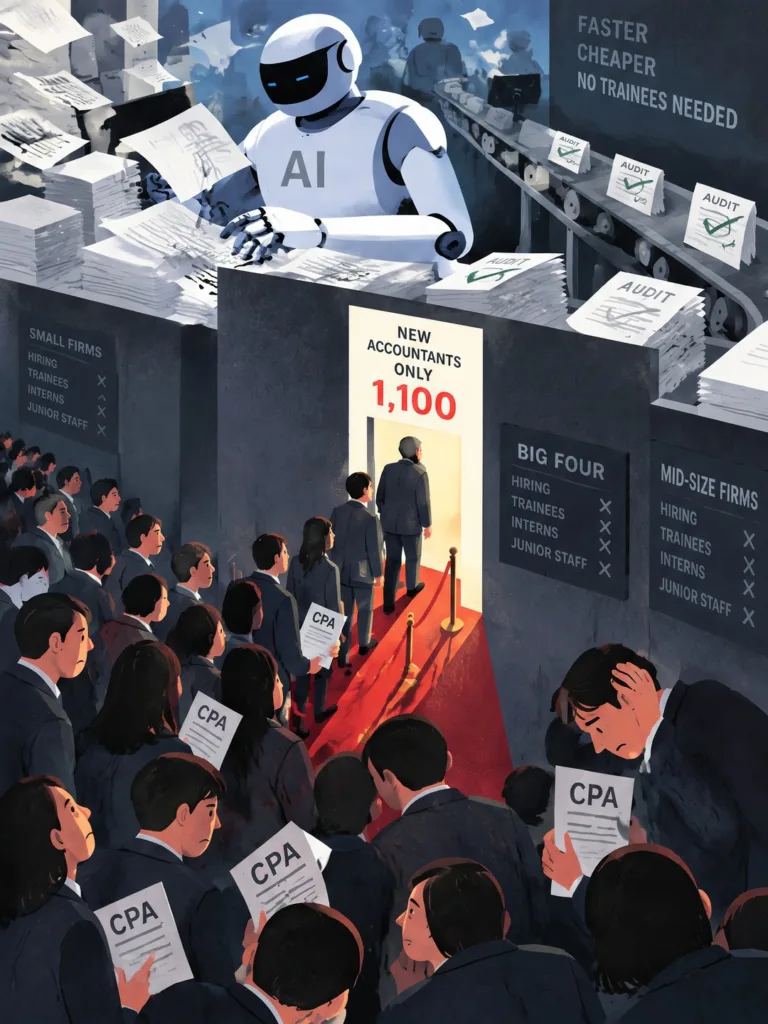
But the key point lies elsewhere. Among the factors, the Commission cited the effect of artificial intelligence (AI) replacing junior CPAs (accountants with short careers, or rookies). AI has now entered the reasoning behind the quota for a professional license.
- Passing the exam does not make you a CPA right away
Exam passers must complete at least one year of practical training before they can register as CPAs. Without a training post, they have to wait holding only a pass certificate.
As of this September, about 300 passers were still unassigned, meaning they had no training post. It is like passing the written driving test and then finding no road-training slot. The difference is that a CPA who cannot finish training cannot register at all.
- Why cut now? Because there are not enough training posts for passers
The chain works like this: accounting firms (firms of CPAs who audit corporate books) cut rookie hiring, passers pile up without training posts, and the Commission cuts the number it admits.
Last year, the Commission cited the buildup of unhired passers and stalled sales and profits at accounting firms. The two-year cumulative count of unassigned passers at that time was about 600.
This year there is one more reason. The Commission said it weighed hiring demand, the accumulated number of unassigned passers, predictability for exam takers, and the the replacement effect on junior CPAs from wider use of artificial intelligence (AI).
- The intake is back to its 2020–2023 level
Minimum intake moved from 1,100 in 2020–2023 to 1,250 in 2024, 1,200 in 2025, 1,150 in 2026, and 1,100 in 2027. In 2024 the Commission raised the number, expecting companies outside accounting firms to need more CPAs. As unassigned passers piled up, it returned the number to its earlier level over three years.
Put simply, a door that was widened once has been narrowed back to its earlier width.
But 1,100 is a minimum. It is the least number of passers set under the CPA Act's enforcement decree, so the actual number could be higher depending on second-round exam results.
- AI and other changes may cut audit demand by 12–16% in three to five years
Research by the Korean Institute of Certified Public Accountants and the Korean Accounting Association estimates that AI and other changes in the accounting environment will cut audit demand by about 12–16% in three to five years. For an accounting firm with 100 audit staff, that is 12–16 people's worth of work (assuming the same rate applies).
Commission members expect AI's replacement of simple accounting work to speed up. The Commission's specific mention of 'replacement of junior CPAs' follows the same line of thinking.
It is like self-checkout counters arriving at a supermarket: cashier jobs shrink first, while store management jobs remain. But for CPAs, the training post is where a career starts, so when rookie positions shrink, the path to becoming a senior professional narrows too.
- Researchers urged deeper cuts, but the Commission moderated the pace
The researchers proposed an appropriate minimum intake of 850–1,000 per year. The Commission chose 1,100, more than that. Because it said it weighed predictability for exam takers, it avoided a sudden sharp narrowing in a single year.
But Commission members agreed that the current hiring policy stance should be kept over the medium to long term. They did not say whether they would cut further.
The Commission said it will 'actively support unassigned CPAs so they can find training institutions stably.' In other words, it will narrow the entrance while first looking after training posts for people who have already passed.
- BITPRESS Insight
A license is a ticket to a job, not the job itself. For CPAs, there is one more gate in between, the 'training post,' and the AI replacement effect the Commission weighed falls on the rookie positions behind that gate.
So for someone preparing for the exam, the number that weighs more than 1,100 is the roughly 300 unassigned passers. Even if the intake shrinks, passers who all find training posts can start learning the job right after passing. If the unassigned count keeps growing, passing alone will not let you start working.
The formula that a license means a job holds only as long as training posts remain for those who pass. Whether passers find training posts, rather than the number of places, decides whether a license leads to a job.
Sources
https://www.yna.co.kr/view/AKR20261124165100002
https://biz.sbs.co.kr/amp/article/20000273811
https://newspim.com/news/view/20241122000140
Glossary
minimum intake quota — A minimum number of exam passers set each year under the CPA Act's enforcement decree. The actual number of passers can be higher depending on second-round results.
practical training — At least one year of on-the-job training that exam passers complete before they can register as CPAs.
unassigned CPAs — A person who passed the CPA exam but has not found a place for practical training.
junior CPA — A CPA with a short career, roughly a rookie.
non-accounting-firm employer — A company or institution outside accounting firms that hires CPAs on its own.
BITPRESS articles are information to help your investment decisions, not a recommendation to buy or sell any stock or coin. Investment decisions and their results are your own responsibility.