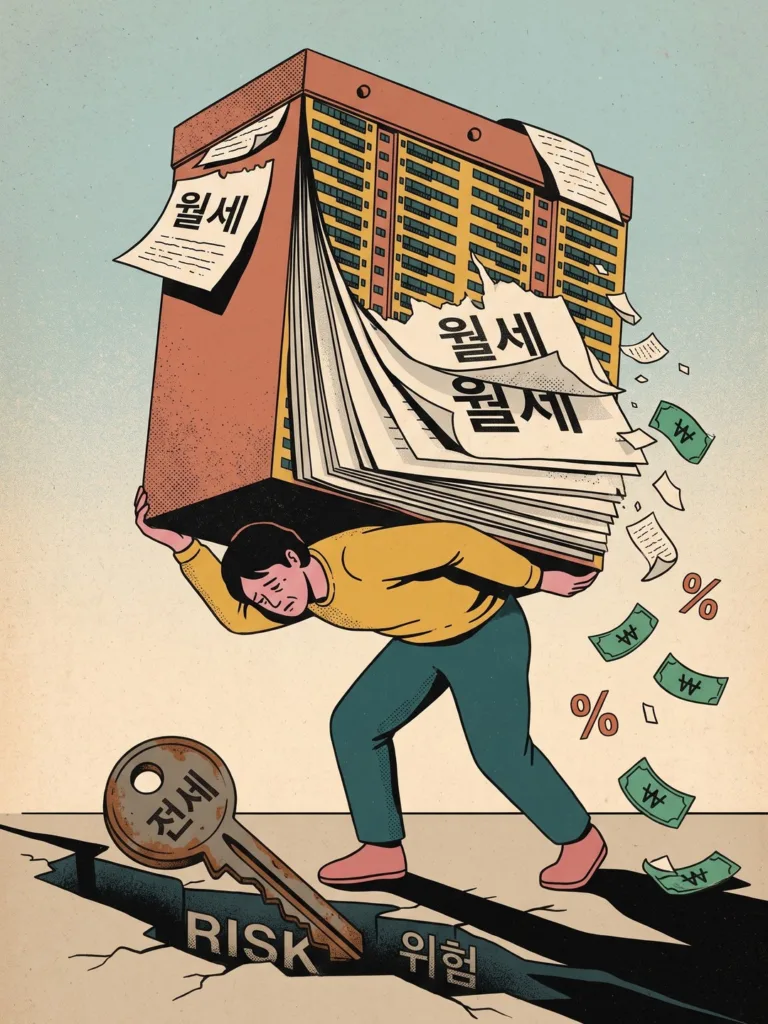
As of November 1, 2025, South Korea had 2.998 million jeonse households, down 254,000 (7.8%) from 2020. Over the same period, monthly-rent households rose from 4.905 million to 5.849 million, an increase of 944,000. In Seoul, monthly rent accounts for 33.7% of households, the highest share in the country. That means one in three households rents month to month.
A common reaction is: “Rent is money that disappears every month, so it's better to take out a loan for a jeonse, even if it stretches your budget.” But jeonse isn't free either. If you borrowed the deposit, you pay interest on it. If it's your own money, you give up the savings interest it could have earned. That interest is the figure to compare with rent.
There is one more item this math doesn't capture: the risk of never getting your deposit back.
- Why have jeonse households fallen by more than 250,000 in five years?
Statistics Korea released the results of its “2025 Population and Housing Census sample survey” on November 24. The share of jeonse households among all households fell from 15.5% to 13.3%, while the share of monthly-rent households rose from 23.4% to 26.0%. The increase came from rent with a deposit. Those households numbered 5.426 million, up 1.039 million in five years. Monthly rent with no deposit, including the traditional advance-payment type, fell by 95,000.
In short, rent with no deposit at all actually declined. The growth was mostly in hybrid leases, which cut the deposit and add monthly payments on top.
Kyung Eun-sook, head of the census division at Statistics Korea, said the rise in rent reflects “the burden of saving a large lump sum to find a jeonse home and the fear of not getting the deposit back in a jeonse fraud.” Those two factors, loan interest and deposit risk, sit on either side of the scale.
- The yardstick for comparing jeonse and rent is the conversion rate
The jeonse-to-rent conversion rate is the annual rate used to turn a deposit into monthly rent. At 5%, lowering the deposit by 100 million won means paying 5 million won a year, or about 416,000 won a month, in rent instead. That rate is the price of not leaving 100 million won with the landlord.
Jeonse loan rates use the same unit. In September 2026, the average bank jeonse loan rate was 4.57% a year, up 0.22 percentage points in one month. Borrowing 100 million won costs 4.57 million won in interest a year. So the question becomes simple: is the rate the landlord quotes higher or lower than my loan rate?
- On 100 million won, the gap between rent and loan interest is about 10,000 won a month
Here are four cases side by side for a 100 million won deposit (assumed calculations, excluding taxes and fees).
| What you did with the 100 million won | Rate applied | Monthly cost |
|---|---|---|
| Own money for jeonse (give up savings interest) | 3.45% a year (September savings rate) | about 290,000 won |
| Borrowed for jeonse | 4.57% a year (September jeonse loan rate) | about 380,000 won |
| Converted to rent (Seoul apartment market rate) | 4.7% a year (May) | about 390,000 won |
| Converted to rent (statutory cap for renewals) | 5.0% a year (now) | about 416,000 won |
In short, for a tenant who borrows the deposit, the line between “rent is wasted money” and “interest is not” means very little. The gap is only about 10,000 to 40,000 won a month.
On the other hand, if the whole deposit is your own money, jeonse is clearly cheaper. The savings interest you give up is about 290,000 won a month, so it costs about 100,000 won a month less than paying rent at the Seoul market rate. A jeonse backed by a loan and a jeonse paid with your own money are completely different calculations.
- Can a landlord set the conversion rate however they like?
There are two kinds of conversion rates. The statutory rate is the base rate plus 2 percentage points. It caps what a landlord can charge when an existing lease is renewed or changed. The base rate was held at 3.00% a year on October 22, so the current cap is 5.0% a year. In July, when the base rate was 2.75%, the cap was 4.75%.
New leases have no such cap. For those, the reference is the market conversion rate, calculated from actual reported leases. For apartments in May 2026, the national average was 5.3% and Seoul's was 4.7%. Within Seoul it varied too: 4.6% in Jongno-gu and 5.3% in Jung-gu.
If a landlord asks for a 6% rate at renewal, that is 6 million won a year on 100 million won, which is 1 million won more than the 5% statutory cap of 5 million won. In a renewal, you don't have to pay that difference.
- Add the deposit risk the table leaves out, and a hybrid lease can make sense
The calculations above assume your deposit is safe until the end. If a jeonse fraud leaves you unable to get your deposit back, the money you handed over, whether borrowed or your own, is locked up or lost. That is a different order of risk from a monthly gap of tens of dollars.
If you switch a 300 million won jeonse to a hybrid lease with a 100 million won deposit, the deposit you hand over falls to one-third. Using the 4.57% loan rate and the 4.7% Seoul market rate, converting the remaining 200 million won to rent adds only about 20,000 won a month (assumed calculation). Think of it as paying a fire insurance premium to cover the risk of a fire.
- BITPRESS Insight
The shift from jeonse to rent with a deposit points the same way as this math. The higher loan rates go and the bigger the fear of jeonse fraud, the more the scale tips toward hybrid leases. The September jeonse loan rate of 4.57% is only 0.13 points below the May Seoul apartment market rate of 4.7%. For tenants with a loan, the idea that “rent is a loss” has nearly disappeared in the numbers.
That said, a hybrid lease isn't always the answer. If most of the deposit is your own money, the savings interest you give up is low, so jeonse is still cheaper. If the landlord asks for a conversion rate above market, rent becomes expensive.
The rule is simple. Compare the rate the landlord quotes with what your money costs you: the loan rate if you borrowed it, or the savings rate if it's your own. Then ask whether the gap is worth paying to reduce the deposit you could lose.
Sources
https://www.hankyung.com/article/2026112476121
https://v.daum.net/v/20260725070654275
https://supple.kr/news/cmvt0934ibtn0m5vu2p5grw5p
https://kbthink.com/realestate/insights/research/261116-7.html
Glossary
Jeonse-to-monthly rent conversion rate — When part of a jeonse deposit is switched to monthly rent, this ratio shows what percentage of the reduced deposit one year of rent amounts to.
Legal conversion rate — The base interest rate plus 2 percentage points. It is the cap that landlords cannot exceed when renewing or changing an existing contract.
Market conversion rate — The average conversion rate by region, calculated from reported jeonse and monthly rent contracts. It is an indicator used as a reference for new contracts.
Banjeonse (jeonse-monthly rent hybrid) — A common name for a lease with a deposit plus monthly rent, where the deposit is lowered and the difference is paid as monthly rent.
Saegeulse (monthly rent without a deposit) — A method of paying several months of rent in advance with no deposit. In statistics, it is counted as monthly rent without a deposit.
BITPRESS articles are information to help your investment decisions, not a recommendation to buy or sell any stock or coin. Investment decisions and their results are your own responsibility.