



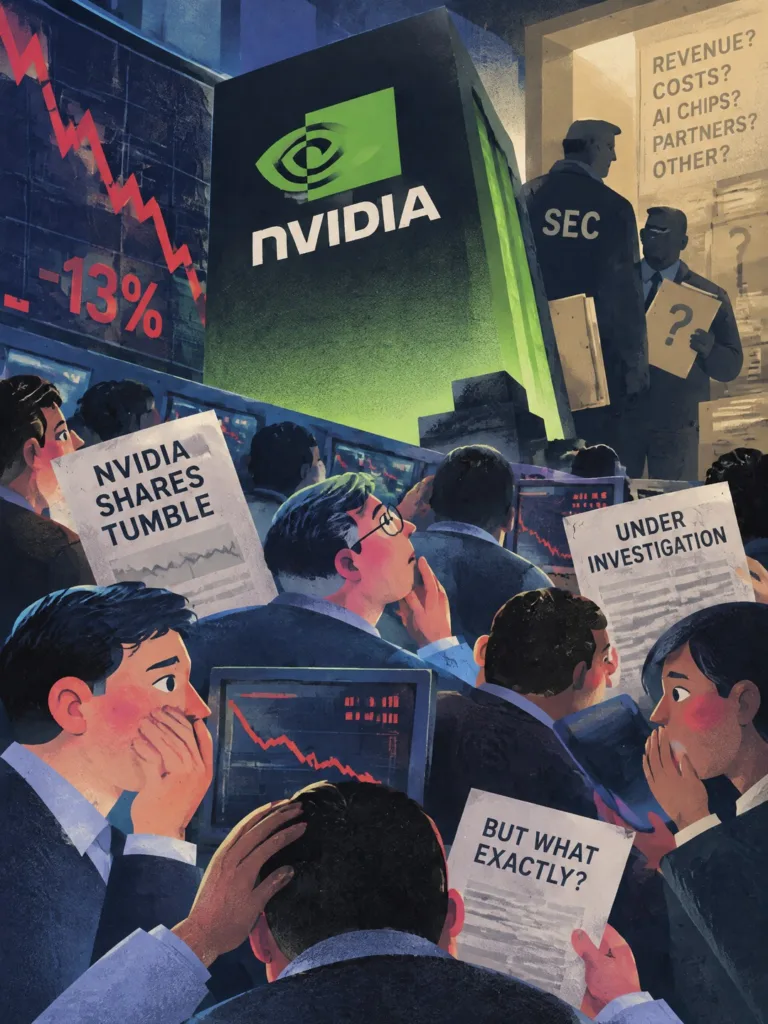
On Nov. 20 (local time), Nvidia's stock fell about 13% intraday to $127.16. It dropped as low as $126.64, a 52-week low, and its market value shrank to about $3.05 trillion. This came right after a report that staff in the enforcement division of the U.S. Securities and Exchange Commission (SEC, the federal agency that oversees U.S. stock markets) were looking into possible accounting problems at Nvidia.
Three days earlier, on Nov. 17, two pieces of news came out on the same day. Nvidia reported quarterly revenue of $115.8 billion, up 103% from a year earlier. The same day came the first report that the SEC is looking into Nvidia's disclosures. The big drop came later, on the day a report that used the word 'accounting' came out.
But the key point is something else. The only fact confirmed so far is that 'an investigation exists.' Neither the SEC nor Nvidia has said what is being examined.
- Why do articles describe the investigation's target differently?
On Nov. 17, a U.S. business newspaper reported that the SEC had started a civil investigation into whether Nvidia misled investors through its disclosures. Three days later, on Nov. 20, an international news agency reported, citing two people familiar with the matter, that the probe is focused on possible accounting problems. Even that agency said it could not confirm exactly what the SEC is examining or when the probe began.
Disclosure is what a company tells investors. Accounting is how it records numbers in its books. They are not the same thing. Yet it is still unclear whether the two reports describe the same probe from different angles.
Put simply, reporters are each writing up fragments they heard from different sources. It is like asking three people who saw the same accident: each one tells a slightly different story.
- Why is the SEC saying nothing?
The SEC says all of its investigations are conducted in private. Its enforcement manual also says that nonpublic information, including whether an investigation has started, should not be shared outside the agency without approval from the SEC commission. This time too, the SEC has not made a statement, and Nvidia did not respond right away.
Think of it like a call to come back for a follow-up after a health checkup. Getting that call does not mean you are sick. But unlike a follow-up test, an SEC probe leaves even outsiders unable to tell what is being re-examined.
So a report of a probe means only that the SEC is 'looking into' something, not that wrongdoing has been found. An investigation is not evidence of wrongdoing, and many end without any penalty.
- What is the revenue-reporting change being mentioned?
What is drawing attention again is a change Nvidia made last year to how it reports revenue by region. It moved from the customer's billing address to the location of the customer's headquarters. As a result, Singapore dropped out of the regional revenue table. A British business newspaper reported that the change was made at a time when Singapore revenue had grown to nearly half of the company's total global revenue.
Think of the difference between where a package is delivered and where a company is based. For example, an order from a U.S. company billed to its Singapore office now counts as U.S. revenue. That is why revenue billed to Singapore no longer appears separately in the table. However, changing the counting method is not, by itself, proof of wrongdoing.
More important, it has not been confirmed whether this change is even part of the SEC investigation. The wire report did not address this point either.
- What steps come before a conclusion, and what becomes public at each stage?
The first step is an investigation by the SEC's enforcement division. Nvidia is at this stage now. Since the only reporting so far comes from anonymous sources, the scope differs from one article to the next.
The second step is a Wells notice, sent when SEC staff decide to recommend penalties. It tells the company which securities law violations are in question. This is the first time 'what' is officially put in writing.
The third step is the decision of the SEC commission. The case may go to court or an administrative proceeding, or, in many cases, end in a settlement without a trial. If SEC staff decide not to recommend penalties, the usual outcome is a closing letter.
- How did Nvidia's 2022 investigation end?
Nvidia has faced a disclosure case before, and it offers a precedent. On May 6, 2022, the SEC announced a penalty, saying Nvidia had not disclosed that much of the rise in its fiscal 2018 gaming chip (GPU) revenue came from crypto mining. The SEC judged that the reason behind the jump in revenue was information investors needed to be told. Nvidia agreed to pay a $5.5 million fine without admitting or denying the findings.
More than four years passed between the fiscal year in question and the settlement announcement.
What is different this time is the starting point. In 2022, the settlement stated the violation. This time, neither the violation nor even the scope of the investigation has been made public.
- BITPRESS Insight
While the target of the investigation is unknown, reports arrive in fragments. The matter could end as a disclosure-wording problem, or it could grow into a problem with accounting numbers. But there is no official information yet to tell the two apart. During this sell-off, Nvidia's market value lost more than a third.
Even if you did not buy Nvidia directly, this matters. According to the ETF head at Strategy Shares, a U.S. ETF issuer, Nvidia is included in 1,068 U.S.-listed ETFs, nearly 20% of all U.S. ETFs. If you owned $10,000 worth of Nvidia stock, the 13% intraday drop that day would have cost you about $1,300.
The scope is decided only when official documents, such as a Wells notice or a settlement, come out. Rather than getting swept up in reports that come out before then, it is better to wait for those documents.
When reading an investigation story, there is one rule. First sort out whether the claim came from an anonymous source or from a company filing or an SEC document. That is how you separate rumor from confirmed fact.
Sources
https://decrypt.co/383744/nvidia-shares-sink-52-week-low-sec-probing-accounting
https://www.investmentnews.com/equities/embattled-nvidia-faces-sec-probe-as-california-attorney-general-eyes-action/269054
https://www.sec.gov/enforce/how-investigations-work
https://www.sec.gov/divisions/enforce/enforcementmanual.pdf
https://www.sec.gov/news/press-release/2022-79
Glossary
SEC enforcement division — The unit of the U.S. Securities and Exchange Commission that investigates violations of securities laws and recommends penalties.
Wells notice — A letter in which SEC staff say they have tentatively decided to recommend penalties, and state which violations they are concerned about.
Closing letter — A letter SEC staff send to a company when they decide not to recommend penalties.
Regional revenue disclosure — A table in which a company splits its revenue by country or region. The numbers depend on whether revenue is grouped by billing address or by headquarters.
52-week low — The lowest price a stock has traded at over the past 52 weeks, or one year.
BITPRESS articles are information to help your investment decisions, not a recommendation to buy or sell any stock or coin. Investment decisions and their results are your own responsibility.





