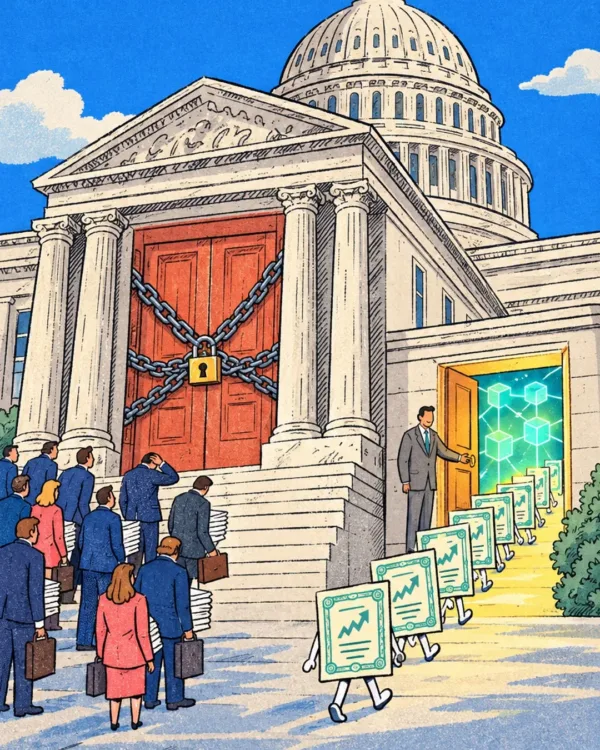
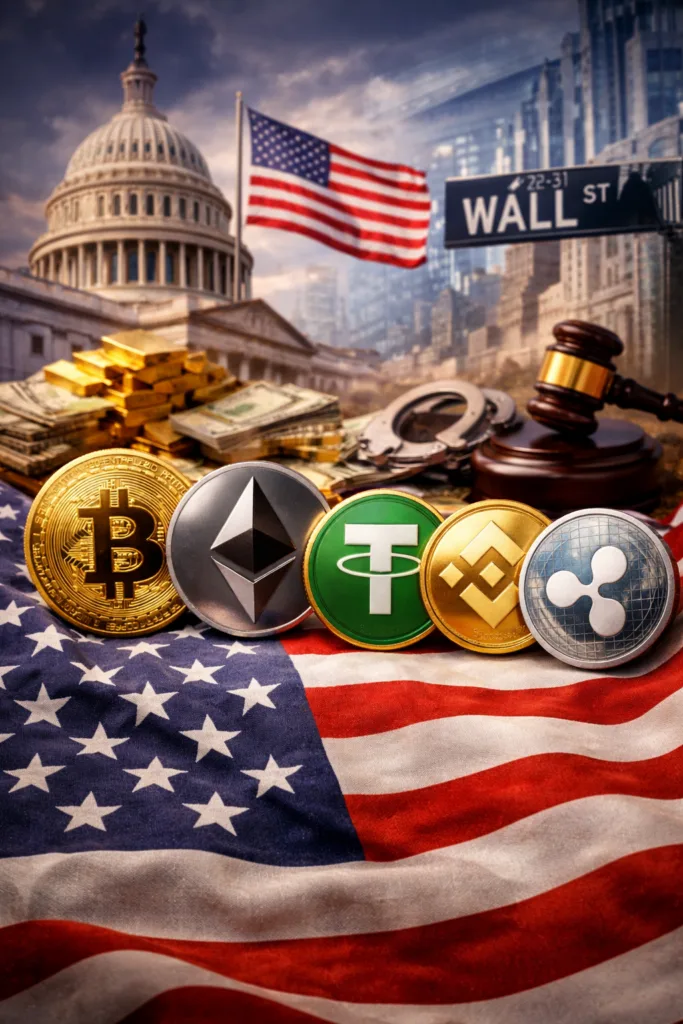
The key variable for the 2026 crypto market is not "supply and demand" but "regulation."
What moves prices is no longer vague.
How the United States treats which assets, and through which products and which rules
it lays down "the rails for money to flow in and out"
is deciding the direction of the top coins by market cap.
First, an important premise needs to be set straight.
Saying "the GENIUS Act added Bitcoin to the national reserves" is not accurate.
The GENIUS Act is a law that creates a regulatory framework for payment stablecoins.
The U.S. "strategic Bitcoin reserve," on the other hand,
was made official by a White House executive order on March 6, 2025.
In other words,
Bitcoin sits in a "national holding framework,"
and stablecoins in a "regulatory framework"
that move on separate policy tracks.
The top 5 by market cap can change over time.
But as of early 2026, the names that keep appearing on major tracking sites
are BTC, ETH, USDT, BNB and XRP.
This article lays out how these five coins
are benefiting structurally from shifts in U.S. policy.
- Bitcoin (BTC)
From digital gold to a "national holding framework"
The point is not that "the United States will buy Bitcoin."
The United States first institutionalized Bitcoin as "an asset it can hold."
The White House executive order issued on March 6, 2025
clarified the framework for the Strategic Bitcoin Reserve and the U.S. Digital Asset Stockpile.
(Strategic Bitcoin Reserve: an institutional framework for managing the Bitcoin held by the U.S. government as a long-term strategic asset. It does not mandate new purchases.)
In principle, the Bitcoin reserve
is run on assets the Treasury already holds (seized and forfeited coins).
There is only one important change.
Perception has shifted from "an asset the government cannot hold"
to "an asset the government can hold."
The way companies and institutions benefit is clear too.
Bitcoin's institutional rail is the spot ETF.
(Spot ETF: a financial product that holds actual Bitcoin as its underlying asset and trades like a stock in a brokerage account.)
Through spot ETFs, Bitcoin
became an asset accessible outside crypto exchanges,
creating a structure in which the whole financial infrastructure, from asset managers to custodians and brokers, earns revenue together.
2026 checkpoints
First half: how the government holding framework actually operates, and whether ETF net inflows persist
Second half: whether Bitcoin is seen not as a "volatile asset" but as "a holding asset defined by policy"
- Ethereum (ETH)
The roadmap to becoming the institutional smart contract standard is now official
Ethereum is now valued not on "hype"
but on "a named schedule."
Ethereum's official roadmap spells out
(Pectra, Fusaka, Glamsterdam: code names for a series of key network upgrades Ethereum is rolling out in sequence over 2025-2026, aimed at improving scalability, overhauling the account structure and strengthening decentralization)
upgrade plans like these.
Since late 2025,
Hegota has been discussed and reported as the roadmap after Glamsterdam,
giving the upgrade schedule continuity.
(Hard fork: a large-scale update that changes the rules of a blockchain network. Whether it actually ships determines whether users feel any change.)
The reasons companies choose Ethereum are simple:
stability, predictable costs and a standardized execution environment.
Institutional uses such as real-world asset tokenization
are spreading mainly across Ethereum and its L2 ecosystem,
and the key is whether "usage" moves to a stage where it actually shows up in fees and supply and demand.
(RWA: a structure for issuing and trading real-world assets such as government bonds, funds and real estate as tokens on a blockchain)
2026 checkpoints
First half: progress on shipping Glamsterdam and L2 usage
Second half: whether dates are set for follow-up roadmap items such as Hegota
- Tether (USDT)
Hit directly by U.S. policy, and the biggest winner of the stablecoin expansion phase
Among the top 5 by market cap, the asset that reflects policy changes fastest is the stablecoin.
And at the center of it is the GENIUS Act.
(GENIUS Act: a law that established a federal regulatory framework for U.S. payment stablecoins, codifying standards for reserves, disclosures and AML)
On July 18, 2025, the White House
officially announced the signing of the GENIUS Act.
The law moves stablecoins
from "an unregulated gray zone" to "an institutional means of payment."
(Payment stablecoin: a coin pegged to the value of a fiat currency such as the dollar and used for payments, transfers and settlement)
The point is not USDT alone.
Dollar tokens that can scale in line with the rules
are combining with banks, fintechs and payment infrastructure
and entering a phase that grows the whole market.
2026 checkpoints
First half: concrete standards for reserves, audits and disclosures
Second half: how fast stablecoins expand into payment rails
- XRP
After regulatory uncertainty, institutional features are the battleground
XRP is an asset whose character has been shaped more by regulation than by technology.
What to watch in 2026 is
"what it builds" now that the uncertainty has eased.
(Confidential Multi-Purpose Tokens, MPT: an XRPL-based token structure designed to let institutions comply with regulations while keeping transactions private)
(ZKP, zero-knowledge proof: a cryptographic technique that proves a fact without revealing the underlying information. In institutional finance, it serves both compliance and privacy at once.)
Ripple has laid out a roadmap to roll out
institutional privacy and compliance features in earnest in the first quarter of 2026,
and through its dollar stablecoin RLUSD
it is aiming to act as a payment bridge between Asia and the United States.
2026 checkpoints
First half: whether the institutional features actually launch
Second half: whether partnerships lead to "usage," not just "announcements"
- BNB
From exchange coin to high-performance infrastructure coin
Starting in 2026, BNB
is shifting its position from "exchange image" to "chain performance."
BNB Chain
has presented 20,000 TPS, sub-second finality and a dual-client strategy
as its 2026 technical roadmap.
(Finality: the time it takes for a transaction to be confirmed irreversibly. A key metric for payment and settlement rails.)
Performance only matters
once real usage arrives.
What to watch with BNB is not the theme
but whether users, transactions and fees actually grow.
2026 checkpoints
First half: whether performance metrics actually improve
Second half: whether the growth trend in chain usage takes hold
BITPRESS Insight
2026 is less a year for "picking coins" than a year for "reading the rails the United States has laid."
Rather than pumping specific coins,
the United States is first building the structure through which money flows in and out.
For Bitcoin, it is the holding framework;
for stablecoins, the regulatory framework;
for Ethereum and BNB, infrastructure execution;
for XRP, delivering institutional features.
Each has its own battleground.
Checklist
- Bitcoin: how the holding framework actually operates
- Stablecoins: finalization of detailed regulatory standards
- Infrastructure coins: launches and usage, not announcements
Sources (plain text)
- The White House, Establishment of the Strategic Bitcoin Reserve and United States Digital Asset Stockpile (2025-03-06)
- Reuters, Trump administration views bitcoin reserve as “digital Fort Knox” (2025-03-07)
- The White House, Fact Sheet: President Donald J. Trump Signs GENIUS Act into Law (2025-07-18)
- Ethereum.org, Ethereum roadmap (Pectra, Fusaka, Glamsterdam)
- CoinDesk, Ethereum upgrade roadmap and Hegota discussion (Dec 2025)
- BNB Chain Blog, Tech Roadmap 2026
- Ledger Insights / Yahoo Finance, Ripple RLUSD Japan rollout reports