



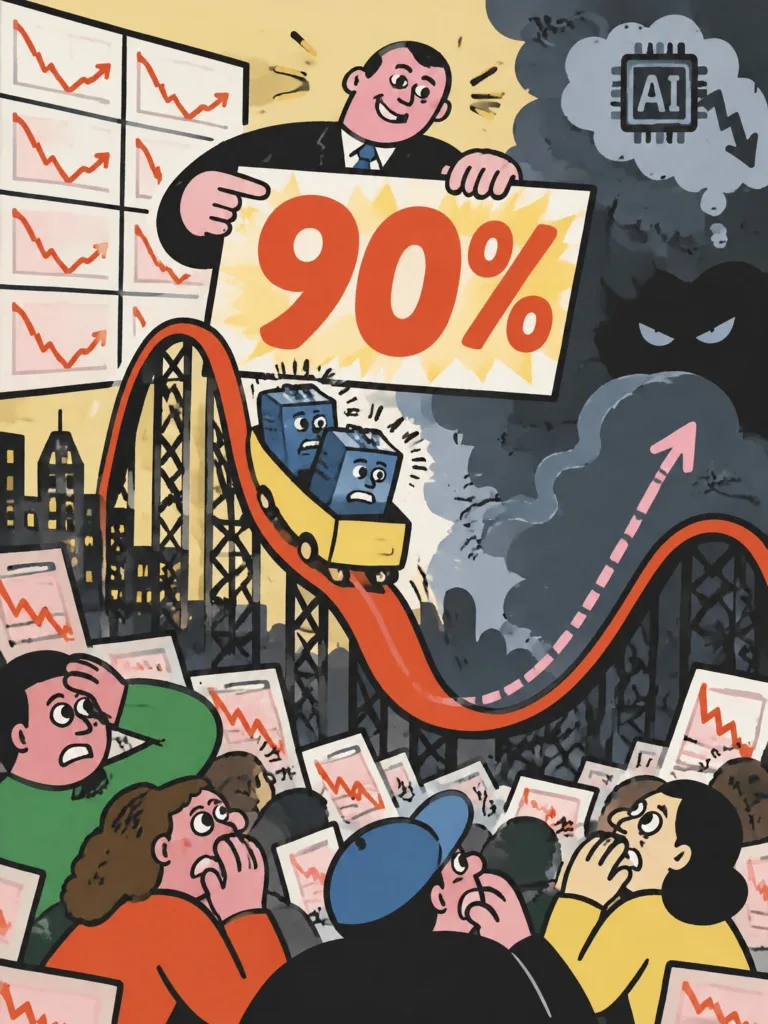
KB Securities analyzed cases since 2005 when Samsung Electronics and SK hynix shares fell more than 40-50% from a peak, and found that the chance of the shares rising within the next three months averaged about 90%. By stock, that is 97% for Samsung Electronics and 81% for SK hynix. The two companies' combined market value fell 53.77% from its record high on June 25 to Nov. 6.
To individual investors stuck with losses, this number sounds like "just hold on." But the key point lies elsewhere. The 90% is a count of how often this happened in the past, not a number that promises this rebound. For that record to hold this time, the reason for this drop has to be the same as back then.
- What does the 90% actually count?
What KB Securities counted is the share of cases in which the stock rose within three months after falling more than 40-50% from a peak. It is a collection of records since 2005, not a model that calculates the future.
The reports do not say how many of these big drops there were, when they happened, or how much the shares rose. The same 90% deserves different levels of trust depending on whether it is 9 out of 10 or 90 out of 100. Without knowing the number of cases, you cannot judge how solid this figure is.
The gap between the two stocks is also large. Read the other way, SK hynix's 81% means that about one time in five, the stock failed to rise within three months.
- Why is a stock "rising" different from getting back to breakeven?
The reports do not say compared with which point, or by how much, a stock had to rise to be counted as "up." What is certain is that this number is not the chance that someone who bought at the peak gets back to breakeven.
If you buy KRW 10 million worth at the peak and the stock drops 50%, you are left with KRW 5 million. A 10% rise from there brings it to KRW 5.5 million. In the statistics that counts as "up," but the loss is still KRW 4.5 million. To get back to your KRW 10 million, the stock has to rise 100% from the bottom.
Put simply, the 90% is a record that the shares often rose again, not a number that tells you how likely your own loss is to be recovered.
- When does the past record hold this time?
For the past rate to mean anything, this drop has to be the same kind as past ones. The reports also do not say why the shares fell in past cases. KB Securities sees this drop as the kind that can reverse. Kim Dong-won, head of research at KB Securities, said in a report on the 13th that "the recent share price correction looks more like a short-term supply-demand imbalance than a result of damaged structural growth."
His evidence is short selling. As of the fourth quarter this year, global tech short interest is up 46% from the start of the year, and this month's hedge fund position unwinding is estimated to be close to the largest since 2016. The logic runs like this: sellers piled in at once and pushed the price down too far → the selling eases and short sellers buy the shares back → the price can recover.
Brokerages differ on why the shares fell. The background to the pile-up of bets on a fall is said to be uncertainty over AI regulation after the U.S. midterm elections and worries about intensifying competition among AI firms to raise capital. If the real reason for the drop is that AI companies are cutting their AI spending, there is no guarantee the shares will bounce back as before even after the selling ends, because orders for memory (semiconductor memory such as DRAM and NAND, the two companies' main products) would shrink.
Think of it like used-car prices. A car that got cheap because a rush of urgent sellers flooded the market regains its market price once those sellers are gone. But if the car got cheap because fewer people want it at all, there is no guarantee the price will return, however long you wait.
- Why is Nvidia's earnings report the first checkpoint?
Nvidia (the U.S. company that makes AI chips) holds its earnings conference call (a phone or video briefing that explains results) for the third quarter of fiscal 2027, which ended Oct. 25, at 7 a.m. KST on Nov. 18 (5 p.m. ET on Nov. 17). What AI companies spend on data centers shows up first in Nvidia's results.
The money trail goes like this. AI companies raise AI spending on data centers → more Nvidia AI chips sell → demand for data center memory can grow → earnings forecasts rise for Samsung Electronics and SK hynix, which make memory. Brokerages are in fact raising their 2027-2028 earnings forecasts for the two companies, citing bigger data center investment and the possibility of rising memory demand.
- BITPRESS Insight
Plenty of people are already holding on. When Toss Insight surveyed 1,000 people in their 20s to 50s, 42.2% said they were holding losing stocks long term against their will. To them, the 90% sounds like a reason to hold.
But a probability figure is only useful once you ask two things first. What was counted, and how many times, and is the reason for the drop now the same as then? KB Securities' 90% answered the first question only with the conditions and time frame, and for the second it offered one side's reading: "it's supply and demand."
There is one test. The past rebound rate is a reason to hold only as evidence builds that this is a drop driven by a rush of sellers; if evidence builds that it is a drop driven by AI companies cutting AI spending, the number is no more than a reference.
Sources
https://www.hankyung.com/article/2026111353166
https://www.yna.co.kr/view/AKR20261116017000008
https://economist.co.kr/article/view/ecn202611070005
https://nvidianews.nvidia.com/news/nvidia-sets-conference-call-for-third-quarter-financial-results-6928873
Glossary
Short interest — The shares that have been borrowed and sold but not yet returned, a measure of how much money is bet on a price fall.
Short covering — Short sellers buying shares back in the market to return the ones they borrowed, which pushes the share price up.
Supply-demand imbalance — A state in which buy and sell orders tilt heavily to one side, regardless of the company's value.
Position unwinding — Investors such as hedge funds closing out the stocks they hold or the money they borrowed all at once.
Conference call — A session in which, after a company reports results, its executives explain them to analysts and investors by phone and take questions.
BITPRESS articles are information to help your investment decisions, not a recommendation to buy or sell any stock or coin. Investment decisions and their results are your own responsibility.





