



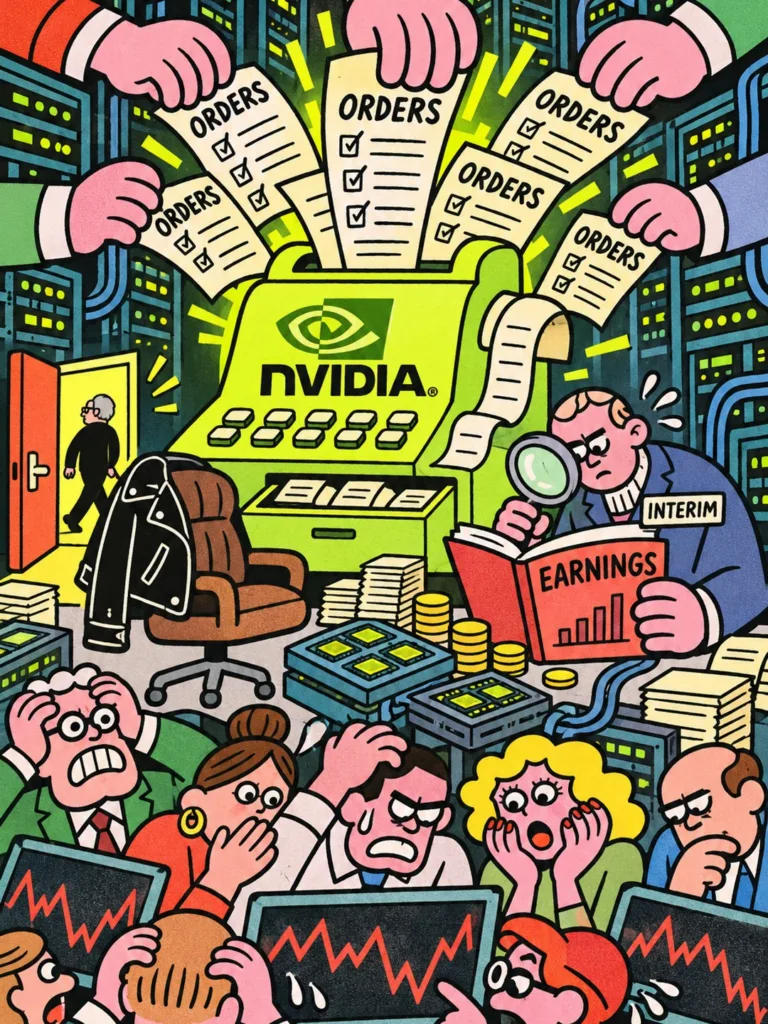
On Nov. 12 U.S. time, Nvidia's stock fell as much as 14% during the session before closing down 4.34%. It was the day Jensen Huang, who co-founded the company in 1993, stepped down as chief executive officer (CEO) and from the board after reports of an affair kept piling up.
The common take is that the founder was Nvidia, so the company's future is in doubt without him. But the real story lies elsewhere. More than 92% of Nvidia's revenue comes from AI data center chips that Big Tech buys, and whether those orders are holding up will show in hard numbers for the first time in the Nov. 17 earnings report.
- How far did the stock fall the day the founder left?
Nvidia named chief financial officer (CFO) Colette Kress interim CEO until a permanent one is chosen. Harvey Jones, a former CEO of chip-design software company Synopsys, becomes Nvidia's first board chair.
For most of the day the stock traded with a market value below $4 trillion, then rose late in the session to finish above it. At its worst the stock was down about 14% on the day, but the loss narrowed to 4.34% at the close.
The shock was not limited to that one day. The stock had already fallen more than 20% over the past month, and brokerage Bernstein cut its price target that day by half, from $400 to $200.
- What the market really feared was the deals Huang had struck
Wall Street feared the deals Huang had been making more than the empty seat itself. Susannah Streeter of asset manager Wealth Club called Kress a 'safe pair of hands' but said it would be hard for her to build business relationships as deep. That creates uncertainty over strategic priorities, pricing and supply agreements, she said.
Gil Luria of investment bank DA Davidson also noted that Nvidia has been led by its founder since the start and that Huang made much of the decision-making. The worry runs like this. Huang leaves → his leverage in price and supply talks with big customers could weaken → orders could then shrink.
- Nvidia's money comes from Big Tech's data center orders
In the second quarter, which ended July 26, Nvidia's revenue was $96.2 billion, up 106% from a year earlier. Of that, $89 billion was data center revenue, about 92.5% of the total. Data center revenue alone was up 117% from a year earlier. Put simply, nearly all the money Nvidia makes comes from AI data centers.
Data center revenue is what Big Tech and cloud companies pay for chips for their AI servers. Nvidia said its next-generation AI chip platform, 'Vera Rubin,' is already running at CoreWeave, Google Cloud, Microsoft Azure, Oracle Cloud and others.
Think of a neighborhood bakery that has changed owners. The bulk orders already in hand still get baked as planned. But whether bulk orders keep coming next month only shows up in the order book the new owner brings in.
- In the Nov. 17 earnings, start with the next-quarter revenue outlook
First, did third-quarter revenue meet the outlook the company set itself? On Aug. 26, Nvidia guided third-quarter revenue to $108 billion, plus or minus 2%. That is about 12% more than the second quarter, and it assumes no data center revenue from China.
But the third quarter ended before Huang left. Even if that number is good, it is only the result of orders taken while he was still there.
So what matters more is the fourth-quarter revenue outlook (guidance) that Kress will give for the first time. If the outlook is higher than the third quarter, big customers' orders were not shaken by the CEO vacuum. If it is lower, it signals that the pricing and supply worries Streeter flagged are starting to show up in the numbers.
Kress has been Nvidia's CFO since September 2013 and has presented at every quarterly earnings report. Before that, she spent 13 years at Microsoft, where she was CFO of its server and tools business. The person who knows the numbers best is taking her first test on them.
- BITPRESS Insight
CEO news and earnings numbers move different things. The founder's exit shook sentiment about what Nvidia is worth going forward, pulling the stock down as much as 14% intraday. What Nvidia actually earns, on the other hand, comes from the orders Big Tech places to build AI data centers.
So this drop will resolve one of two ways. If the order outlook holds, it was a discount born of worry about one person. If the order outlook shrinks, it becomes evidence from then on that the business itself is in trouble.
More than the size of the drop on the day the CEO left, whether the new CEO's next-quarter revenue outlook has shrunk will have a bigger say in where Nvidia's stock goes.
Sources
https://www.cnbc.com/2026/11/12/nvidia-nvda-jensen-huang-second-affair.html
https://www.foxbusiness.com/markets/colette-kress-named-nvidia-interim-ceo-jensen-huangs-abrupt-resignation-raises-investor-concerns
https://nvidianews.nvidia.com/news/nvidia-announces-financial-results-for-second-quarter-fiscal-2027
Glossary
Interim CEO — The person who runs the company until a new chief executive is chosen.
Data center revenue — Money Big Tech and cloud companies pay for Nvidia chips to run their AI servers.
Guidance — The forecast a company gives itself at an earnings report for next-quarter revenue and other figures.
Vera Rubin — The name of the next-generation AI chip platform Nvidia began producing in earnest in 2026.
BITPRESS articles are information to help your investment decisions, not a recommendation to buy or sell any stock or coin. Investment decisions and their results are your own responsibility.





