



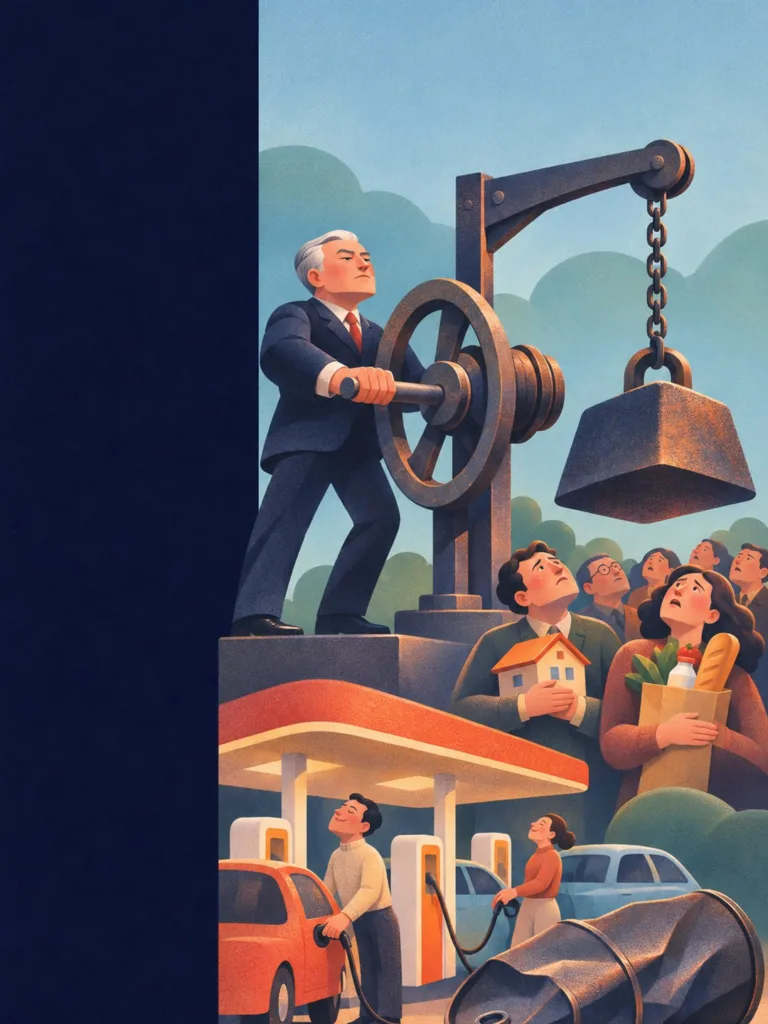
Brent crude, the benchmark for global oil prices, was about $92 a barrel on November 11, down more than 18% from late October. Yet the U.S. 10-year Treasury yield (the interest rate on money the U.S. government borrows for ten years) rose as high as 5.004% during trading on November 10, topping 5% again. A rising Treasury yield means existing Treasuries lose value and loans priced off that yield get more expensive.
The common reading goes like this. When gasoline gets cheaper, inflation worries ease, and interest rates fall along with them. Markets believed that for a long time.
But the real point lies elsewhere. What moves yields has shifted from oil to the Federal Reserve (the Fed, the U.S. central bank) and its expected rate hike in December.
- How far did oil fall, and what did yields do?
What pushed oil down was hope that the war between the U.S. and Iran could end in negotiations. Brent fell 7.63% on November 2 alone, and on November 10 it briefly dropped below $90 a barrel during trading. That same day, U.S. gasoline fell to $3.978 a gallon, below $4 for the first time since July.
Yet on that same November 10, the 10-year yield rose more than 0.08 percentage points before the open to 4.95%, then hit 5.004% during the day. Pump prices were falling while the cost of borrowing was climbing.
- Since mid-September, oil and yields have moved apart
This year, markets treated oil and the 10-year yield as moving together. They expected higher oil prices to push up delivery fees and restaurant prices, so lenders wanted more interest.
Nicholas Colas of DataTrek, a U.S. investment research firm, pointed out that this link has broken since mid-September. Yields rising on November 10 as oil fell fits that pattern.
- Inflation excluding energy rose more than expected
U.S. consumer prices for October, released on November 10, rose 0.4% from the previous month, above the 0.3% forecast. Core inflation (prices excluding items that swing with weather and war, such as food and energy) also rose 0.3%, above the 0.2% forecast. Markets read this as the earlier jump in energy prices spreading to other goods while the economy holds up.
Think of grocery shopping. Pump prices can fall in a day, but restaurant menu prices that rose in the meantime do not drop right away just because gas got cheaper. Still, what was confirmed is only one month's figure for October, and how long the trend lasts is not yet settled.
Put simply, U.S. prices are rising faster than expected even without gasoline. Because this is a one-month rate, even a small gap, if it repeats for several months, adds a lot to the annual inflation rate.
- Now the Fed's December decision is what sets rates
On September 16, the Fed raised its benchmark rate by 0.25 percentage point to 3.75% to 4%. It was the first hike since July 2023. On October 28 it held rates steady, but Governor Lisa Cook and Cleveland Fed President Beth Hammack dissented, arguing for a 0.25 percentage point hike.
Before the inflation report, Fed Governor Christopher Waller said that if prices came in higher than expected, the Fed should consider a 0.5 percentage point hike in December, adding, "If we raise only 0.25 percentage point, our credibility is at risk." As of November 10, markets put the odds of a December hike at 84%, and after the inflation report they began to see it as nearly certain. Dallas Fed President Lorie Logan favors raising 0.25 percentage point twice more and then pausing to assess.
The 10-year yield reflects expectations for how high the benchmark rate will go. Once expectations of a hike harden, the 10-year can rise even when oil falls.
- How does this reach my loan interest and growth stocks?
Even a 0.25 percentage point rise in loan rates, the size of one benchmark-rate hike, is quickly felt. The 10-year yield is a reference for loan rates such as U.S. mortgages, so when it rises, loan interest tends to rise too. Suppose you borrowed 300 million Korean won for 30 years with equal monthly payments of principal and interest (a repayment method where principal and interest together come to the same amount each month): at 4% a year you would pay about 1,432,000 won a month, and at 4.25%, about 1,476,000 won. That is about 44,000 won more a month (an illustrative calculation).
Growth stocks (stocks priced on far-off future profit rather than profit today) are weighed down for the same reason. When far-off profit is converted to today's value, it is discounted by the interest rate, so a higher rate takes a bigger bite. On November 10 the Nasdaq Composite fell 0.74%, about double the S&P 500's 0.38% drop.
- BITPRESS Insight
Treasury yields are rising despite lower oil because markets are looking at the Fed's December hike before they look at gasoline. The rule that lower oil means lower rates holds only when energy is all of inflation. Now the oil price has already spread to other goods, and the Fed is weighing a December hike to bring that inflation down. So bond buyers first price in how high the Fed will take its benchmark rate, ahead of the oil price.
In judging the weight on loan rates and growth stocks, what matters is not that oil fell. What comes first is whether inflation excluding energy holds up even with oil lower, and whether the Fed answers it with a rate hike.
Sources
https://cnbc.com/2026/11/09/stock-market-today-live-updates.html
https://www.federalreserve.gov/newsevents/pressreleases/monetary20261028a.htm
https://longbridge.com/news/302315745
https://www.nationthailand.com/news/world/40073041
https://tradingeconomics.com/united-states/government-bond-yield
https://tradingeconomics.com/commodity/brent-crude-oil
https://www.marketwatch.com/story/falling-oil-prices-are-no-longer-enough-to-bring-down-borrowing-costs-in-the-worlds-most-important-bond-market-3176d25a
Glossary
10-year Treasury yield — The interest rate on money the U.S. government borrows for ten years, and a benchmark for many loan rates, including mortgages.
Core inflation — Inflation measured without food and energy, which swing sharply with weather and war; used to see the underlying trend in prices.
Federal Reserve (the Fed) — The U.S. central bank. It sets the benchmark interest rate to manage prices and employment.
Benchmark rate — The policy rate set by the central bank, which underlies bank loan and deposit rates and Treasury yields.
Equal monthly payments — A repayment method where principal and interest together come to the same amount each month.
BITPRESS articles are information to help your investment decisions, not a recommendation to buy or sell any stock or coin. Investment decisions and their results are your own responsibility.





