



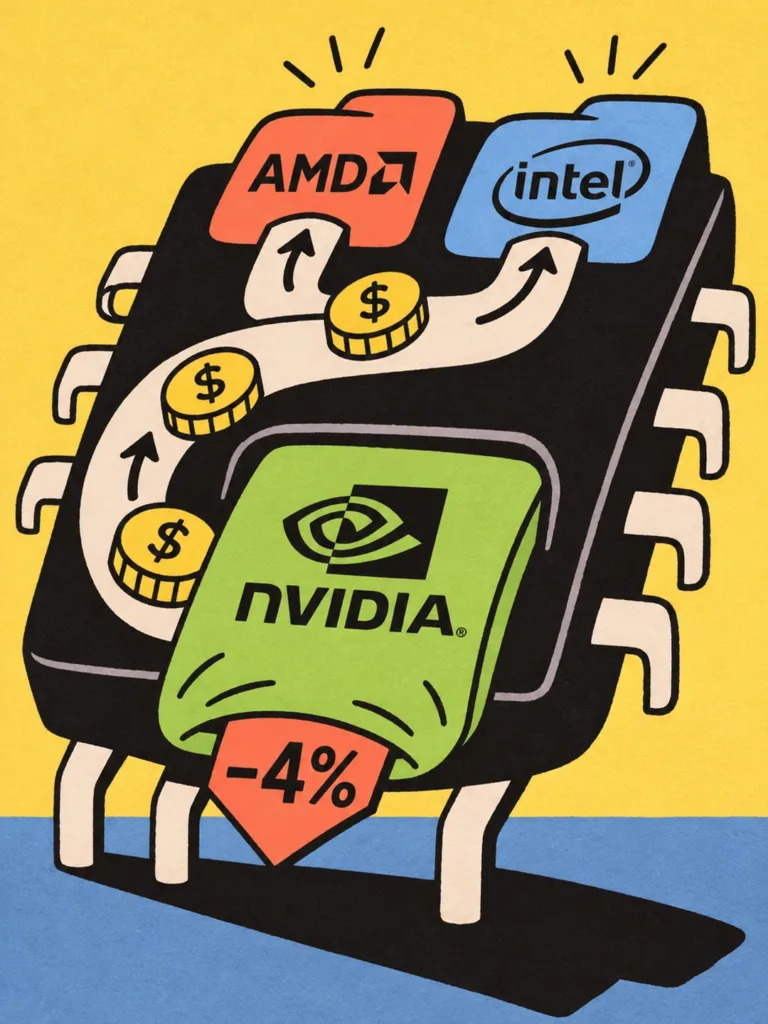
Nvidia's stock closed down 4.27% at $178.67 on Nov. 9 (US time). The drop wiped out nearly $200 billion in market value in a single day. Yet the S&P 500 index rose 2.3% the same day, its biggest one-day jump since April.
The common reading goes like this. CEO Jensen Huang is caught up in an affair scandal with a person suspected of ties to Chinese intelligence, so AI stocks as a whole must be shaky. The person under suspicion is not Huang himself but the other person. Nvidia makes up about 6.7% of the S&P 500, so when it fell sharply, the index usually fell with it.
But the real point lies elsewhere. The market read this not as bad news for the AI industry but as a CEO risk for one company, Nvidia. Money looking to invest in AI is read as having stayed in AI and moved to rival chipmakers. Still, with the whole index up 2.3% that day, the rivals' gains also include a broad market rebound.
- What happened at Nvidia?
In an internal memo over the weekend, Huang admitted to the affair and apologized to his family and employees. Alice Huang, named as the other person (a former executive at Singapore data center company Megaspeed International), is suspected of ties to Chinese intelligence. There are also allegations that she approached Huang to gather information on AI chips and the US administration's moves.
Nvidia's board has opened an investigation. But its statement said, "There is no reason to believe, so far, that national security or Nvidia's confidential information has been compromised." During the session the stock fell as much as 8.79% to $170.24 before trimming its losses.
Citigroup analysts pointed to two key variables. One is whether the findings are serious enough to shake Huang's position; the other is whether regulation could block Nvidia's sales.
- How does the index normally move when Nvidia falls?
Bloomberg data show that on days Nvidia dropped more than 4%, the S&P 500 fell more than 1.6% on average. On Nov. 5, too, when Nvidia fell 9.3%, the index dropped about 4.4%.
A day like this one, when Nvidia fell more than 4% while the index rose more than 2%, has happened only three times since Nvidia joined the S&P 500 in 2001. The previous one was in May 2009, when Nvidia's market value was about $5 billion. Put simply, Nvidia was a small company then with a small weight in the index, but this time a company that moves the index heavily fell and the index still rose.
Say you put KRW 10 million into each. Someone who put it in Nvidia lost about KRW 430,000 in a day, while someone who put it in an S&P 500 index fund gained about KRW 230,000.
- Why did other chip stocks rise even more that day?
If AI demand itself had been in doubt, other companies selling AI chips should have fallen too. Yet AMD (a US chipmaker that competes with Nvidia in AI chips) rose 13.26% and Broadcom (a US chipmaker that makes chips for AI data centers) rose 8.78%. Marvell (a custom AI chip company) rose 9.49%, Intel 5.49% and Qualcomm 3.66%, too.
Nvidia: down 4.27%. Rivals: up as much as 13.26%. That is far more than the index's 2.3% gain that day. The market is read as seeing not weaker AI chip sales but possible shakiness in Nvidia's leadership, and money looking to invest in AI is read as having moved to rival chips. Joachim Klement, an investment strategist at Panmure Liberum, also judged that the impact is for now contained within Nvidia.
Think of a famous neighborhood bakery whose owner is caught up in a scandal. Customers don't give up bread; they go to the bakery next door. But if flour prices spike, every bakery struggles together. This case was the former.
- What besides Nvidia pushed the index up?
Chips weren't the only reason the index rose. US stocks suffered their biggest one-day drop since April 2025 on Thursday, Nov. 5. On the 9th, oil fell more than 4% on news that US-Iran talks would continue, and the Dow rose more than 1,100 points.
It was a day when major indexes rebounded together after a big drop, and falling oil prices also lifted the market.
- When could this line break?
Huang's role at the company is so large that the risk is concentrated in him. Analyst Patrick Moorhead pointed out that Huang is a product strategist and the person who closes deals with big customers, and that he is the company's face in Washington and Beijing, a last role this episode puts at risk.
Klement added a warning. If Huang's position becomes shaky, Nvidia could cut back the support (investment, partnerships and the like) it has given other companies in Asia and the US, and the risk could then spread a bit more to other chip stocks. What differs from May 2009 is size. A company worth $5 billion then is now worth more than $4 trillion. Nvidia is scheduled to report third-quarter earnings on Nov. 17.
- BITPRESS Insight
The ones who lost this time were investors who had piled their money into the single stock Nvidia. Money looking to invest in the AI industry is read as not having left, only changing seats within the same industry. Still, with the whole index up 2.3% that day, the rivals' gains can't all be put down to money that moved over. People holding an index fund actually made a profit.
Where bad news points matters more than how big it is in deciding which way money flows. Bad news aimed at one CEO stays with that company; bad news aimed at demand spreads across the whole industry.
When one stock falls sharply, it's an industry-wide problem if rivals fall too, and a company-specific problem if rivals rise more than the market.
Sources
https://www.etoday.co.kr/news/view/2645996
https://www.bloomberg.com/news/articles/2026-11-09/nvidia-sees-historic-split-from-s-p-as-stock-sinks-market-soars
https://en.bloomingbit.io/feed/news/124030
https://www.cnbc.com/2026/11/09/nvidia-jensen-huang-chinese-spy-investigation.html
https://www.nbcnews.com/business/markets/nvidia-stock-falls-probe-ceos-relationship-chinese-spy-rcna608290
https://finance.yahoo.com/technology/live/nvidia-scandal-live-updates-nvidia-stock–board-investigates-ceo-jensen-huang-affair-alleged-chinese-spy-163130372.html
https://www.marketwatch.com/story/are-amd-and-broadcom-the-real-winners-of-the-nvidia-spy-scandal-d2343072
Glossary
S&P 500 — A benchmark stock index that bundles 500 large US companies; the larger a company's market value, the more it moves the index.
Key-person risk — The risk that a company's value leans heavily on one person, so a problem for that person shakes the company's value.
Board investigation — A process in which the board, which oversees a company's management, looks directly into a problem involving management.
Index fund — A fund that buys an index such as the S&P 500 as is, so if one stock falls while others rise, the losses are offset.
BITPRESS articles are information to help your investment decisions, not a recommendation to buy or sell any stock or coin. Investment decisions and their results are your own responsibility.





