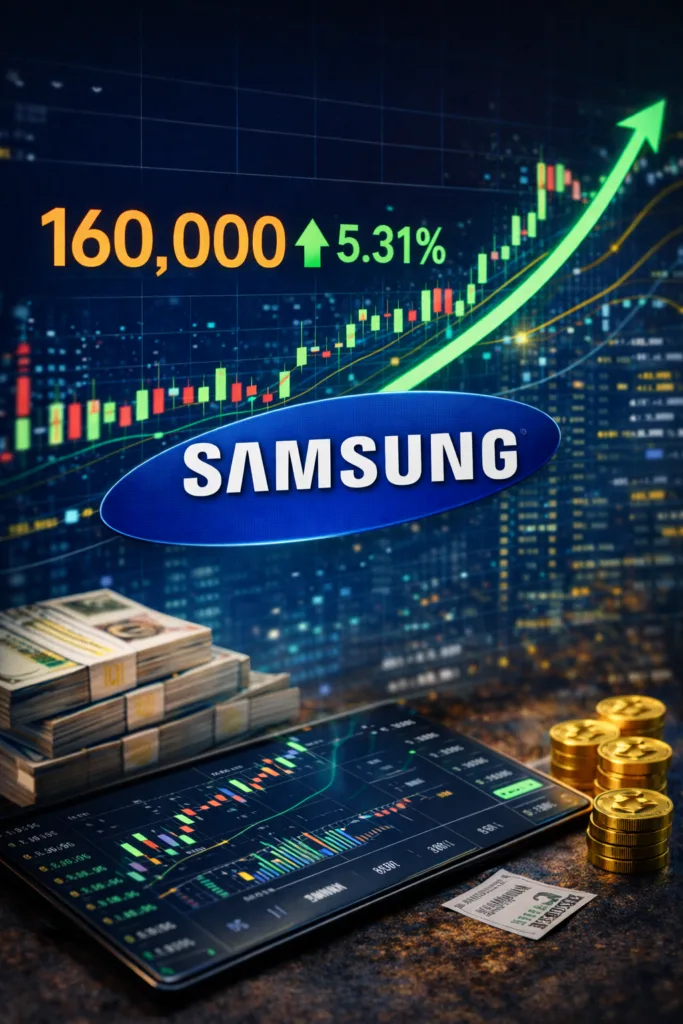
After breaking above KRW 120,000, Samsung Electronics set yet another all-time high.
The market's question is no longer "can Samsung hit KRW 120,000?"
How far should Samsung Electronics' corporate value be rewritten?That calculation has begun in earnest.
This surge is hard to explain by short-term flows or a year-end rally alone.
With three pillars moving at once, technological competitiveness, earnings structure and the global chip cycle,
the view is gaining ground that Samsung Electronics has entered a phase where its valuation itself is being reset.
1. Building its own smartphone GPU broke the "parts maker" frame
The factor most often cited as the starting point of this rally is
Samsung Electronics' success in developing its own dedicated smartphone GPU.
Samsung Electronics has long relied on design IP from foreign companies such as Qualcomm and Arm,
but by bringing this in-house it has reached the point where it can directly control core computing functions.
This is not just about cutting costs.
With tighter AI computing optimization, better power efficiency and close integration of chip design and software now possible,
Samsung Electronics is seen as having leapt a step forward into a full-fledged system semiconductor company.
The market sees this
as a signal of a shift from "parts supplier" to "technology platform company".
2. HBM market share is being reassessed, and the structure of earnings estimates is changing
Expected to kick into full gear next year,
the memory chip supercycle is another key reason behind the stock's rerating.
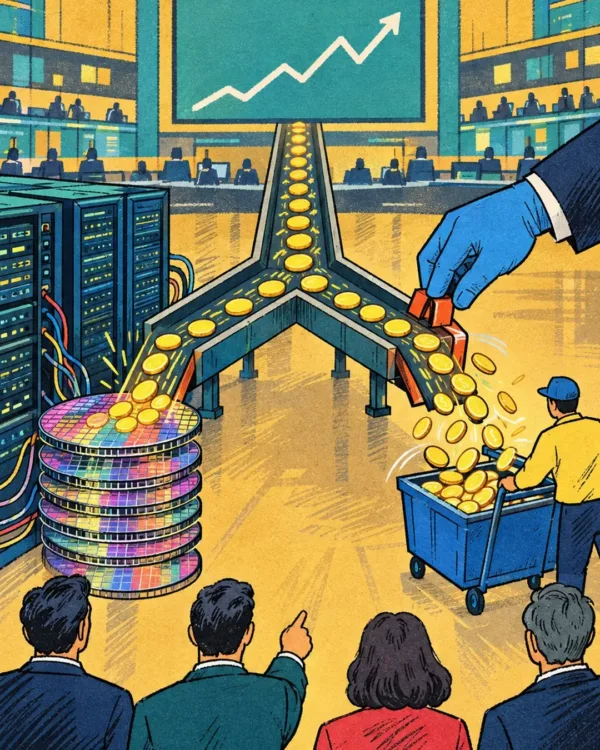
In particular, in the market for a key component of AI data centers,
HBM (high-bandwidth memory), Samsung Electronics' share
could expand from about 16% this year to the mid-to-high 30% range next year, according to forecasts.
This is not just a gain in market share.
It means the benefits of growing AI infrastructure investment have entered
a structure that feeds directly into revenue and profit.
Add forecasts of DRAM and NAND prices rising together,
and earnings consensus is being revised up quickly.
Global investment banks and Korean brokerages
have aggressively raised their forecasts for Samsung Electronics' operating profit next year
and started setting target prices in the KRW 150,000 to KRW 160,000 range.
3. A tailwind for chips from the U.S.: foreign money is back
The direct force pushing up the stock is
the return of foreign buying.
As chip companies including Micron (MU) rallied on the U.S. stock market
and worries about an AI bubble eased,
global money has been flowing back into the semiconductor sector.
In the process, in the Korean market,
Samsung Electronics is effectively the only stock serving as "the global chip bellwether" .
Buying has continued even after the stock broke its previous high,
leaving it open to the upside with no clear psychological resistance level.
4. [Insight] Why "KRW 160,000 Samsung" makes sense: recalculating the numbers and the P/E
Many investors
wonder, "It's at an all-time high; is it OK to get in now?"
But the market's talk of "KRW 160,000" rests on
a clear mathematical and valuation basis.
The key is the **P/E (price-to-earnings ratio)**.
According to recent brokerage consensus,
Samsung Electronics' 2026 revenue is projected at about KRW 380 trillion,
and operating profit at KRW 100 trillion to KRW 133 trillion .
That is well above its 2024-2025 results.
Based on these earnings,
at the current share price the 12-month forward P/E is only about 7 to 8 times.
Given that in past chip supercycles
Samsung Electronics traded at P/E multiples of 12 to 15 times,
even though the stock has risen sharply,
earnings are improving even faster, which can be read as a situation where the valuation burden has actually eased.
If the market rerates Samsung Electronics
as an AI platform company
and its P/E normalizes (re-rates) to just 12 times,
the stock could, by the numbers, have room to go above KRW 160,000according to this analysis.
In summary
Samsung Electronics' latest record high
① a technological leap in bringing the GPU in-house,
② a shift in earnings structure centered on HBM, and
③ a recovery in the chip cycle led by the United States:
is the result of these three factors coming together at once.
The market has now begun to price Samsung Electronics
not as "a large-cap stock that rises when the economy recovers," but
as a benchmark asset of the AI and semiconductor era.
BITPRESS Insight
"KRW 160,000 Samsung" is not just a numbers game.
The current share price trend
is the process of unwinding the undervaluation discount long attached to Samsung Electronics.
The key is not whether there will be a short-term pullback.
It is how long this rerating phase can be justified by earnings and technology,
The answer will come from upcoming earnings and
how fast the AI memory market actually grows.