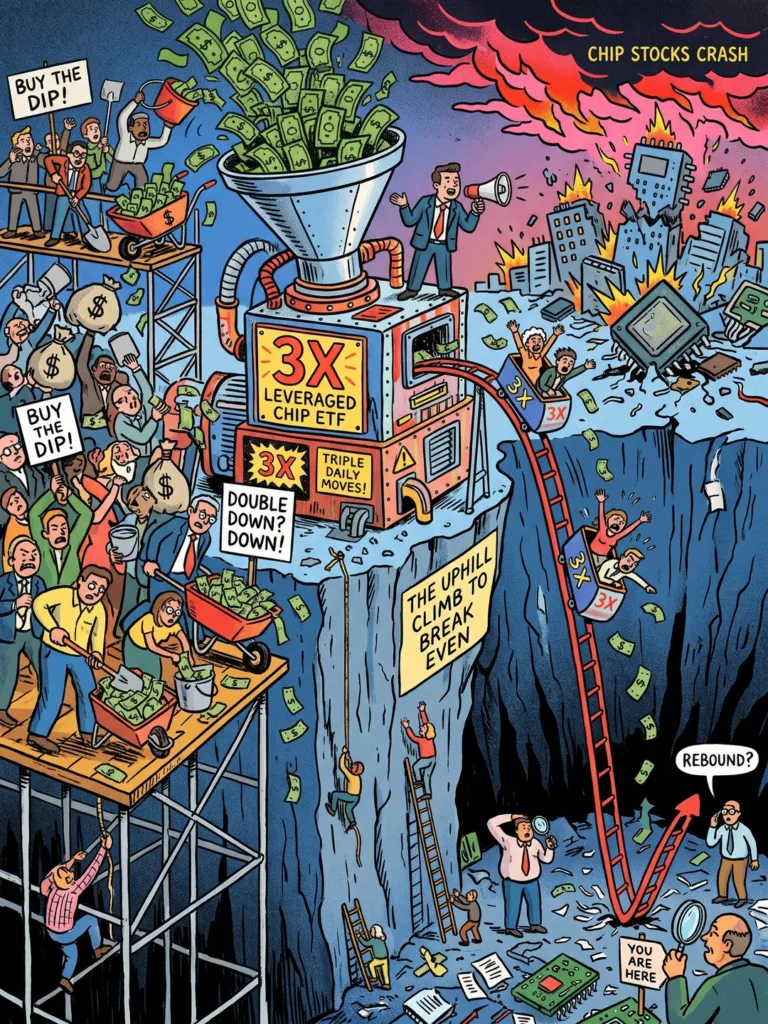
The Philadelphia Semiconductor Index, the benchmark for U.S. chip stocks, fell 12% over six trading days through Oct. 15 (U.S. time), erasing about $1 trillion in market value. The same week, SOXL, a 3x chip ETF, took in more money in a single week than at any time in the fund's history. An ETF is a fund that bundles many stocks and trades like a single stock, and SOXL is a leveraged product that tracks the daily moves of chip stocks at three times their size.
The common reading is buying the dip: prices have fallen a lot, so a rebound should pay triple. But the key is time, not direction. A 3x ETF promises 3x for one day only, and after a big drop it takes a much bigger gain to get back.
- How much came into SOXL in a week prices fell?
Bloomberg reported that about $3.8 billion had flowed into SOXL through Oct. 15, putting it on track for its biggest weekly inflow ever. After the week ended, Investing.com reported that the full week's inflow through Oct. 16 topped $7 billion, a record for the fund. The two figures differ because they cover different periods.
The whole fund was worth about $19 billion as of Oct. 15, which gives a sense of how large a week's inflow was. Meanwhile the fund's price kept falling. Through Oct. 15 it fell nearly 21% that week alone, and through Oct. 16 it lost about a third over the full week. That it had risen a lot before the drop may also have caught eyes: as of Oct. 15, SOXL was up 163% for the year.
- Why did chip stocks fall that week?
Reuters reported that a hot inflation reading raised bets on interest-rate hikes. If prices come in higher than expected → bets grow that rates will rise further → debt-heavy AI companies may face higher borrowing costs, and worry attaches. The same report said the $50 billion in debt at CoreWeave, an AI cloud company, triggered a crisis of confidence that spread into a selloff in AI and tech stocks.
The Philadelphia Semiconductor Index fell more than 11% that week (Oct. 12-16), and its eight-session losing streak was the longest since October 2008. The earlier 12% covers six trading days through Oct. 15, so the periods differ. Put simply, it was a week when chip stocks all got much cheaper at once.
- Why does a 3x ETF triple only for a day?
SOXL aims for three times the daily return not of the Philadelphia Semiconductor Index but of the NYSE Semiconductor Index. While the Philadelphia Semiconductor Index fell more than 11% that week, SOXL lost about a third.
Because the 3x is recalculated every day, returns over weeks or months can differ from three times the index's. Here is a hypothetical calculation. If the index falls 10% in a day, it needs an 11.1% gain to get back. The index goes from $1,000 to $900 and back to $1,000, but a 3x ETF falls 30% and then rises 33.3%, so $1,000 goes to $700 and ends at only about $930.
Think of a discount tag. Take 30% off a $10 item and it costs $7, and adding 33% back only gets you to $9.30. The difference is that with a 3x ETF this math repeats every day.
- Where does money that went in during the drop stand now?
For any asset, losing about a third means a 50% gain is needed to get back to even. If $10,000 became about $6,670, getting back to $10,000 takes that $6,670 growing by 50%. A 3x ETF swings three times as hard, so losses this big come much faster than with the index.
On Monday, Oct. 19, the week after, the chip index ended its eight-session losing streak and SOXL rose 5.32%. A $6,670 stake would be about $7,020, still far from even. Still, the $7 billion-plus came in over a week at many different prices, so the size of the loss depends on when each person bought.
- BITPRESS Insight
People who bought a 3x ETF in a week prices fell were betting on direction: that chips would eventually rise again. Even if that call is right, a 3x ETF's results depend on when it rises and how much it swings along the way. Because it recalculates 3x every day, the rougher the ups and downs, the smaller the share you can keep from the same rebound.
So with a 3x ETF, ask "how long will I hold it, and through how much swinging?" before "will it rise?" Unless it is a trade that ends within days, start by allowing for the fact that when the index is back to even, your money may not be.
Sources
https://www.bloomberg.com/news/articles/2026-10-15/a-1-trillion-chip-rout-draws-billions-into-leveraged-etf-bets
https://www.briefs.co/news/etf-buyers-pile-into-chip-funds-as-1-trillion-gets-vaporized/
https://ph.investing.com/news/stock-market-news/leveraged-chip-fund-sees-record-7-billion-inflow-amid-selloff-93CH-2635643
https://www.investing.com/news/stock-market-news/us-chip-stocks-rise-after-steepest-weekly-selloff-in-months-4957420
https://finance.biggo.com/news/3cf1aba9-a412-43e8-a3b8-87024eb5ee3d
https://www.etfcentral.com/fund/SOXL
https://247wallst.com/investing/etf/2026/08/19/soxl-turns-every-1-nvidia-move-into-3-heres-what-10000-did-in-the-last-12-months/
Glossary
ETF — A fund that bundles many stocks into one basket and trades on an exchange like a single stock.
Leveraged ETF — An ETF built to move a set multiple, such as 2x or 3x, of its underlying index's daily move.
SOXL — Direxion's ETF, built to track three times the daily return of the NYSE Semiconductor Index.
Philadelphia Semiconductor Index — The benchmark index of major U.S.-listed chip companies' shares, showing how the chip sector is doing.
Gain needed to break even — How much a fallen price must rise from its lower level to get back to its original value; the bigger the fall, the much bigger the gain needed.
BITPRESS articles are information to help your investment decisions, not a recommendation to buy or sell any stock or coin. Investment decisions and their results are your own responsibility.