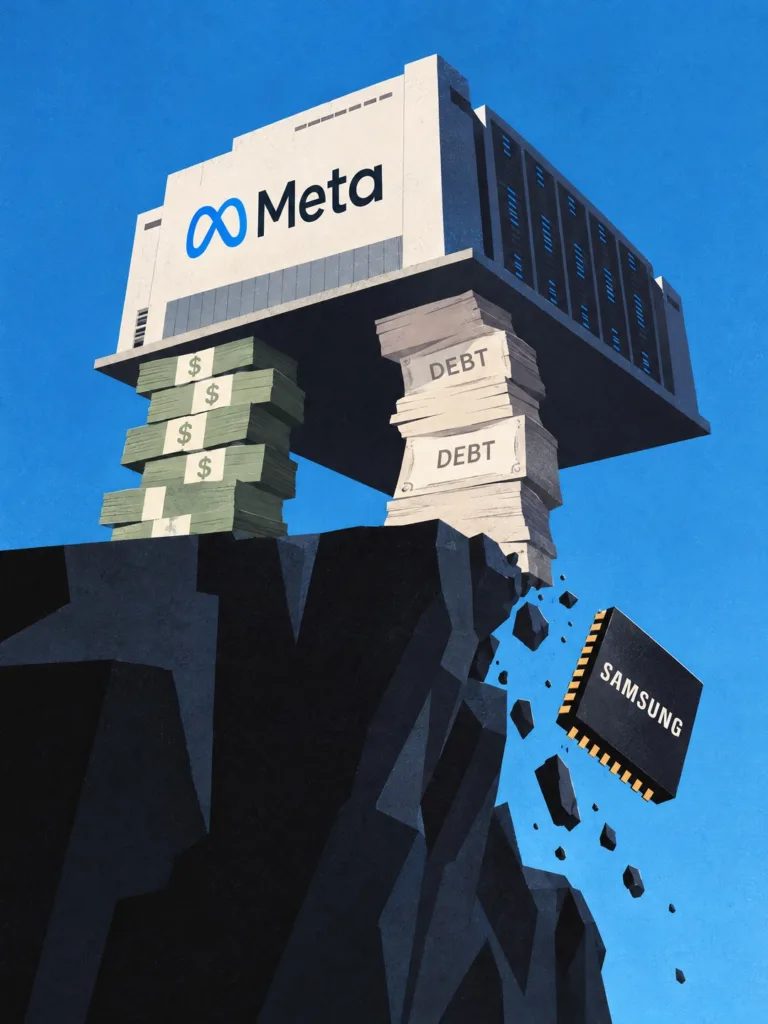
Samsung Electronics shares rose 5.7% on Oct. 21, then fell 4.03% the next day, Oct. 22, to close at KRW 214,500 (about $162). In between, Meta (the company that runs Facebook and Instagram) reported third-quarter results in the U.S. Revenue was $64.6 billion, up 26% from a year earlier, and Meta raised the low end of its 2026 capital spending outlook from $130 billion to $135 billion.
The common reading goes like this. If big tech companies spend more on AI data centers, that is good news for Samsung Electronics, which sells the memory chips that go inside them. The Oct. 22 drop also had profit-taking after the previous day's surge and the end of a share buyback behind it. But Meta's results raised a separate question. It is not how much Meta spends, but what it pays for it with.
- What did Meta say it will spend more on?
Meta spent $34.91 billion on facilities such as data centers in the third quarter. That is about 80% more than the $19.37 billion in the same period a year earlier. Meta said it will keep investing aggressively next year, for its core business and for AI.
For a chip company, that money is a purchase order. Building a data center takes servers, and servers need memory. Going only this far, Samsung Electronics shares should have gone up.
- Why did Meta end up spending more than it earned?
The problem is the third-quarter cash math. The cash Meta's business brought in (operating cash flow) was $32.79 billion, and its spending on facilities was higher than that. As a result, free cash flow, the cash left after investing, was a $2.12 billion deficit. A year earlier it was a $10.63 billion surplus, and this is the first deficit in more than 10 years.
Think of a month when a household spends more fixing up the house than it earns. A family with a $3,280 paycheck that spends $3,490 on a remodel is $210 short. And Meta is a household that plans to make the construction even bigger next year.
- Where does the missing money come from?
Meta's long-term debt rose from $58.7 billion at the end of last year to $80.9 billion at the end of September, an increase of $22.2 billion in nine months. Meta also decided to create a new class of non-voting shares (Class C), and it named financing as one of the reasons, citing the large investments the AI race requires.
The money Meta has already promised to spend later (future spending commitments) is also about $825 billion, up about 18% in the three months since July. Picture a household whose overdraft and installment contracts are growing together. Still, Meta held $82.45 billion in cash and securities at the end of September, so it has not run out of money.
- How does worry about a customer's wallet reach chip stocks?
A chip company's sales come from big tech's investment. If customers invest using debt and new shares, the reading goes, they could slow their orders the moment borrowing gets harder. Some analysts also said that worry over how AI infrastructure spending is financed weighs on expectations for orders at Korean chip stocks. Stock prices can price in such a possibility before orders actually fall.
This doubt is not new. The debate over whether AI investment pays off began with credit risk at CoreWeave, a U.S. AI cloud company. Daishin Securities analyst Lee Kyung-min said that, with cash flow in deficit because of heavy capital spending, it still needs to be confirmed whether AI investment is profitable.
The worry showed up in numbers after the Korean market closed. On Oct. 22 (U.S. time), Meta's shares fell 7%. The premium on its five-year credit default swaps (CDS), the insurance premium paid against the risk that Meta cannot repay its debt, rose in a day from about 107 basis points to 114.5 basis points, a record high (100 basis points equal 1 percentage point). That means insuring $10 billion of Meta's debt costs about $114.5 million a year. But because this happened after Korean trading ended, it cannot be counted as the cause of Samsung Electronics' Oct. 22 drop.
- What else piled on in the Oct. 22 drop?
Domestic buying and selling also played a part in the Oct. 22 drop. SK hynix fell 5.49% as well. After the previous day's 5.7% rise, some investors sold to lock in gains. The share buybacks of Samsung Electronics (about KRW 15 trillion, or about $11.3 billion) and SK hynix (about KRW 40 trillion, or about $30.2 billion) also ended on Oct. 6 and Oct. 21, respectively. Net buying by other corporations (corporate investors such as companies) had once averaged KRW 1.6 trillion (about $1.21 billion) a day, but came to only KRW 20.5 billion (about $15.5 million) that day.
The Bank of Korea added to the pressure by holding its policy rate at 3.00% a year and saying it will keep its tight stance (keeping rates high to squeeze the money supply). Put simply, it was a day when a big, steady buyer of shares dropped out and interest-rate pressure remained. Meta's cash deficit was a background worry on top of that, one the market began to link to chip stocks.
- BITPRESS Insight
This episode adds one more yardstick for reading AI investment news. Until now, how much big tech spent moved chip stocks. Now one part of the market has started to look separately at whether that money comes from cash earned by the core business or from debt and new shares.
Investment made with earned money can continue as long as the earnings do. Investment made with borrowed money can lose speed if borrowing gets more expensive or lenders hesitate. For a chip company's shareholders, even at the same amount of spending, the first kind is the longer-lasting order.
Meta says AI investment is already lifting its advertising revenue. Even so, the fall in Meta's shares and the rise in its debt insurance premium read as a sign that the market is worried that spending has gone beyond the cash being earned. Read AI investment news by "is it spent within what is earned?" rather than "how much is spent?" and you can see why chip stocks can fall even on good news.
Sources
https://s21.q4cdn.com/399680738/files/doc_news/Meta-Reports-Third-Quarter-2026-Results-2026.pdf
https://www.hankyung.com/article/202610230400i
https://www.newspim.com/news/view/20261022001100
https://www.kdfnews.com/news/articleView.html?idxno=189766
https://www.topstarnews.net/news/articleView.html?idxno=16255068
https://kbmaeil.com/article/20261021500691
https://www.seoul.co.kr/news/economy/securities/2026/10/22/20261022500155
https://cryptobriefing.com/meta-negative-free-cash-flow-ai-spending/
Glossary
Free cash flow — The cash left over after a company takes the money it spent on capital spending out of the cash its core business earned.
Capital spending — Money spent on long-lasting facilities and equipment, such as data centers and servers.
Credit default swap (CDS) — The insurance premium paid against the risk that a company cannot repay its debt; the higher it rises, the riskier the market thinks that company's debt is.
Future spending commitments — Amounts a company has already contracted to pay later, such as data center leases and equipment purchases.
Other corporations — A group in stock market statistics for investors that are ordinary companies rather than financial firms.
BITPRESS articles are information to help your investment decisions, not a recommendation to buy or sell any stock or coin. Investment decisions and their results are your own responsibility.