



On Oct. 8, the Nasdaq Composite fell 1.3% to close at 27,193.34, its worst day since mid-August. That afternoon a British business newspaper reported that OpenAI, the maker of ChatGPT, had told investors its end-of-September revenue (stretched to a full year) was close to $50 billion, and the drop deepened afterward. That is about $20 billion less than the $70 billion figure that had been going around.
Did OpenAI earn less than expected? No. OpenAI's revenue did not fall; it grew. The problem was an expectation people had set in advance, "it must be around $70 billion," which was too high. When that expectation broke, even the stocks of companies with big deals with OpenAI fell along with it.
- Did OpenAI's revenue really fall?
No. In the materials OpenAI showed investors, revenue growth for July-September was 77%. The revenue here is annualized revenue: if the company keeps earning at the current pace for a full year, how much would that be? For example, one month's sales times 12.
Think of exam scores. A friend who scored 60 gets an 80. But everyone expected a 90. The score clearly went up, yet a story says "fell short of expectations." That is what happened here. On top of that, the expected figure was not something OpenAI had said.
- Where did the $70 billion figure come from?
Investors built it by calculation. First they estimated OpenAI's August revenue at about $40 billion. Then OpenAI told them it had "grown more than 70% since the third quarter began," so they added that 70% to the $40 billion and got about $70 billion.
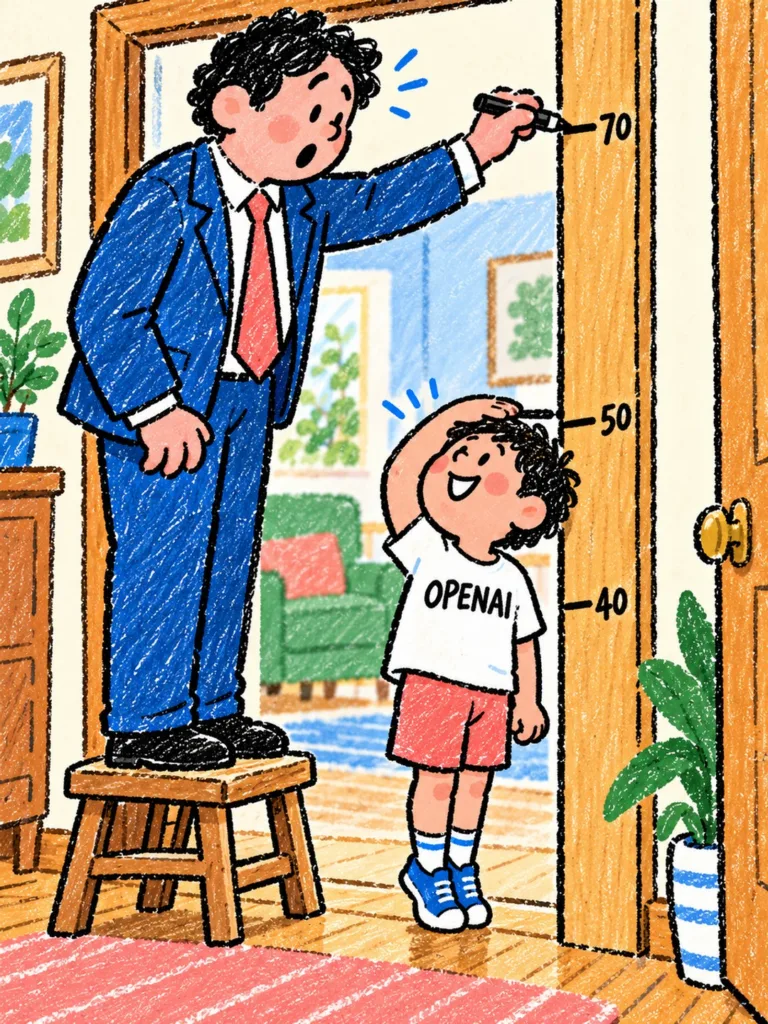
But the 70% was growth measured from July. It can be seen as stacked on top of an August number that had already grown. Think of the height marks on a door frame: the grown-ups heard, "The child has grown 70% since July," and drew a mark even higher on top of the height measured in August. When they actually measured, it was about $50 billion. The child clearly grew but didn't reach the mark. In short, OpenAI didn't shrink; the mark was too high.
- Who fell harder on the Nasdaq?
The same day, the S&P 500 (an index of 500 large US companies) fell 0.5%, while the Nasdaq fell 1.3%. Chip and cloud companies fell harder. Oracle (an enterprise software and cloud company) fell 5.5%, Broadcom (an AI chip company) 4.4%, AMD 3.9% and Nvidia 2.9%.
If you held $10,000 of Oracle stock, that is about $550 lost in a day (a simple calculation that ignores exchange-rate changes). The day was also weighed down by higher oil prices and US Treasury yields at their highest in decades.
- Why do other companies' stocks fall on OpenAI's number?
Because OpenAI is a big customer of these companies. Oracle and CoreWeave (a data-center company that rents out computers for AI) have cloud-computing contracts with OpenAI. Nvidia and AMD are also tied to OpenAI through business. Think of a shop with a big deal with one regular customer. When word spreads that the customer is struggling, the shop owner gets nervous too.
The chain goes like this. OpenAI's revenue has to grow fast → so it can pay for future computing contracts → those payments become revenue for data-center and chip companies. When the first link's number falters, the links after it come under doubt too.
It isn't the first time. On April 28, after a report that OpenAI had missed its revenue and user targets, Oracle fell 4.1% and CoreWeave 5.8%. That report also cited an anonymous source saying OpenAI's chief financial officer had told leaders internally she was worried the company might not be able to pay for future computing contracts if revenue didn't grow fast enough. This time the news was not that revenue had fallen, yet the stocks moved the same way.
- BITPRESS Insight
The people whose decisions change with this news are those holding US AI stocks like Nvidia and Oracle, or Nasdaq funds that hold a lot of them. Even when their own results stay the same, these companies can fall together if the number of their big customer, OpenAI, comes into doubt.
The number that shook the market this time was not one OpenAI announced. It was an expectation built by adding 70% to an investor estimate of $40 billion. OpenAI isn't listed yet, so its revenue becomes known in pieces through investor materials and news reports, which makes it easy for estimates to creep in.
There is one rule of thumb. "Lower than expected" is not the same as "fell." When you look at an AI stock, tell apart who the company's big customer is, and whether that customer's number was reported by the customer itself or estimated by others.
Sources
https://finance.yahoo.com/technology/article/openais-annualized-revenue-20-billion-lower-than-prior-investor-estimates-174058048.html
https://finance.yahoo.com/markets/stocks/articles/openai-corrects-annualized-revenue-figure-183756345.html
https://krdo.com/money/cnn-business-consumer/2026/10/08/tech-stocks-drop-after-report-that-openais-revenue-is-lower-than-expected/
https://finance.yahoo.com/markets/live/stock-market-today-thursday-october-8-dow-sp-500-nasdaq-080537884.html
https://investing.com/news/stock-market-news/us-stock-futures-steady-after-nasdaq-slides-on-openai-revenue-concerns-4940052
https://www.taipeitimes.com/News/biz/archives/2026/04/29/2003856411
Glossary
Annualized revenue run rate — Revenue from a certain period stretched to a full year (e.g., one month's sales × 12), used to gauge the size of fast-growing companies.
Nasdaq Composite — An index of the stocks listed on the US Nasdaq exchange, with a heavy weighting in tech stocks.
Cloud-computing contract — A deal in which an AI company rents computers in a data center, paying usage fees instead of buying them.
BITPRESS articles are information to help your investment decisions, not a recommendation to buy or sell any stock or coin. Investment decisions and their results are your own responsibility.





