



On Oct. 1, Korea reported that its September semiconductor exports reached $60.3 billion, up 262.8% from a year earlier. It was the first time a single product, chips, topped $60 billion in a month. On Sept. 30 (U.S. time), U.S. memory chipmaker Micron reported better-than-expected results.
That day, the KOSPI closed up 1.95% at 6,971.35 and the KOSDAQ up 4.48% at 894.29. It looks like a day when everyone was buying. But individual investors net sold (sold more than they bought) KRW 1.7115 trillion on the KOSPI and KRW 878.8 billion on the KOSDAQ, about KRW 2.6 trillion in total. One clue lies not in the chip outlook but in the index levels at which individuals bought their shares.
- Buying in the morning, individuals were selling by the close
The morning was different. At 10:30 a.m., with the KOSPI down 0.23% at 6,822.25, individuals were net buying KRW 537.5 billion. The direction flipped after that, and by the close they were net sellers of KRW 1.7115 trillion.
Who took the other side differed by market. Of the KRW 1.7115 trillion individuals sold on the KOSPI, institutional investors (pension funds, asset managers and the like) took KRW 417.1 billion. Foreigners also sold KRW 336.6 billion, so the rest was effectively taken by investors other than institutions and foreigners (such as "other corporations," meaning ordinary companies). On the KOSDAQ, foreigners bought KRW 327 billion and institutions KRW 570.4 billion.
Put simply, the shares individuals let go were split between institutions and foreigners on the KOSDAQ, and between institutions and other investors on the KOSPI.
- For individuals, 6,971 may be just below break-even
The KOSPI topped 9,000 in June, then fell to 5,593.56 on July 30. "In the May-June bull market, individual investors' net buying was concentrated at KOSPI 7000-8500, and most of it is in loss territory," a brokerage analyst said. The Oct. 1 close of 6,971 sits just below that range.
Individuals net bought KRW 42.401 trillion of KOSPI stocks in June, KRW 5.372 trillion in July and KRW 3.235 trillion in August. Put simply, the index range where individuals bought the most is 7,000-8,500, and they kept buying for a while even after the index fell.
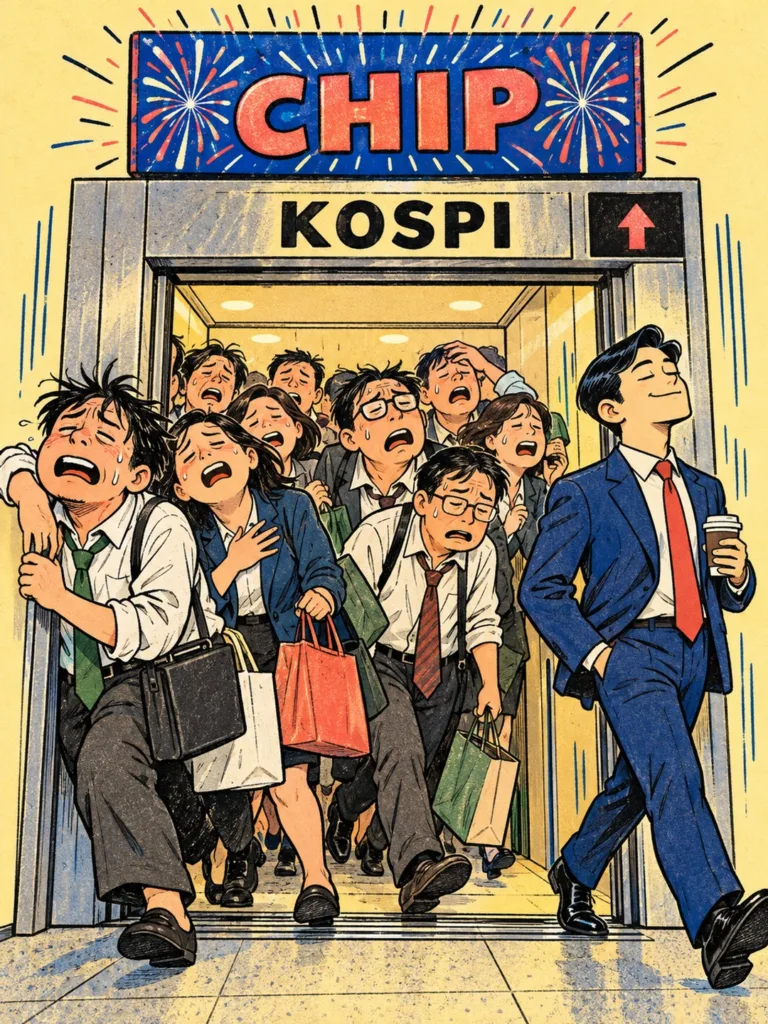
Holding a losing stock is like riding an elevator that stalled and then started moving again. Some of the people stuck inside for a long time get off as soon as the doors open. But unlike an elevator, a stock can keep going up even if nobody gets off. The selling on the KOSPI on Oct. 1 may have included this kind of break-even selling.
The KRW 878.8 billion of selling on the KOSDAQ should be looked at apart from this explanation. The analyst's view is about KOSPI index levels, and the KOSDAQ rose 4.48% that day, a bigger gain.
- Buyers in June-August, individuals turned sellers in September
Individuals net sold KRW 14.197 trillion of KOSPI stocks over the month of September (in June-August they were net buyers). Foreigners also sold KRW 21.591 trillion that month. Institutions and other corporations (ordinary companies) took those shares, and the index held at 6,500-7,080.
Money parked in brokerage accounts to buy stocks (investor deposits) stood at KRW 104.6644 trillion on Sept. 30, 25.08% below its June 4 peak. Average daily KOSPI trading value fell 57.63%, from KRW 50.215 trillion in May to KRW 21.278 trillion in September.
Put simply, individuals' money, which had been flowing into Korean stocks, turned to flowing out in September. The same analyst cited the reasons as "individuals' growing losses and shrinking stock gains, a switch to U.S. stocks, and a move into high-yield products on high interest rates."
- The same day, 10 big brokerages began tightening margin loans on their own
Oct. 1 was also the day the securities industry began tightening "debt-funded investing" (investing with borrowed money). From that day, 10 large brokerages (designated comprehensive financial investment firms) voluntarily keep the money they lend customers (credit extension) within 90% of their equity capital. The legal limit is 100% of equity capital.
From Oct. 19, a rule that makes a brokerage cut back when loans tied to one stock exceed 15% of its total margin lending will apply only to new loans. A plan to raise the minimum deposit rate (the share you must pay with your own money when buying stocks on credit) from 45% to 50% is set to take effect within this year. Once it does, buying KRW 10 million of stock will take at least KRW 5 million of your own money, up from KRW 4.5 million.
Still, the industry sees brokerages already lending less than 90% as having room to lend more. There is no basis for concluding that individuals' selling that day was caused by the debt rules. What is clear is that these 10 brokerages now have a self-imposed cap on loans for debt-funded investing.
- After July's plunge, KRW 1 trillion of debt-funded stock was force-sold
The balance of debt-funded investing (the value of stocks bought with money borrowed from brokerages, known as margin loans) peaked at KRW 38.6328 trillion on June 24. After the KOSPI plunged in July, stocks bought with loans that couldn't be repaid were sold off by brokerages (forced liquidation). Forced liquidations reached KRW 1 trillion in July, and the balance fell by about KRW 10 trillion to KRW 28.935 trillion on July 31.
The balance has grown again since, to KRW 33.3901 trillion on Sept. 30. From Sept. 1 to 23, debt on the KOSPI fell KRW 902.4 billion while debt on the KOSDAQ rose KRW 248.7 billion, lifting the KOSDAQ's share of total debt from 20.9% to 22.1%.
Two things are different from July. The balance is KRW 5.2427 trillion below its peak, and the 10 large brokerages have started managing their margin loans themselves. One thing is the same: in stocks heavy with borrowed money, forced selling can deepen the drop when prices fall.
- BITPRESS Insight
No single reason explains why individuals sold on the day chips set a record. But on the KOSPI, the index climbed to just below 7,000-8,500, the range where individuals bought the most, so that selling may have included break-even selling. The KOSDAQ selling lies outside this explanation.
In this setup, the buyers matter. Who takes the shares individuals may let go at 7,000-8,500 will shape how high the index goes next. On Oct. 1, the buyers on the KOSPI were institutions and investors other than institutions and foreigners, while foreigners were selling.
The rule of thumb is simple: if the index rises on good news while individuals sell, look at where individuals bought and who takes those shares, together. This data alone can't tell whether it is a signal of a fall.
Sources
https://www.fnnews.com/news/202610010917096745
https://www.mt.co.kr/economy/2026/10/01/2026100109004992929
https://www.newspim.com/news/view/20261001001167
https://www.fnnews.com/news/202610011036530980
https://www.etoday.co.kr/news/view/2631591
https://www.newspim.com/news/view/20260923000893
https://www.fnnews.com/news/202609291811062984
https://www.newsis.com/view/NISX20260804_0003735544
Glossary
Net selling — The amount by which sales exceed purchases over the same period, meaning that much money was pulled out of the market.
MarginLoans — Borrowing money from a brokerage to buy stocks, commonly called "debt-funded investing" in Korea.
Forced liquidation — When stocks bought with borrowed money fall and the collateral runs short, the brokerage sells those stocks without the investor's consent.
DownPaymentRatio — The share of the total you must pay upfront with your own money when buying stocks on credit.
Investor deposits — Cash put in brokerage accounts to buy stocks, showing money waiting to enter the market.
KOSPI — Korea's main stock index of large listed companies, its version of the S&P 500.
KOSDAQ — Korea's second stock market, home to smaller and tech-heavy companies.
Other corporations — Ordinary company accounts that are not individuals, foreigners or institutions; Korea's exchange reports them as a separate investor group.
BITPRESS articles are information to help your investment decisions, not a recommendation to buy or sell any stock or coin. Investment decisions and their results are your own responsibility.





