
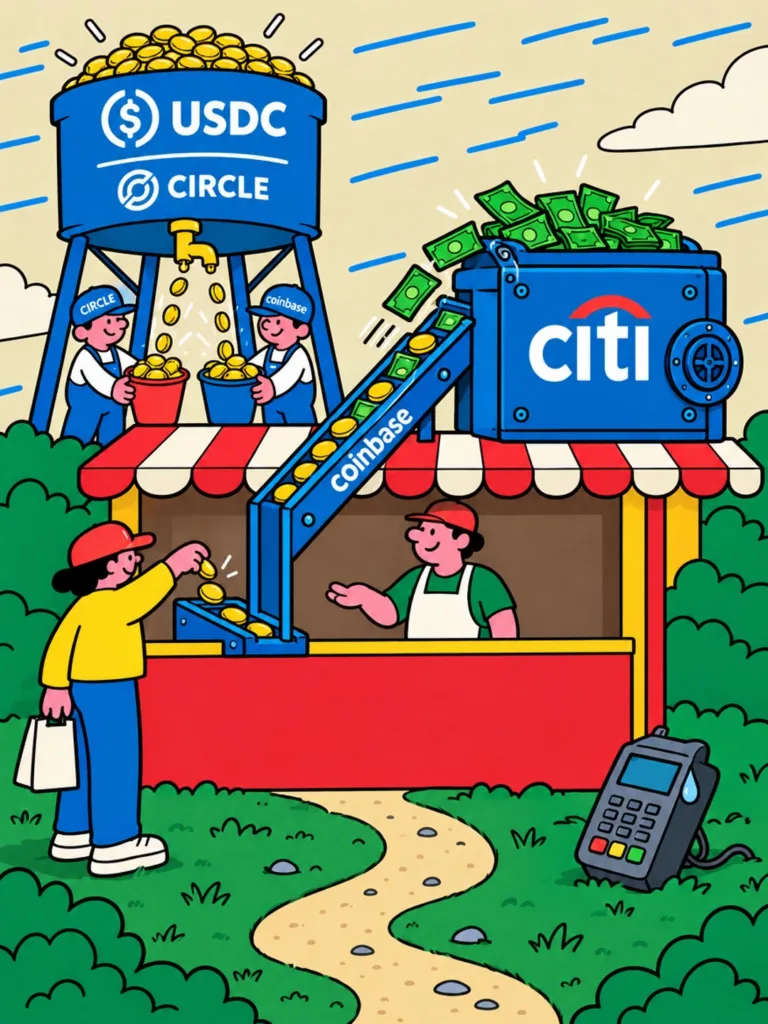
Citi (Citigroup), a major US bank that moves about $6 trillion a day, announced on Sept. 28 that it will let business clients using its merchant payments service accept stablecoin payments (coins whose value is pegged 1:1 to the dollar) at checkout. Coinbase, the largest US crypto exchange, will handle the crypto side. The service is set to launch in the US first; the announcement gave no start date and no merchant fees.
The news is often read as "even big Wall Street banks now accept crypto." But take the structure apart and the shop never needs to hold or manage the coins it receives. So who makes money on these payments? The payment fee has not been disclosed, and Coinbase's and Circle's existing stablecoin income depends heavily on balances and interest rates. Whether these payments will add to that income is not yet known.
- Customers pay in coins; shops get dollars
Business clients using Spring by Citi, Citi's merchant payments platform (a Citi service that handles payment acceptance, gateway processing and settlement), will be able to accept stablecoins at checkout. Coinbase's payments service automatically converts the coins it receives into dollars, and Citi, as the bank of record, pays the money into the shop's account (settlement).
Think of it as a checkout counter with a currency exchange attached: however the customer pays, only dollars pile up in the shop's till. The difference is that the customer pays not in foreign cash but in coins pegged to the dollar, and the shop never has to store or manage those coins.
- Why Citi teamed up with Coinbase
The two companies had earlier announced, in October, a plan to work together on digital asset payments, and this announcement fills in the details. Citi banks 90% of the top e-commerce companies and 15 of the world's 20 largest fintechs. Citi says the service lets merchants serve more than 150 million stablecoin holders worldwide. That is Citi's figure for the holders merchants could theoretically reach, not a count of actual customers.
A product running the other way was also announced: a virtual account that automatically converts dollars arriving in Coinbase business customers' accounts into stablecoins. "Citi is exactly the kind of regulated banking partner the digital asset economy needs to move from experimentation to everyday commerce," said Brett Tejpaul, Head of Coinbase Institutional.
- Until now, shops paid a fee on every card sale
US shops pay a fee every time they accept a card. According to the Merchants Payments Coalition, a US merchant group drawing on Nilson Report data, credit and debit card fees combined reached a record $198.25 billion over 2025. For Visa and Mastercard credit cards alone, the average fee rate was 2.36%.
Put simply, a $1,000 credit-card sale costs the shop about $23.60 in fees (a hypothetical calculation applying the average Visa and Mastercard credit-card fee rate). Payment fees are a cost the shop bears, so if stablecoin payments are cheaper, the shop's cost structure could change. But Citi and Coinbase have not disclosed what they will charge merchants, so it is not yet known how much shops would save, or who would get that share if card fees shift to coins.
- Stablecoin money comes from interest on balances, not fees
Stablecoin companies make money differently from card companies. Take USDC (a dollar stablecoin issued by Circle): Circle invests the dollars people hand over when they buy coins, mostly in US Treasuries and cash equivalents, and earns interest. Circle's reserve income in the second quarter of 2026 was $668 million.
Coinbase receives part of that income. According to Circle's 2025 IPO filing, Coinbase is known to receive a set proportion of part of Circle's USDC reserve income. The current terms cannot be confirmed from public documents. Coinbase's stablecoin revenue in Q2 2026 was $292.15 million, about 25% of its $1.1543 billion in net revenue (our calculation).
Put simply, card fees arise each time a payment happens, while stablecoin income builds up while coins sit in someone's wallet. Under Citi's setup, though, the shop's coins are converted into dollars automatically. That means no coin balance earning interest is left on the shop's side, at least.
- What happened with Shopify a year ago
This has happened once before. In June 2025, online store platform Shopify teamed up with Coinbase and Stripe to let merchants accept USDC payments. The default was automatic settlement in local currency, and merchants could choose to receive USDC directly. Shopify also dropped foreign transaction and currency conversion fees.
A year later, Coinbase's results hold a twist. In Q2 2026, the average USDC balance held in Coinbase products hit a record $20 billion. Yet stablecoin revenue fell 5% from a year earlier. Lower interest rates alone cut it by $55.9 million, and higher balances made up part of that. How much Shopify payments contributed to these figures has not been disclosed.
Citi is a major bank, so the impact could grow if more businesses sign up, but the size of the service has not been disclosed. As with Shopify, automatic conversion is the default on the shop's side. And Coinbase's and Circle's existing stablecoin income still depends more on balances and interest rates than on payment counts.
- BITPRESS Insight
The question of who makes the money is still open. Shops may get terms cheaper than the 2.36% credit-card average, but those terms have not been disclosed. Citi handles dollar settlement, putting it on the path merchant funds travel. Coinbase's and Circle's existing income has come from stablecoin balances rather than from individual payments.
So for this news to show up in Coinbase's and Circle's results, USDC balances will likely need to grow, more than payment counts. Even when balances grow, income can fall if rates drop. This year's second quarter is an example.
There are three tests. Check whether the article says coins are converted automatically, to see whether the shop holds any coins. Check Circle's and Coinbase's quarterly reports to see whether USDC balances grew. Check whether interest rates are rising or falling. Until the payment fee is also disclosed, stablecoin-payment news is best read as conditional.
Sources
https://www.citigroup.com/global/news/press-release/2026/citi-coinbase-expand-collaboration-connect-digital-fiat-payments-corporations-consumers
https://finance.yahoo.com/markets/crypto/articles/citi-turns-coinbase-help-clients-011000834.html
https://www.pymnts.com/cryptocurrency/2026/citi-coinbase-unlock-merchant-stablecoin-payments-with-fiat-settlement/
https://www.sec.gov/Archives/edgar/data/0001679788/000167978826000088/coin-20260630.htm
https://investor.coinbase.com/news/news-details/2026/Coinbase-Q2-Earnings-Everything-Exchange-Drives-3rd-Consecutive-Quarter-of-Record-Crypto-Trading-Volume-Market-Share-Revenue-Diversification-and-Resilience/default.aspx
https://www.circle.com/pressroom/circle-reports-second-quarter-2026-results
https://decrypt.co/312757/coinbase-circles-residual-usdc-reserve-revenue-filing
https://merchantspaymentscoalition.com/credit-and-debit-card-swipe-fees-reach-record-19825-billion-president-and-congress-call-action
https://www.fintechweekly.com/magazine/articles/shopify-coinbase-stripe-stablecoin-usdc-commerce
Glossary
Stablecoin — A coin whose value is pegged 1:1 to a government currency such as the dollar, so its price barely moves.
USDC — A dollar stablecoin issued by US-based Circle, which keeps the dollars it receives in Treasuries and cash equivalents.
Settlement — The step after a payment in which the card company or bank actually pays the money into the shop's account.
Reserve income — Interest a stablecoin issuer earns by parking the dollars it received for coins in assets such as Treasuries.
Card processing fee — The share of each sale a shop pays to card companies and payment processors when it accepts a card.
BITPRESS articles are information to help your investment decisions, not a recommendation to buy or sell any stock or coin. Investment decisions and their results are your own responsibility.