

One of the things Bitcoin investors bring up most often is the “four-year cycle theory.” Put simply, it is the hypothesis that Bitcoin has repeated a pattern of bull market, overheating, bear market, bottoming and reaccumulation, centered on the halving that comes roughly every four years.
Halving
Note: An event in which the new Bitcoin reward paid to miners on the Bitcoin network is cut in half roughly every four years. After the April 20, 2024 halving, the block reward fell from 6.25 BTC to 3.125 BTC.
As of May 25, 2026, Bitcoin is 765 days past the April 20, 2024 halving. After hitting an all-time high of about $126,198 on Oct. 6, 2025, it was pushed down to around $60,000 in February 2026 and is now moving around $77,000.
Looking at these numbers alone, the conclusion is fairly clear. By the four-year cycle theory, we are not at the start of a bull market; we are closer to a bear market or reaccumulation phase, after the post-2024-halving bull run has already peaked and come down.
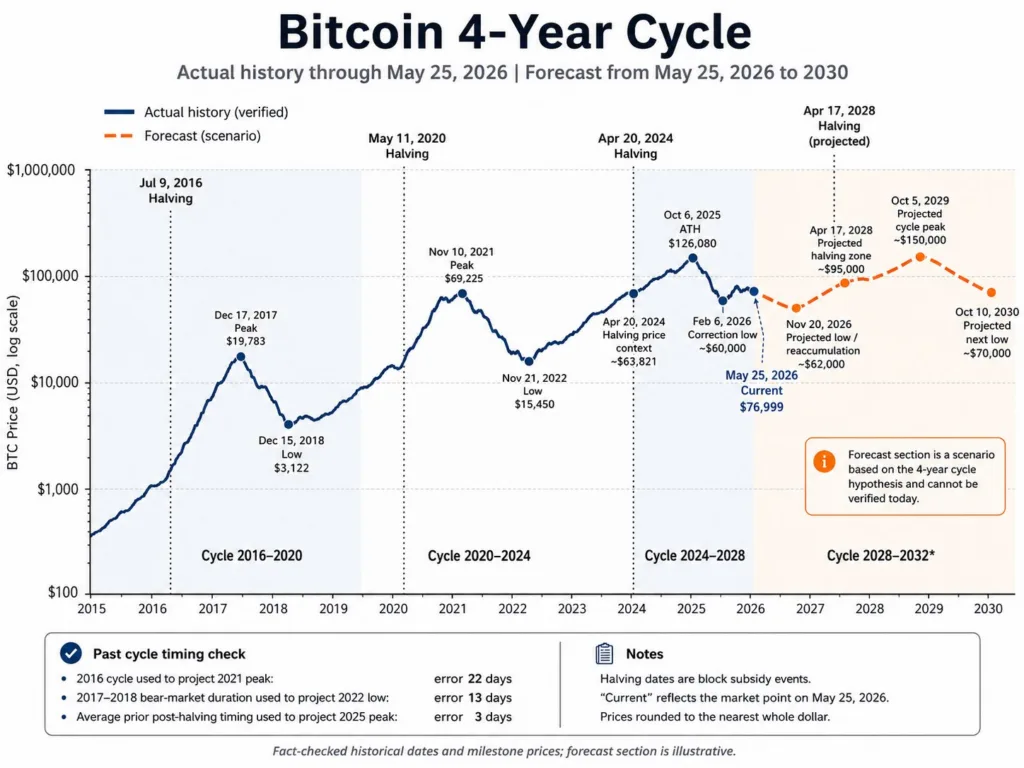
- Where are we on the four-year cycle?
The four-year cycle theory generally breaks into four stages: first, the bottoming phase; second, the run-up around the halving; third, the full-blown rally and overheating after the halving; and fourth, the bear market after the peak.
Applying this framework to the 2024 halving cycle, the bottom formed around $15,450 on Nov. 21, 2022, and recovery began in 2023. In 2024, U.S. spot Bitcoin ETF approvals coincided with the halving to strengthen the uptrend, and the cycle's highest confirmed peak so far came at about $126,198 on Oct. 6, 2025.
Spot Bitcoin ETF
Note: An exchange-traded fund that holds actual Bitcoin as its underlying asset or tracks its price. Investors can get exposure to Bitcoin's price through a regular brokerage account without storing Bitcoin themselves.
In other words, it makes more sense to see the present not as “the early stage of a post-halving rally” but as “a phase of correction and bottom-testing after the post-halving peak has passed.” Bitcoin may already have hit the low of this downturn near $60,000 in February 2026, but going by the four-year cycle theory alone, bottom confirmation and re-accumulation could continue through the fourth quarter of 2026.
- When did the rise begin?
In this cycle, the rise had already begun after the November 2022 low. But a rally strong enough for investors to feel took hold in the second half of 2023, and it gathered speed in early 2024 with expectations for, and then the actual approval of, U.S. spot Bitcoin ETFs.
The previous two cycles looked similar. The December 2018 low came about 513 days before the May 2020 halving, and the November 2022 low came about 516 days before the April 2024 halving. Applying that average to the next halving, expected on April 17, 2028, puts the candidate for the next cycle's low or re-accumulation starting point around Nov. 20, 2026, roughly 514 days earlier.
So, judging by the four-year cycle theory alone, the next full-fledged bull market would start between the fourth quarter of 2026 and the first quarter of 2027. However, if the low of about $60,000 from February 2026 is never broken, one could also argue the market has already made an earlier-than-expected bottom and entered a recovery phase.
- When did the decline begin?
It is natural to date this cycle's decline from the all-time high on Oct. 6, 2025. Bitcoin peaked at about $126,198 and began falling that same month, sliding to the low $60,000s by February 2026. The drawdown from the peak was about 52%.
The current level of about $77,000 is roughly 39% below the peak. That is different from the 75–84% crashes of 2018 or 2022, but it is enough to signal that the overheated phase of the bull market is over.
The key point is that this downturn may be shallower than past ones. U.S. spot ETFs, institutional investors, holdings by listed companies and a more mature derivatives market have created a structure unlike past cycles. So rather than “the four-year cycle repeats exactly,” the more realistic reading is “the timetable is similar, but the depth of the drop and the speed of recovery may differ.”
- Forecasting the next turning points
Assuming the four-year cycle theory holds going forward, the next scenario can be summarized as follows.
The candidate window for the next re-accumulation or start of a rise is the fourth quarter of 2026 to the first quarter of 2027. Narrowed down to dates, the key period is around November 2026. This comes from the pattern that the past two lows formed about 513–516 days before the following halving.
The next halving is currently expected around April 17, 2028. A halving is a single-day event, but markets usually price in expectations over several months before and after it. So from late 2027 through the first half of 2028, expectations for the next up-cycle could grow steadily stronger.
The candidate for the next peak is around October 2029. The peak after the 2016 halving came 526 days later, the peak after the 2020 halving came 548 days later, and the peak so far after the 2024 halving came 534 days later. The average of the three is about 536 days. Adding that to the expected halving on April 17, 2028 gives around Oct. 5, 2029.
The candidate for the start of the next decline is the fourth quarter of 2029. If a peak forms around October 2029, a bear market of about a year could begin from that point, as in the past. The candidate for the next low is the third to fourth quarter of 2030. It took 363 days from the 2017 peak to the 2018 low and 376 days from the 2021 peak to the 2022 low, an average of about 370 days. Applied to the October 2029 peak candidate, that makes around October 2030 the candidate for the next low.
In short, the next big pattern under the four-year cycle theory is: “a low or re-accumulation in late 2026, the 2028 halving, a peak around October 2029, and a low in the second half of 2030.”
- How accurate was the four-year cycle theory over the last two cycles?
More accurate than you might think. In particular, “the time from halving to peak” was strikingly similar.
After the July 9, 2016 halving, Bitcoin hit what was then an all-time high of about $19,783 on Dec. 17, 2017. The time from halving to peak was 526 days. A low then formed near $3,122 on Dec. 15, 2018. It took 363 days to go from peak to low.
After the May 11, 2020 halving, Bitcoin peaked near $69,225 on Nov. 10, 2021. The time from halving to peak was 548 days. Had you applied the 526 days of the 2016 cycle to predict the 2021 peak, the forecast date would have been Oct. 19, 2021, just 22 days off the actual peak.
The bear-market low was similar. Applying the 363 days from the 2017 peak to the 2018 low to the Nov. 10, 2021 peak gives an expected low of Nov. 8, 2022. The actual low came on Nov. 21, 2022 near $15,450, a gap of 13 days.
The forecast for the peak after the 2024 halving was also quite accurate. The average time from halving to peak in the 2016 and 2020 cycles is about 537 days. Applied to the April 20, 2024 halving, the expected peak date is Oct. 9, 2025. The actual all-time high to date came on Oct. 6, 2025, only three days off.
But this is “accuracy on dates,” not “accuracy on prices.” The four-year cycle theory has been quite useful for gauging when market sentiment is likely to shift, but it is not a model that can pinpoint how high Bitcoin will rise or how low it will fall.
- Conclusion: Is this the start of a buying window or a danger zone?
Going by the four-year cycle theory alone, this is not the start of a bull market. The bull market already began in late 2022 and likely wrapped up with the October 2025 peak. We are now in a correction more than seven months past the peak, a period for testing whether the roughly $60,000 low of February 2026 is the real bottom.
Conservatively, it is reasonable to leave room for another drop and a bottoming process through the second half of 2026, especially around October–November 2026. On the other hand, if the February 2026 low holds and Bitcoin decisively reclaims its key moving averages near $83,000, the market can be seen as having already moved into the next re-accumulation phase.
For investors, the point is not whether “the four-year cycle theory is right or wrong.” What matters more is that the theory is less a tool for predicting prices and more a timetable for taking the market's temperature. On the current timetable, Bitcoin is closer to a cool phase preparing for the next cycle than to the heart of a hot bull market.
7. BITPRESS Insight
Over the past two cycles, Bitcoin's four-year cycle theory was a framework that predicted fairly accurately both the timing of peaks (12–18 months after a halving) and the shape of declines (75–84% corrections from the peak). In this fifth cycle, too, the October 2025 peak fell within that range. The present (May 2026) is, in theory, in the middle of the post-peak correction, and based on past patterns the low is most likely to form between June and October 2026. The most likely window for the next bull market to reignite is from the second half of 2027 to around the 2028 halving. Still, investors should keep in mind that the steady inflow of institutional money through spot ETFs may limit the depth of declines compared with the past, while also keeping upside multiples below past levels. The four-year cycle theory remains useful as a compass for locating roughly where the market stands, but its limits as a precise timing tool are becoming increasingly clear.
Sources
https://www.digitaltoday.co.kr/news/articleView.html?idxno=667241
https://kr.beincrypto.com/bitcoin-halving-2028-is-now-half-complete/
https://www.digitaltoday.co.kr/news/articleView.html?idxno=656904
https://www.blockmedia.co.kr/archives/1052687
https://cryptonews.com/kr/news/bitcoin-halving/
https://www.kucoin.com/news/articles/when-was-the-last-crypto-bear-market-are-we-in-one-in-2026-how-long-will-it-last
https://www.coingecko.com/learn/bitcoin-price-predictions-expert-forecasts
https://www.fidelity.com/learning-center/trading-investing/four-year-bitcoin-and-crypto-cycles
https://mudrex.com/learn/when-will-bitcoin-bottom-prediction/
https://www.calebandbrown.com/blog/is-bitcoins-four-year-cycle-broken/
https://beincrypto.com/analyst-reveals-when-the-current-bitcoin-cycle-will-peak/