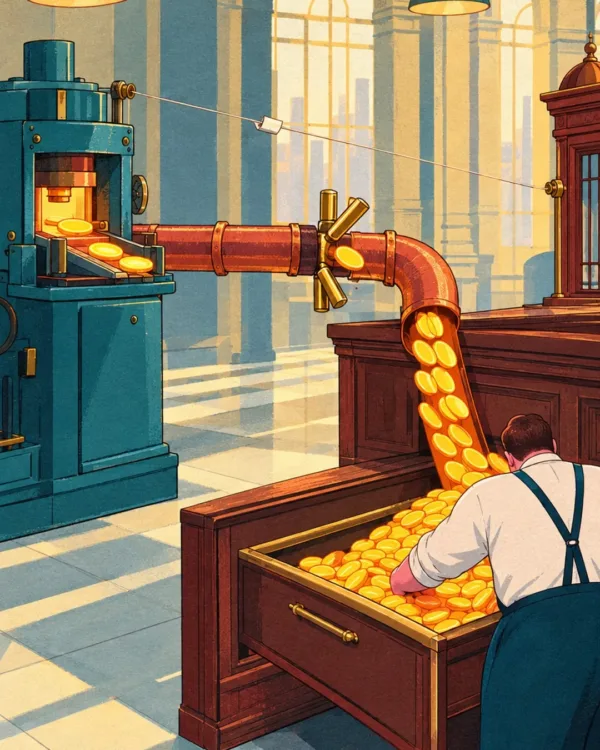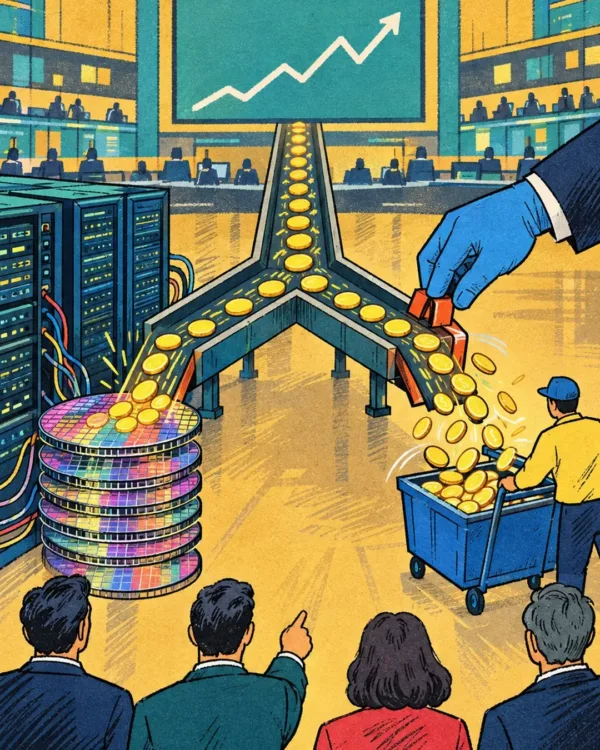

News that Samsung Electronics' management and union reached a tentative deal on bonuses of around 12% just before a general strike may look like a routine labor story. But the heart of the matter is not a pay raise. It is that a new price tag now exists for how directly workers at Korea's big companies can claim a share of corporate profits.
To be precise, the Samsung Electronics agreement is not yet final. It is a tentative deal awaiting a vote by union members. According to reports, management and the union agreed on a bonus package totaling around 12%, combining 1.5% OPI with a 10.5% special performance bonus for the semiconductor (DS) division. It also includes scrapping the bonus cap and paying the full after-tax amount in company shares. So the key point is not simply “they get 12% more,” but that the basis for performance pay is becoming more and more structured.
OPI stands for Overall Performance Incentive, a profit-sharing bonus paid when the company earns profits above a set target.
Treasury shares are a company's own shares that it holds or buys back. They may do less for immediate spending than cash, but when the stock is rising they can create a bigger wealth effect for employees.
1. The key point: Samsung's 12% is not just a bonus but “turning workers into asset holders”
What makes this deal economically important is how it pays out. Paying the full after-tax amount in company shares means employees receive not plain cash but an asset tied to Samsung Electronics' share price. This blurs the line between labor income and capital income. Employees become both wage earners and quasi-shareholders who stand to gain when the stock rises.
This is where a new trend in Korea's economy begins. If past bonuses were closer to a reward of “you worked hard, so here's more,” payouts tied to profit margins, operating profit and business results may now expand. Then workers become not a fixed cost for the company but holders of a right to share in boom-time profits. Put simply, workers at large companies end up holding a kind of call option on their company's upcycle.
A call option is the right to profit when the price of a particular asset rises. Here, it is used as a metaphor for a structure in which employees share in part of the company's earnings and stock gains.
This structure is likely to ripple through asset markets more than through consumer spending. Cash bonuses easily flow into cars, travel, luxury goods and tuition, but share-based bonuses tend to stay in brokerage accounts or, over time, become part of a down payment on a home. In other words, Samsung's 12% may affect apartment deposits more strongly than department store sales.
2. This trend is not just about Samsung
As the attached image shows, bonus disputes are no longer a Samsung Electronics issue alone. They are spreading to Hyundai Motor and Kia, HD Hyundai Heavy Industries, Kakao, LG Uplus, Doosan Enerbility and others. Hyundai Motor's union demanded bonuses equal to 30% of net profit, and Kakao's union demanded 13–14% of operating profit. LG Uplus's union also demanded 30% of operating profit, and Doosan Enerbility's union has called for changes to how bonuses are paid.
What matters is that many of these are “union demands,” not “confirmed payouts.” So it is hard to say that Korea's big companies as a whole have already moved into a large-scale profit-sharing system. But there is a clear change: the center of wage negotiations is shifting from base pay toward “profit sharing.”
Wage and collective bargaining is the process in which management and labor negotiate pay, benefits and working conditions.
3. The first-round effect on Korea's economy: a bigger boost to assets than to consumption
On the surface, bigger bonuses boost domestic demand. When money is released, spending rises, and when spending rises, the economy can pick up. But there is an important catch. Big-company bonuses are not money spread evenly across the population. They are concentrated liquidity flowing to specific industries, regions and job types.
That is exactly why they can act more strongly on asset markets than on overall consumption. High earners at large companies, in particular, are not just consumers; they tend to become the “marginal buyers” who accept the last asking price in the housing market. Home prices do not move with average income. They are set by the purchasing power of whoever can pay the final price.
So even if total bonuses are a small share of GDP, they can exert considerable force on sale prices in specific apartment complexes or neighborhoods. If Samsung Electronics DS employees, Pangyo tech workers, Hyundai Motor and Kia researchers and production workers, and people in shipbuilding and power equipment all receive large bonuses at the same time, they may become a new layer of home buyers before they become drivers of consumer spending.
4. Housing impact: not a nationwide rise but a rise in the “bonus belt”
The most likely scenario is not a nationwide apartment rally but a local repricing in areas that benefit from bonuses. Chip bonuses are likely to affect the Suwon, Yongin, Hwaseong, Dongtan, Pyeongtaek, Seongnam and Pangyo corridor. Auto bonuses could affect Ulsan, Hwaseong, Gwangmyeong, Uiwang and the Yangjae area. Tech bonuses are likely to show up more sensitively in Pangyo, Bundang, Seongsu, Mapo and areas with easy access to Gangnam.
This means bonuses are not money that lifts all of Korean real estate, but money that pushes prices one notch higher in areas where demand is already concentrated. Areas that combine new buildings, good school districts, transit and short commutes react fastest to this kind of liquidity.
The core logic is simple. Bonuses are not fuel that raises home prices nationwide; they are fuel that speeds up “the decision to buy” among people who can afford good homes. In a market with plenty of pent-up demand, that difference is huge. The moment renters who have been holding out on jeonse (Korea's lump-sum deposit lease) decide, prompted by a bonus, that “it's time to buy,” asking prices can move before transaction volume does.
5. Price impact: tutoring and dining costs may rise before ramen prices
It is hard to argue that spreading bonuses will immediately trigger broad-based inflation. Demand for daily necessities does not surge just because incomes rise. Big-company employees do not buy twice as much rice or ramen because they got a bonus.
Instead, the money is more likely to flow into services. Think children's education, dining out, travel, medical care, fitness, premium appliances, car options, interior design, weddings and pet services. In other words, bonus-driven price pressure may be felt first in service prices in urban middle-class neighborhoods rather than on supermarket price tags.
Areas dense with high-income office workers, such as Pangyo, Gangnam, Mapo, Yongsan, Dongtan, Bundang and Gwanggyo, may react faster than the national average. In the end, bonuses are less a variable that shakes prices across Korea than one that pushes up the cost of living people feel in specific neighborhoods.
6. Bigger bonuses could both narrow and widen inequality
On the surface, bigger bonuses look like better distribution that increases workers' share. To some extent, that is true. But from the perspective of Korea's economy as a whole, the outcome is not necessarily equal.
When unions of full-time workers at large companies share more of the profits, those employees build income and wealth faster. Meanwhile, workers at suppliers and subcontractors, employees of small and midsize companies, freelancers and the self-employed have a hard time accessing the same structure. In that case, Korea's inequality could be reshaped from a simple “capital vs. labor” divide into “workers who get bonuses vs. workers who don't.”
This gap shows up most clearly in real estate. Workers who receive bonuses can move to homes in better locations and enter asset markets faster. Those who don't must cope with rising jeonse prices and higher barriers to buying at the same time. So bonuses can be a ladder for one group, and for another, a sign that the ladder has just gotten taller.
7. Impact on companies: the bigger issue is “cycle conflict,” not less investment
For companies, profit-linked bonuses clearly have advantages. Concentrating rewards on employees when results are strong can lower turnover, strengthen cohesion and reduce labor disputes. In industries with fierce competition for talent, such as semiconductors and AI, the pay system itself is a competitive edge.
But the risks are considerable. Semiconductors, autos, shipbuilding and power equipment are classic cyclical industries. Operating profit soars in booms but can shrink quickly or turn into losses in downturns. The problem is that bonus expectations formed during a boom stay as a psychological baseline even in a downturn.
In other words, even when this dispute ends, the next one could be bigger. The issue ahead is likely to shift from “how much more do we get this year” to “how much will be shared when the industry turns down.” The more a system for sharing excess profits takes root, the bigger the disappointment in a downturn may be.
8. The most realistic three-stage outlook
First, in the short term, the benchmark for big-company labor negotiations is likely to rise.
The Samsung Electronics case sets a powerful precedent for other companies' unions. “Even Samsung did it” may become the strongest card at the bargaining table. Large companies with healthy profits in particular are likely to face more frequent demands for profit-sharing structures.
Second, within a year, the gap in housing-market heat between bonus-benefiting areas and others could widen.
Rather than home prices rising together nationwide, areas where chip, tech and auto workers are concentrated, and the neighborhoods where they actually live or could move to, are likely to react first. Places that combine new buildings, school districts, transit upgrades such as the GTX express rail and access to industrial complexes may be the most sensitive.
Third, within three years, class lines in the labor market could shift.
In the past, the key divides were between permanent and temporary workers and between large companies and small ones. Going forward, the difference between “those plugged into pay tied to corporate profits” and “those who earn only a fixed wage” may matter more. That difference will not end with income; it is likely to accumulate over the long term into stock ownership, home ownership, children's education and retirement readiness.
DSR stands for debt service ratio. It is the share of a borrower's annual income that goes to principal and interest payments over a year, and it is a key metric that caps mortgage limits.
9. Conclusion: Samsung's 12% bonus may be a “regional asset-market variable” as important as interest rates
When looking at the housing market, people usually focus on interest rates, supply, lending rules and taxes. But from now on, big-company bonuses should be seen as an important variable too. That is especially true in a country like Korea, where high-earning full-time workers are concentrated in specific industries and regions, the supply of well-located housing is limited, and real estate remains the main pillar of wealth building.
The real meaning of the tentative Samsung Electronics deal is not “how much the union got.” The more important question is this: in Korea, who among shareholders, investment, suppliers, employees and local communities will receive a company's excess profits, and in what order?
If the answer to that question changes, the path money takes through Korea's economy changes. And when that path changes, the map of real estate changes too. That is why Samsung's 12% may be not just a pay story but a signal pointing to a new direction for Korea's asset markets.
BITPRESS Insight
The tentative Samsung Electronics bonus deal is not just wage news. The key is that big-company workers are moving toward structurally sharing part of corporate profits. If this trend spreads, it is likely to affect housing in specific areas and service prices more than it boosts consumption. From now on, reading Korea's asset markets and inequality means looking not only at interest rates but also at “which workers in which industries get how much profit sharing.”