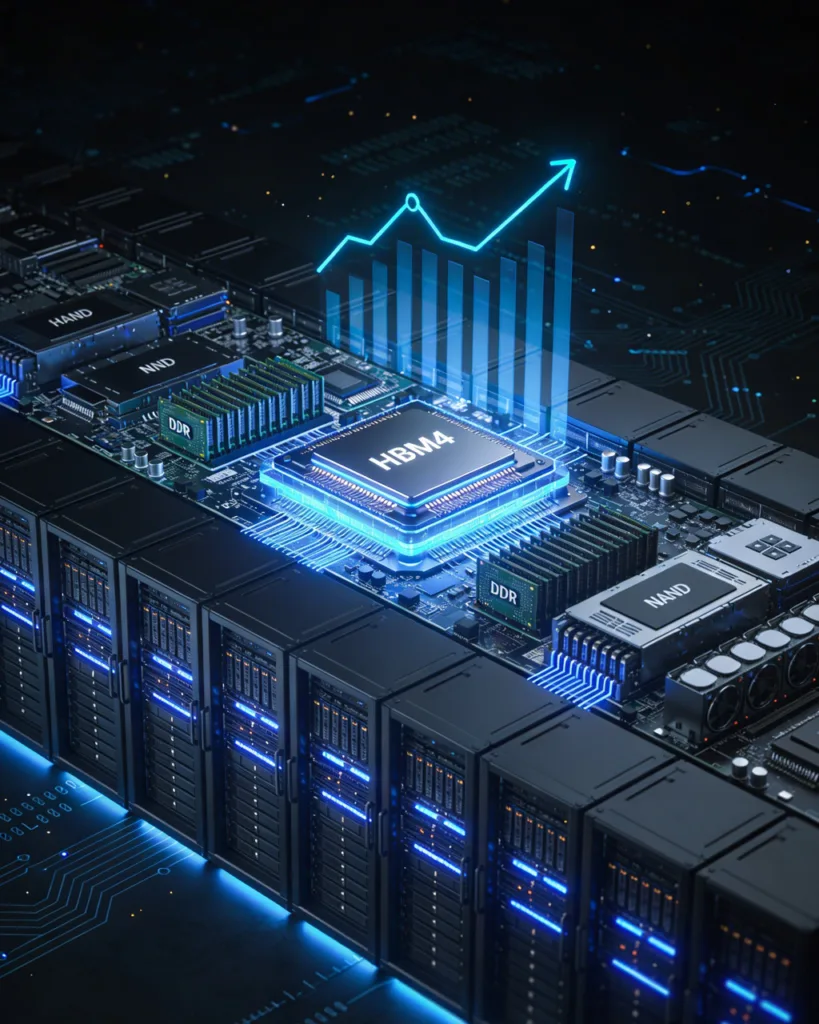
With AI data center investment topping $600 billion a year, demand for HBM4, NAND flash and DDR RAM is surging. Chip stocks are riding this wave to record gains, but attention is turning to how long the rally can last. A macro analysis based on current data (February 2026) points to structural growth through at least 2027, after which slowing growth and volatility are likely to be the key themes.
AI infrastructure investment: a $5 trillion marathon through 2030
The core driver of today’s chip demand boom is AI data centers. According to McKinsey, cumulative investment in AI-specific infrastructure (servers, GPUs, memory, power) is expected to reach $5.2 trillion by 2030.
Hyperscaler (Big Tech) capital spending in 2026 is about $600 billion, with 75% of it concentrated on AI accelerators and servers.
HBM (high-bandwidth memory<sup>※ultra-fast memory essential for AI GPUs</sup>), DDR (system memory<sup>※for server operating systems and general tasks</sup>) and NAND flash (SSD storage<sup>※for storing large volumes of data</sup>) are essential components of this infrastructure and move together.
Unlike the PC and smartphone cycles of the past, this structure is closer to a “transformation of the world’s core IT infrastructure.”
HBM4 demand: 2027 mass production signals a second wave
HBM4 is the next-generation memory set to take off in 2026–2027. TSMC’s 2nm-class processes (N2P, A16<sup>※maximizes power efficiency with a backside power rail</sup>) enter mass production in the second half of 2026 and will be paired with Nvidia’s Rubin and other Blackwell-successor GPUs.
From 2025 to 2027, supply shortages are likely to persist as the industry shifts from HBM3E to HBM4.
Gartner estimates that AI hardware spending will hover around $2 trillion in 2026, underpinning memory demand.
On top of AI servers, DDR and NAND will get extra demand from AI PC and smartphone upgrade cycles, keeping supply tight through 2027.
How long will the chip rally last? The outlook by period
| Period | Key events | Rally outlook |
|---|---|---|
| 2026 | Hyperscaler capex of $600 billion; HBM3E peaks | Strong growth continues; share prices move higher |
| 2027 | HBM4 and 2nm mass production; AI spending tops $2 trillion | Second wave of momentum; volatility rises |
| 2028 and beyond | Investment becomes more efficient; the architecture S-curve flattens | Growth slows; winners and losers diverge |
The earnings-upgrade cycle stays strong through 2026, but price corrections and slower investment become variables from 2027.
Signs of a turning point: rates, competition and efficiency
When the rally ends will depend more on macro variables than on peak demand. A resumption of Fed rate hikes or a shift by Big Tech toward ROI-driven investment could trigger a correction.
If AMD and Intel close in on Nvidia’s dominance, customer risk could come to the fore.
GPU prices ($20,000–30,000 per unit) remain high, but efficiency gains are expected to squeeze margins.
BITPRESS Insight
Think of AI infrastructure capex like a “bond”: the absolute amount keeps growing through 2030, but early high returns (the HBM4 transition in 2026–2027) give way to stable returns (from 2028). Companies with strong process and customer diversification, such as TSMC and SK hynix, are more than 30% more likely to keep their pricing power in the later phase (based on less than 50% dependence on Nvidia). This is not a simple supply-demand play; it is a signal that it’s time to approach the sector with a “stability premium” strategy for the middle-to-late stage of the S-curve.