
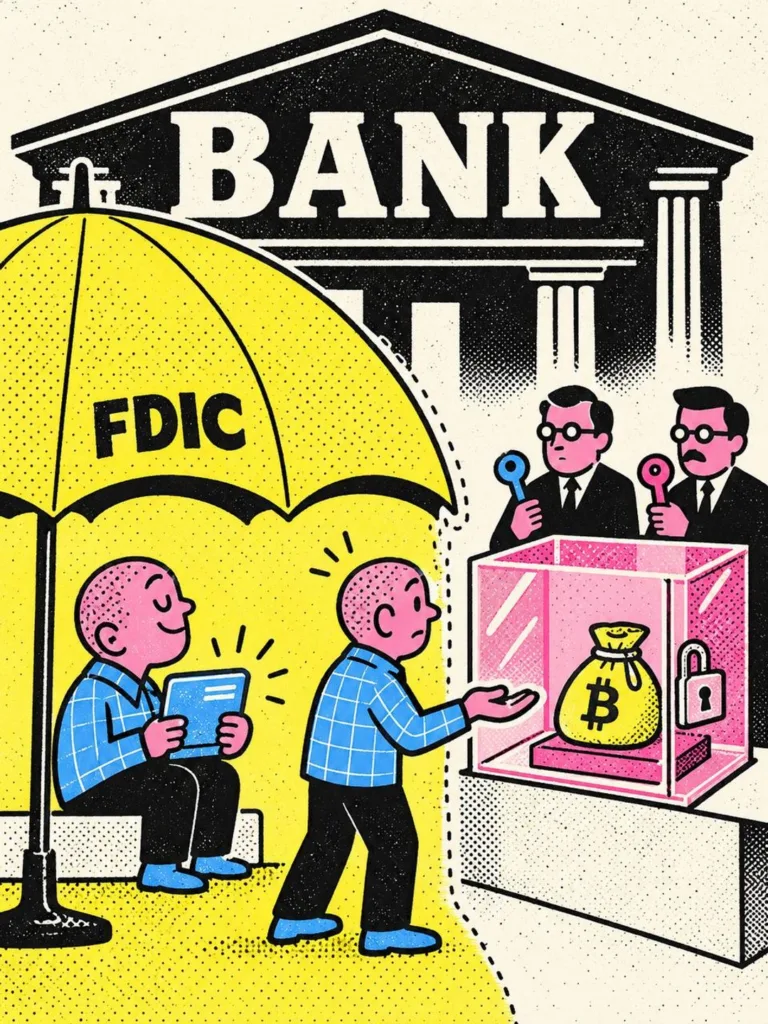
Crypto.com (a crypto exchange that also operates in the US) received preliminary conditional approval for a federal trust bank charter on Feb. 20, and Agora, issuer of AUSD, a dollar stablecoin (a coin pegged to $1), on Sept. 18, from the OCC (the Office of the Comptroller of the Currency, the federal regulator that grants national bank charters). A trust bank is a bank that holds and manages clients' money and assets rather than taking deposits to lend out.
With the word 'bank' attached, it is easy to assume the government will repay your money if it fails. But there is a catch. US regular banks have a reserve requirement (the share of deposits a bank must keep on hand) of 0%, yet they still get government deposit insurance. A trust bank, which keeps assets held in trust accounts apart from its own money, has no such insurance.
So the answer to 'are my coins protected like a deposit?' depends not on the bank sign but on which bucket your assets go into. Put the two kinds of bank side by side, bucket by bucket, and the same headline reads differently.
- If a regular bank fails, who repays you?
The Federal Reserve (the US central bank) cut the reserve requirement ratio to 0% on March 26, 2020. In law, there is no share of deposits that a bank must keep back.
Instead, deposits at regular banks carry insurance from the FDIC (the Federal Deposit Insurance Corporation, the US government agency that repays depositors if a bank fails). It covers up to $250,000 per depositor, per bank, per account ownership category. The FDIC says no depositor has lost a penny of insured deposits since 1933.
A regular bank takes deposits and lends them out. Put simply, your deposit is money the bank puts to work, and the insurance backs you if that bank fails.
- Why does a crypto firm's trust bank lack that insurance?
A federal trust bank is a bank the OCC charters for 'trust company operations and related activities' only. The Crypto.com trust bank is centered on holding crypto and dollars in trust accounts.
The rules require assets held in trust accounts to be kept apart from the bank's own assets and managed jointly by at least 2 staff members chosen by the board. And the OCC wrote that the Crypto.com trust bank is not an insured depository institution.
Think of a bank safe deposit box. The FDIC excludes the contents of a safe deposit box and crypto assets from insurance. Unlike a safe deposit box, though, a trust bank is examined by the OCC.
If a trust bank fails, a receiver (the official who winds it down) appointed by the OCC closes its trust and custody accounts or moves some or all of them to other trust or custody firms. The law requires assets held in trust (fiduciary) accounts to be kept apart from the bank's general assets, with separate books. We could not confirm whether the same separation rule applies to non-trust custody such as Agora's.
- How do the two banks differ, bucket by bucket?
| Item | Regular commercial bank (deposit-insured) | Federal trust bank (no deposit insurance) |
|---|---|---|
| Core business | Takes deposits and lends | Trust company operations and related activities (holding and managing assets, etc.) |
| Deposit insurance | Up to $250,000 per depositor, per bank, per ownership category | None (not an insured depository institution) |
| Where your money sits | Deposits the bank takes in and uses for loans and more | Assets held in trust (fiduciary) accounts kept apart from the bank's general assets with separate books, managed jointly by 2 or more staff |
| Capital standard | Common ratios for all national banks: tier 1 capital (the bank's own money that absorbs losses first) 6%, leverage (own money ÷ total assets) 4%, etc. | The same common ratios, plus a minimum dollar amount added as an approval condition: tier 1 capital of $10 million to $15 million, and liquid assets covering 180 days of operating costs |
| If the bank fails | The FDIC repays up to the insurance limit | No insurance payout. A receiver closes trust and custody accounts or moves some or all of them to other trust or custody firms |
| Community Reinvestment Act | Applies | Does not apply |
| Bank Holding Company Act | An insured bank counts as a 'bank' under this law | Must not become a 'bank' under this law (approval condition) |
The capital bucket for trust banks is an approval condition the OCC set for Crypto.com (tier 1 capital — the firm's own money that absorbs losses first — of $15 million) and Agora ($10 million). Crypto.com must hold at least half of that, $7.5 million, in liquid assets such as cash and Treasuries maturing within 90 days. Operating costs must include the costs of a wind-down, and both apply during the first 3 years of operation.
The Community Reinvestment Act (a law requiring banks to put money back into the areas they serve) also applies only to insured depository institutions. The OCC said the law does not legally apply to the Crypto.com trust bank.
- What are the first 3 things to check in a 'bank charter' headline?
The first is insurance. Whether the bank in the headline is an insured depository institution or a trust bank without insurance decides how your money is protected.
The second is the approval stage. The OCC writes that even after preliminary conditional approval, all pre-opening requirements must be met before final approval, and until then it can change or withdraw the approval. A headline saying 'received a charter' may mean the firm has not opened yet.
The third is what you hand over. The Agora trust bank is centered on issuing a dollar stablecoin and managing its reserves, and takes only institutional and corporate clients. Its custody is also ordinary custody (non-fiduciary), not a trust account. We could not confirm in official documents whether coins you keep at an exchange are placed with that firm's trust bank. Even with the same trust bank charter, whether individuals can use it directly differs from the start.
- If a stablecoin company fails, who gets paid first?
Once the GENIUS Act (the US stablecoin law signed on July 18, 2025) takes effect, licensed issuers must hold reserves at least equal to the amount outstanding, that is, 1 to 1 or more. That is the opposite of bank deposits, which have a 0% reserve requirement.
In return, the same law says stablecoins cannot get FDIC deposit insurance or a US government guarantee. After it takes effect, if an issuer fails, holders are repaid from the reserves ahead of other creditors, and issuers cannot pay interest.
The law is not yet in effect. It takes effect on the earlier of 120 days after final rules are issued or 18 months after signing, and is due to take effect by Jan. 18, 2027 at the latest. Put simply, bank deposits are backed by government insurance, and stablecoins by reserves held in advance and a right to be repaid first.
- BITPRESS Insight
Uninsured federal trust banks are not new. According to the OCC, as of March 31, 2026, uninsured federal trust banks managed $7.2 trillion in assets, of which $1.7 trillion was in custody accounts.
So 'no insurance' means that, even with a bank charter, the money is protected in a different way. Deposits are backed by insurance if the bank fails, while assets held in trust accounts come with a rule that keeps them from mixing with the bank's own money (a rule that does not guarantee repayment).
The test comes down to one line. When you see a 'bank charter' headline, look less at the word 'bank' and first at whether your money goes in as a 'deposit' or as trust-account 'custody'.
Sources
https://www.occ.gov/topics/charters-and-licensing/interpretations-and-decisions/2026/cd1367.pdf
https://www.occ.gov/topics/charters-and-licensing/interpretations-and-decisions/2026/cd1393.pdf
https://www.fdic.gov/resources/deposit-insurance/understanding-deposit-insurance
https://www.federalreserve.gov/monetarypolicy/reservereq.htm
https://www.federalreserve.gov/releases/h10/current/
https://www.law.cornell.edu/cfr/text/12/9.13
https://www.law.cornell.edu/cfr/text/12/5.20
https://www.law.cornell.edu/cfr/text/12/3.10
https://www.law.cornell.edu/uscode/text/12/1841
https://www.govinfo.gov/bulkdata/PLAW/119/public/PLAW-119publ27.xml
https://www.law.cornell.edu/uscode/text/12/92a
https://www.law.cornell.edu/cfr/text/12/51.7
https://www.law.cornell.edu/cfr/text/12/9.16
Glossary
Federal trust bank — A bank chartered by the US Office of the Comptroller of the Currency whose business is limited to holding and managing other people’s assets instead of taking deposits and making loans.
Reserve requirement — The share of deposits a bank must legally keep on hand; in the US this ratio has been 0% since March 26, 2020.
FDIC deposit insurance — A program under which a US government agency repays depositors of a failed insured bank up to $250,000 per depositor, per bank, per ownership type.
Tier 1 capital — A bank’s own money that absorbs losses first, mainly money paid in by shareholders plus retained earnings.
Preliminary conditional approval — A stage at which final approval will be granted once all pre-opening requirements are met; until then the regulator can change or withdraw it.
BITPRESS articles are information to help your investment decisions, not a recommendation to buy or sell any stock or coin. Investment decisions and their results are your own responsibility.