Bitcoin dominance is Bitcoin's share of the whole crypto market. If the market is one pizza, it is the share taken by Bitcoin's slice: Bitcoin's market value divided by the total market value of all coins. Unlike a pizza, though, this one grows and shrinks every day with coin prices.
So when dominance rises, the share of everything else, the altcoins (every coin other than Bitcoin), shrinks by the same amount. That does not mean your altcoin's price fell, or that money left altcoins. Even on a day when the whole pizza grows and every slice gets bigger, dominance rises if Bitcoin's slice grows faster.
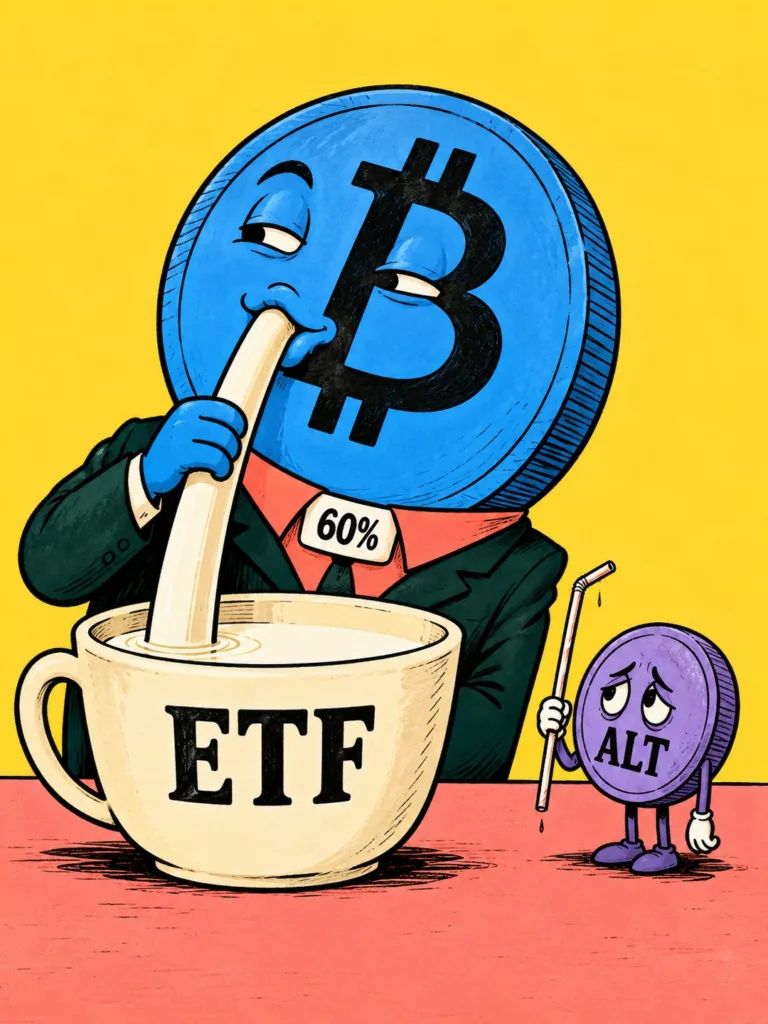
On Oct. 2 (US time), Bitcoin rose above $87,000 during the session, its highest level since Sept. 23. The same day, Bitcoin dominance closed in on 60%.
This number is often read as money leaving altcoins for Bitcoin. Yet Ether also rose that day. There are other possible explanations for why altcoins rise less: where the channels that bring in new money are, and how many coins that money gets split across.
- Dominance is a share, not a price
In the 24 hours to 9:10 a.m. UTC on Oct. 2, Bitcoin rose 3.4%. Ether, XRP, Solana and BNB also rose, but none of the four kept pace with Bitcoin. The source article does not give their individual gains.
Take a hypothetical. If Bitcoin's share is 58.8%, Bitcoin rises 3.4% and every other coin rises 1%, its share becomes about 59.4% (BITPRESS calculation). Put simply, dominance can rise even on a day when everyone makes money.
So on this day, major altcoins didn't fall; they rose less. But this is one day and a handful of large coins. The same day, SKY, AAVE and APT jumped 7% to 10%, the best performers among the 100 largest coins by market value.
- '60%' depends on where you measure it
There is no single official dominance number. A guide on the crypto data site TV Hub put it at 58.8% on Oct. 2; another tracker had 58.65% a day earlier. Sites also count different numbers of coins, from the top 125 to more than 15,000.
The dominance figure most people see puts stablecoins (coins pegged one-to-one to the dollar) into the total market value, the bottom of the fraction. Stablecoins stay at $1 even when the market rises, so they only enlarge the total and make Bitcoin's share look smaller.
The TV Hub guide estimates that taking out the more than $300 billion in stablecoins puts Bitcoin's share at about 64%. By that measure, it is already above 60%. On Oct. 2, the share of Tether (USDT), the largest stablecoin, slipped to about 6.3%, read as traders moving out of cash-like coins into other tokens.
- In September, more ETF money went to Bitcoin
Spot ETFs (exchange-listed funds that buy and hold the actual coins) are one channel that carries money from brokerage accounts into the crypto market. In September, US spot Bitcoin ETFs took in net inflows of $2.6 billion to $2.65 billion (tallies differ slightly).
Spot Ether ETFs drew net inflows of $830 million in the same month. Comparing just the Bitcoin and Ether ETFs, about 76% of the new money went to Bitcoin. Each fund buys only the coin it was built to hold, so this money does not go to other altcoins.
It's as if the highway on-ramp is wider on Bitcoin's side. Unlike a highway, though, this on-ramp is also an exit. On days when money leaves the ETFs, selling comes out the same way.
There is no data to say this gap caused the latest rise in dominance. It is one possible explanation.
- Altcoin money is split across countless coins
Bitcoin is one asset. Altcoins are not. According to data from CoinGecko, a crypto data site, about 20.2 million coins entered the market over the five years from 2021 to 2025, and 53.2% of them are no longer traded.
Many never made it past a handful of trades. A CoinGecko analyst named one key driver: memecoins from launch platforms like pump.fun that let anyone create a coin easily. In other words, the number of coins is not the amount of money.
An editor at the blog of crypto wallet company Tangem argued that with investment spread across millions of assets, the money needed to lift the whole altcoin market is spread too thin. Korean exchanges alone trade 673 coins (as of end-June). The argument is that even when new money comes into altcoins, it has a hard time piling into any one coin, including yours.
- In the last bull run, altcoins as a whole also fell short of Bitcoin
In October 2025, Bitcoin set a new all-time high of around $126,000, 84% above its 2021 peak. At the same time, the total market value of altcoins excluding stablecoins was $1.48 trillion, about 7.5% below its November 2021 peak of $1.6 trillion (BITPRESS calculation). Bitcoin's share had peaked earlier, at 66.06% in June 2025.
Data for the downturn comes from a separate source. A survey by Korean financial regulators found that in the first half of this year, Bitcoin fell 40% from its peak, Ether 57%, all crypto assets in Korea 69% on average, and coins traded mainly in Korea (listed on only one Korean exchange) 77%.
Put simply, in Korea in the first half of this year, other coins fell more than Bitcoin. But this data covers a different period and different assets from the 2025 figures, so the two can't be read as one trend.
Today Bitcoin is at only a little over two-thirds of its October 2025 high. One crypto analyst said that in past bull markets, altcoins didn't truly break out until Bitcoin hit new all-time highs. Still, there is no set answer for when altcoins will catch up.
- BITPRESS Insight
Dominance near 60% is not just a warning that money is leaving altcoins. On Oct. 2, major altcoins rose; they just rose less than Bitcoin. Where September ETF money went, and altcoin money being split across countless coins, are the possible explanations.
If you hold altcoins, ask three questions about dominance news. First, did your coin's price fall, or did it just rise less? Second, does the figure include stablecoins? On Oct. 2, the figure with them (58.8%) and the estimate without them (about 64%) differed by about 5 percentage points. Third, is there a channel that brings new money into your coin, a product like an ETF that is set up to buy it?
Dominance is your coin's share, not its price. If your coin only rose less, it has not gotten worse. When the news says that share has shrunk, before worrying, first check whether its price fell or just rose less.
Sources
https://www.coindesk.com/markets/2026/10/02/crypto-traders-are-in-risk-on-mode-as-bitcoin-dominance-nears-return-to-60
https://www.theblock.co/news/markets/2026-10-02-bitcoin-nears-highest-level-january-85000-sell-wall-clears-us-jobs-data-disappoints-417570
https://blockonomi.com/bitcoin-etfs-record-2-65-billion-in-september-inflows
https://en.cryptonomist.ch/2026/10/01/bitcoin-value-analysis-2026-momentum/
https://www.tv-hub.org/guide/bitcoin-dominance
https://finance.yahoo.com/markets/crypto/articles/bitcoin-dominance-explodes-60-66-110614040.html
https://www.coindesk.com/markets/2026/01/14/more-than-half-of-all-crypto-tokens-have-failed-and-most-died-in-2025
https://tangem.com/en/blog/post/altcoin-season-dead/
https://cryptoslate.com/how-retail-altcoin-traders-lost-800-billion-betting-against-bitcoin/
https://www.mt.co.kr/stock/2026/10/01/2026100111223667149
https://www.etoday.co.kr/news/view/2631344
Glossary
Bitcoin dominance — Bitcoin's share (%) of the total crypto market value; because it is a ratio, not a price, it can change even when everything rises.
Altcoins — A catch-all name for every coin other than Bitcoin, including Ether, XRP and Solana.
Stablecoin — A coin pegged to $1, like Tether (USDT), used like cash inside the crypto market.
Spot ETF — A fund that buys and holds the actual coins and lets investors trade shares of it on a stock exchange.
Maximum drawdown (MDD) — How far a price fell from its highest point to its lowest point over a set period, as a percentage.
BITPRESS articles are information to help your investment decisions, not a recommendation to buy or sell any stock or coin. Investment decisions and their results are your own responsibility.