



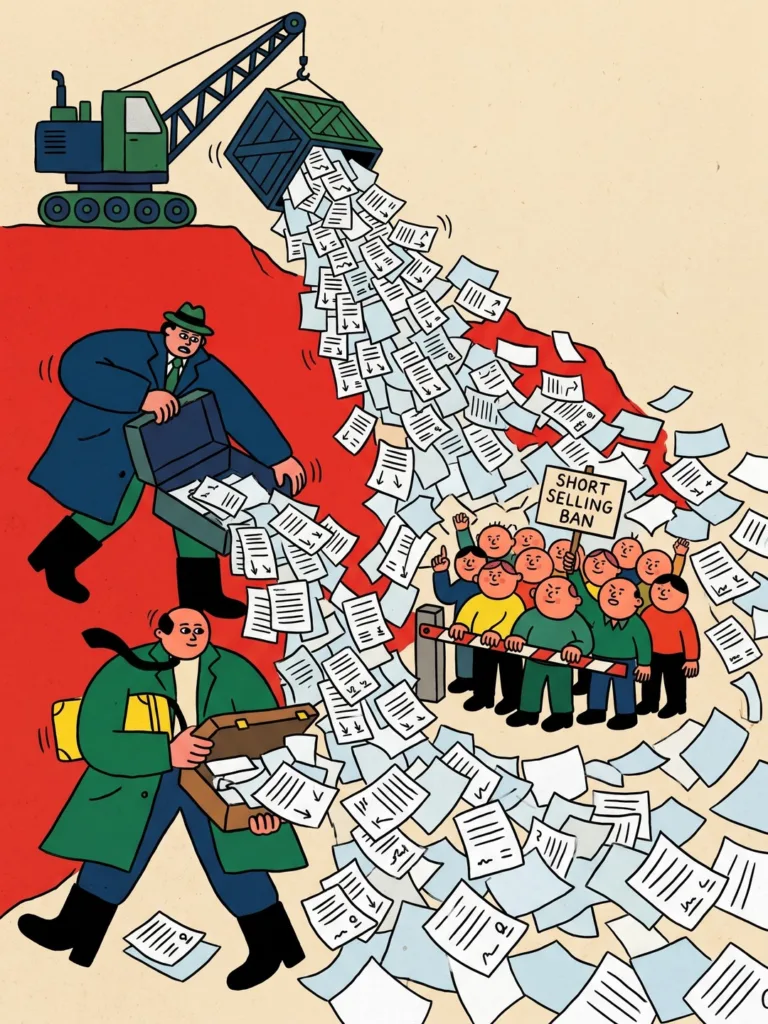
Taiwan's Financial Supervisory Commission announced on Nov. 19 a limit that bars short sales below the previous day's close for any stock that fell more than 3.5% in the prior trading session, effective from the 20th. On the first day, Nov. 20, the TAIEX, Taiwan's main stock index, fell another 6.23% to 36,033.29, its lowest close in seven months.
Among Korean individual investors, a common complaint is, 'Taiwan is blocking it, so what is our government doing?' The hope is that if short selling alone is banned, fewer people will sell, and my Samsung Electronics and SK hynix shares will fall less. But the key point is somewhere else. Korea has already banned short selling before, and there is a record of what happened.
- What Taiwan blocked, and how the market reacted
Short selling means borrowing shares to sell, then buying them back at a lower price to return them and keep the difference. Taiwan barred this trade below the previous close for stocks that had fallen more than 3.5%. It did not ban short selling outright. It was a price limit that blocked selling fallen stocks at even lower prices.
Even so, the index fell more than 6% on the first day. On Nov. 21, Taiwan announced five measures again. From Nov. 23, short sales cannot be made below the previous trading day's close, and the minimum margin deposit required for short sales rises from 130% to 150%.
- Why KOSPI kept falling after the 2020 short-selling ban
On March 13, 2020, the Financial Services Commission decided to ban short selling on all listed stocks for six months, effective from March 16. KOSPI closed at 1,771.44 on March 13, the last trading day before the ban, but by March 19 that same week it had closed at 1,457.64. That is a further drop of about 17.7%. Foreign investors sold for 11 straight trading days through that date.
Samsung Securities analyzed that during the ban period (March 16 to June 12), individuals were net buyers and foreigners were net sellers. It saw 'continuous selling pressure on Korean stocks rather than signs of short covering' among foreigners. Put simply, banning short selling cannot stop people from selling shares they already own.
Think of a secondhand market. You can stop someone from selling an item they borrowed, but you cannot stop someone from selling their own. When too many items flood the market, prices fall.
- In 2023, KOSPI rose for one day, then fell the next
On Nov. 6, 2023, the first day of the full short-selling ban, KOSPI rose 5.66% to close at 2,502.37. That day, foreign investors were net buyers of KRW 711.6 billion on the KOSPI market. But the next day KOSPI fell 2.33% to 2,443.96, and foreign investors were net sellers of KRW 101.5 billion. Institutional net selling was larger at KRW 399.5 billion, while individual investors were net buyers of KRW 459.7 billion. Market commentary pointed to profit-taking, uncertainty, and U.S. interest rates and the dollar as reasons. Even with short selling still banned, sales of shares people already held pushed the index down.
That ban lasted until March 30, 2025, when it was lifted. During that time, the ban made it harder for foreign investors to enter the Korean market, which has been cited as one reason Korea has failed to join the MSCI Developed Markets Index (the benchmark that global pension funds and funds use to guide investment).
- This time regulators chose to delay forced sales, not to ban short selling
On Nov. 6, the government and the Bank of Korea held an emergency market review meeting and, from Nov. 9 through Jan. 31 next year, exempted brokerages from the requirement to keep margin-loan collateral ratios at 140%. Margin loans (known in Korea as bitthu) mean borrowing money from a brokerage to buy stocks.
Normally, if a stock's fall pushes the collateral ratio below 140% and the investor cannot fill the gap in time, the brokerage forcibly sells the shares. This is called a forced sale. The aim is to break this chain: falling prices, then lower collateral ratios, then forced sales, then more falling prices from that selling.
Take an account that borrowed KRW 10 million and has collateral valued at KRW 13.5 million. It falls short of the 140% standard, but at a brokerage that has lowered its standard to 130%, the shares are not forcibly sold. The debt and interest remain the same, and if collateral is still short when the grace period ends, the account becomes subject to forced sales again.
- Who is doing the short selling now?
From Nov. 2 to 17, foreign investors accounted for 73.89% of KOSPI short-selling trading value, 15 percentage points higher than in September (58.84%). On the 17th, foreign investors accounted for 82.62% of the KRW 1.2151 trillion in short selling on the main KOSPI market of large companies and the KOSDAQ, a market of smaller and tech companies. That is why individual investors blame short selling.
But as the 2020 record shows, foreign investors sell the shares they already hold even when short selling is banned. A short-selling ban blocks only one way of selling. It does not change the minds of sellers.
- BITPRESS Insight
A short-selling ban is less a tool to stop a fall than a tool to slow it down. In 2020, the index kept falling after the ban, and in 2023 it gave back its gain the very next day. According to Samsung Securities, foreign investors during the 2020 ban sold shares they already held rather than buying back borrowed shares.
So this time, instead of short selling, regulators first slowed the margin-loan sell-offs that pile up regardless of investors' own choices. But this grace period has an end date: late January next year.
A short-selling ban announcement alone is not a reason to hold on. Whether your shares fall less depends less on whether short selling is blocked than on whether foreigners keep selling the shares they hold and whether forced-sale volume remains.
Sources
https://www.hankyung.com/article/2026112115757
https://focustaiwan.tw/business/202611190022
https://www.mt.co.kr/article/2026110614220822255
https://www.seoul.co.kr/news/newsView.php?id=20261106500147
https://newstomato.com/ReadNews.aspx?no=1319764
https://www.newsis.com/view/NISX20200313_0000955309
https://www.newsis.com/view/NISX20200313_0000955099
https://www.ytn.co.kr/_ln/0102_202003192146463462
https://www.newsis.com/view/NISX20231107_0002512048
https://www.newsis.com/view/NISX20231106_0002511058
https://www.newsis.com/view/NISX20231107_0002512189
Glossary
Short selling — A trade in which investors borrow shares and sell them first, then buy them back at a lower price to return them and keep the difference.
KOSPI — South Korea's main stock market index, covering the large companies listed on its main board
Forced liquidation — When a brokerage forcibly sells shares in a margin-loan account whose collateral ratio was not restored in time.
BITPRESS articles are information to help your investment decisions, not a recommendation to buy or sell any stock or coin. Investment decisions and their results are your own responsibility.





