



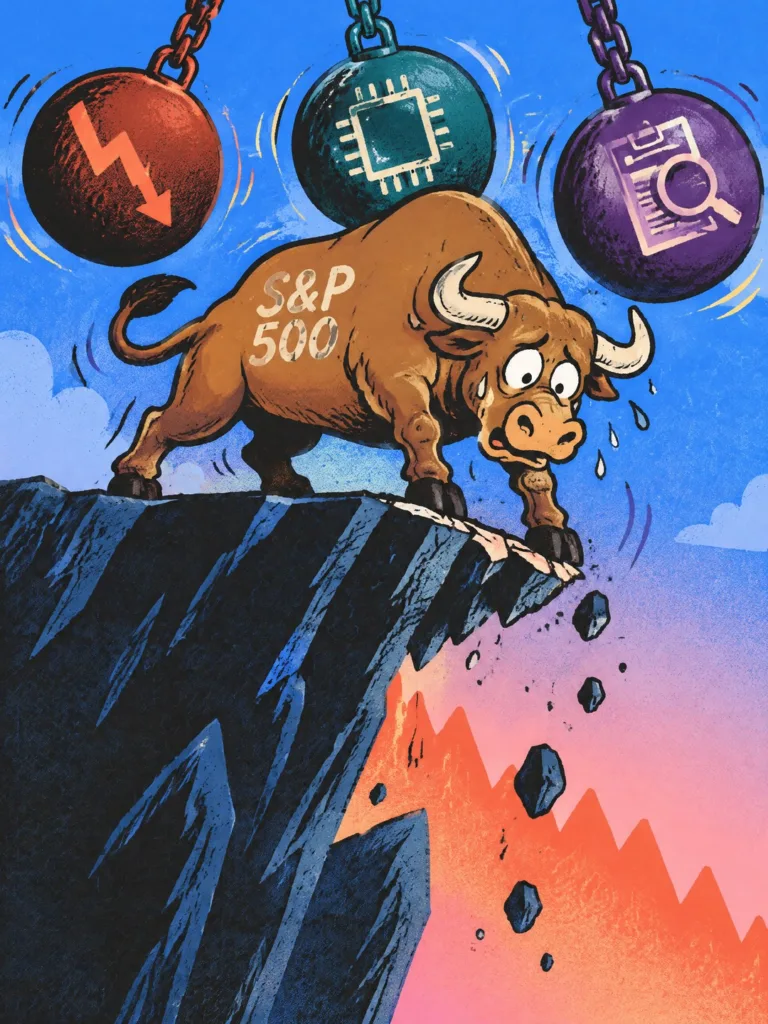
On Nov. 20 (U.S. time), the S&P 500 fell 3.7% in a single day to close at 6,910.39. That is about 11.6% below its Oct. 6 high of 7,818.93 (calculated as 6,910.39 ÷ 7,818.93). A drop of 10% or more from a peak is called a “correction,” and together with the Dow, the index has entered that zone. The S&P 500 has now fallen for seven straight trading days and dropped 8.6% this week alone.
There are two usual readings. One side says a drop of more than 10% means the bottom is near. The other says an AI bubble has burst and there is no floor. But what matters is not the size of the drop but what you watch. Some read the same drop as a sign of more selling, while others see a short-term oversold market. They watch different indicators. Before the open on Monday (Nov. 23), three crossroads narrow the question.
- What would KRW 10 million invested at the peak be worth now?
If KRW 10 million had gone into a fund that tracks the S&P 500 at the Oct. 6 peak, it would be worth about KRW 8.84 million now (a hypothetical that excludes exchange rates and fees).
The losses concentrated in AI stocks. On the 20th, the Nasdaq fell 5.28% and Nvidia closed down 14% at $125.53. All 20 semiconductor and memory stocks in the Nasdaq-100 are now more than 20% below their highs, a bear market. Nvidia reported quarterly revenue of $115.8 billion, up 103% from a year earlier, yet it has dropped 23% this week alone. Put simply, it is not the whole market but AI stocks that are pulling the index down.
- Has the fear index reached panic-selling levels?
The VIX (volatility index) is the market's forecast of how much the S&P 500 will swing over the next 30 days. It closed at 35.89 on the 20th, about twice its 2026 average of 18.4 and its highest close since April 2025. Separately, Goldman Sachs' own investor sentiment gauge, which is not the VIX, rose to 9 out of 10.
Goldman Sachs traders said selling has spread across systematic investors (funds that buy and sell by fixed rules) and could bring considerable further selling next week. Think of it as an automatic stop-loss order in a trading app: once the price breaks a set line, it sells without human judgment. The difference is that countless funds are set to trigger near similar levels, so they move together.
- Have AI chip orders actually fallen?
The numbers so far point to rising orders. In its Nov. 17 earnings report, Nvidia raised its fiscal 2028 revenue growth forecast from 70% to about 75%. The stock still moved the other way, because of two issues: how the orders are funded, and who is placing them.
The first is deals in which a chipmaker funds customers' purchases of its chips and data center construction. Nvidia's interim CEO, Colette Kress, said it will be far more selective with such deals from now on. It is like a car dealership that stops offering its own financing: fewer cars may sell. The second is China. According to the Financial Times, TSMC and Samsung Electronics have suspended chip shipments to some Chinese customers under new U.S. export rules until they obtain export licenses.
If large customers' actual order cancellations show up in the numbers, the earnings outlook falls and the drop has a stronger basis. If they don't, the argument that prices fell before earnings did, and that the stock is oversold, gains strength.
- How far does the Nvidia accounting probe reach?
Reuters reported that officials at the U.S. Securities and Exchange Commission (SEC) are looking into Nvidia's accounting, but it could not confirm when the inquiry began or what it covers. Markets are focused on a change Nvidia made last year to how it reports revenue by region. It now counts sales by the headquarters address rather than the customer's billing address, and the Singapore line disappeared from its regional table as a result. The Financial Times reported that the change came when Singapore sales had grown to nearly half of total revenue.
Think of it as keeping the books by a company's head office address rather than the warehouse where the goods are delivered. Total revenue stays the same, but it becomes harder to see which country the chips actually went to. U.S. Treasury Secretary Scott Bessent said, “We need answers from the board and outside counsel within 10 days.”
There is also a precedent. In May 2022, Nvidia agreed to a $5.5 million settlement over charges that it did not tell investors that crypto mining demand had boosted its gaming revenue. If the probe ends at disclosure issues, it may be settled with a payment, as it was then. But if it spreads to revenue itself, the revenue figures behind the earnings numbers will have to be checked again.
- What stopped the fall in April 2025?
The closest comparison is the tariff shock of April 2025. In early April, the VIX closed at 45.31. When the tariff pause was announced on April 9, the S&P 500 jumped 9.52% in a single day, and it hit a new record high on June 27. The cause was one policy, and once that policy stopped, the decline stopped too.
This time there are three causes, and a single announcement will not resolve them all. The VIX close of 35.89 is still below the April 2025 level.
- BITPRESS Insight
The three crossroads differ in nature. The fear index shows who is selling. Selling by funds that follow fixed rules stops once their volume runs out. Chip orders and the accounting probe show whether earnings are changing. If those are confirmed, the decline is a fall in the company's underlying worth, not just in its price.
So if the index dips a bit more on Monday, that alone is not a signal. If only the fear index rises while order and probe news stays the same, the selling looks mechanical. Conversely, even if the index rebounds, if order cancellations or revenue problems are confirmed, the decline will return.
How far a stock falls matters less than why it fell: whether the sellers are behind it, or shrinking earnings are.
Sources
https://www.foxbusiness.com/markets/wall-street-suffers-historic-losses-dow-sp-500-plunge-correction-territory
https://www.cnbc.com/2026/11/20/sp-500-correction-market-sell-off.html
https://www.hankyung.com/article/202611211574i
https://finance.yahoo.com/markets/live/stock-market-today-friday-november-19-dow-sp-500-nasdaq-anthropic-nvidia-141644188.html
https://stockanalysis.com/news/tsmc-samsung-suspend-chip-shipments-china/
https://decrypt.co/383744/nvidia-shares-sink-52-week-low-sec-probing-accounting
https://www.investmentnews.com/equities/embattled-nvidia-faces-sec-probe-as-california-attorney-general-eyes-action/269054
https://en.wikipedia.org/wiki/2025_stock_market_crash
Glossary
Correction — A drop of 10% or more from a recent peak in a stock index. A drop of 20% or more is called a bear market.
VIX (volatility index) — The market's forecast of how much the S&P 500 will swing over the next 30 days. Often called the “fear index.”
Systematic investors — Funds that buy and sell automatically by fixed rules, such as price trends, rather than by human judgment.
Oversold — A state in which a stock has fallen faster and further than changes in company value would justify.
U.S. Securities and Exchange Commission (SEC) — The government agency that oversees U.S.-listed companies' disclosures and accounting and investigates whether they mislead investors.
BITPRESS articles are information to help your investment decisions, not a recommendation to buy or sell any stock or coin. Investment decisions and their results are your own responsibility.





