



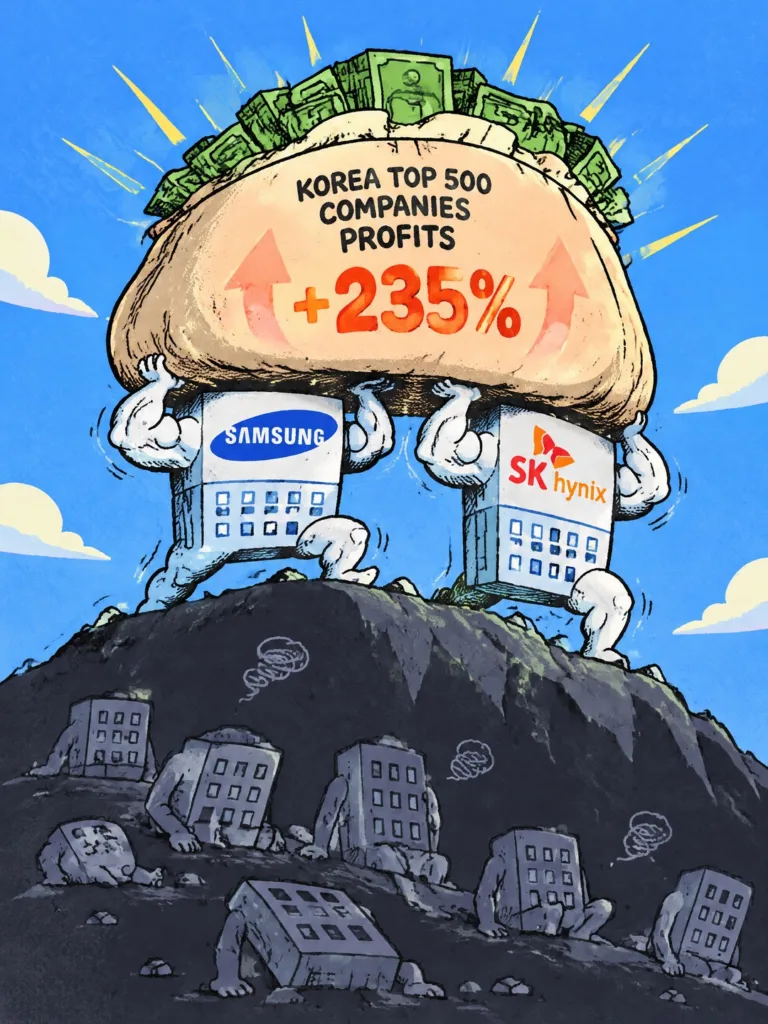
Among Korea's top 500 companies by sales, the 324 that had filed Q3 reports (July to September) posted 239.4 trillion won in operating profit. That is up 235.5% from 71.4 trillion won in the same period a year earlier. The figures come from CEO Score, a private research firm that surveys corporate earnings and governance, and were released on November 17.
The KOSPI index sits around the 5,000 level (5,018.85 at the November 9 close), and corporate profit has more than tripled in a year. Many people read this as 'Korean companies all earned well together.' If so, shouldn't your stock be rising too?
But the key point is different. About 80% of the 239.4 trillion won went to Samsung Electronics and SK hynix. Without those two, the other companies' profit growth was just 1.7%.
- Of the 239 trillion won, 190 trillion came from two companies
Samsung Electronics' Q3 operating profit was 107.4 trillion won. That is up 783.1% from 12.2 trillion won a year earlier. It is the first time a Korean company has topped 100 trillion won in quarterly operating profit. Its memory chip division alone earned 106.5 trillion won.
SK hynix earned 83.3 trillion won, up 632.1%. Together the two companies earned 190.8 trillion won, about 80% of the total for the top 500 companies. The chip boom, driven by surging demand for artificial intelligence (AI), is behind it.
Put simply, most of this quarter's 'profit surge' is a story about two chipmakers.
- Without those two, profit rose just 1.7% in a year
In the same survey, the growth rate for the remaining companies excluding those two was 1.7%. Recalculating from the published figures, the other 322 companies earned about 48.6 trillion won this quarter, versus about 47.8 trillion won a year earlier. The increase over the year is less than 1 trillion won.
Think of a 10-person team whose average pay tripled in a year. Two people got large bonuses, and the other eight saw their 3 million won monthly pay rise to 3.05 million won. The difference is that, unlike pay, company profit is the basis for its share price.
- Compared with the previous quarter, the rest's profit actually fell
The Korea Exchange, together with the Korea Listed Companies Association and the KOSDAQ Association, released an analysis on November 18 that uses a different base. It compared 635 December year-end companies listed on KOSPI with the previous quarter (April to June), not with a year earlier.
Consolidated operating profit for all KOSPI-listed companies rose 10.55%, from 229.6 trillion won to 253.8 trillion won. Without the two companies, however, it fell 20.78%, from 79.5 trillion won to 63.0 trillion won. Sales also fell 3.12%.
The 1.7% above compares 324 of the top 500 companies with a year earlier. The 20.78% compares 635 KOSPI-listed companies with the previous quarter. Because both the period and the group differ, the profit figures for the other companies also differ: about 48.6 trillion won and 63.0 trillion won. Neither number is wrong. They answer different questions.
In the same analysis, the two companies' operating profit rose 40.7 trillion won from the previous quarter, while the other companies' profit fell 16.5 trillion won. That is why the total looked like it had risen.
- More than half of KOSPI-listed companies saw profit fall
359 KOSPI-listed companies (56.54%) saw operating profit fall or turned to a loss from the previous quarter. 200 companies (31.50%) saw profit rise or turned to profit, and 76 stayed in the red. Profit fell in 12 of the 20 industries.
Compared with a year earlier, the gap between industries is also wide. In the CEO Score survey, profit in IT and electronics rose 645.3%, while energy (-62.9%), insurance (-47.2%) and securities (-38.5%) fell. Korea Electric Power Corporation had the largest drop, with operating profit down 4.0 trillion won (70.9%) in a year.
If you own any stocks, it is worth checking in the earnings release whether that company's profit rose or fell.
- Why can the index rise while my stock stays flat?
Both the profit total and the KOSPI index are moved mainly by the biggest companies. The total simply adds up amounts, so the largest profits decide the number. The KOSPI index gives more weight to companies with larger market capitalization.
So when those two companies' profits surge, the total jumps. When their share prices rise, the index often rises with them. Companies with flat profit often see flat share prices. But share prices also move for other reasons, such as interest rates and industry outlooks.
Think of it like the average home price in an apartment complex. If the values of two large units jump, the average rises, but the price of your own unit can stay the same.
- BITPRESS Insight
'Profit up 235% at top 500 companies' is not a wrong number. But two chipmakers created that figure. The rest rose 1.7% from a year earlier, and fell from the previous quarter. When the total and the index rise but your stock stays flat, that is not strange. It is exactly what these numbers show.
The 'corporate profit' in the news is not the same number as what your own company earned. Under the same index, people who owned those two companies and people who did not had very different third quarters.
Rather than only checking whether the index is rising, it is better to also check whether your own company's operating profit has grown.
Sources
https://ceoscoredaily.com/page/view/2026111619323627563
https://www.hankyung.com/article/2026111847626
https://koreatimes.co.kr/economy/20261109/kospi-barely-holds-5000-fails-to-regain-momentum
Glossary
Operating profit — The profit a company makes from its core business of selling goods or services, after subtracting costs.
Year-on-year — Compares July to September this year with the same months last year. This removes seasonal differences and shows the change over one year.
Quarter-on-quarter — Compares July to September this year with the previous quarter, April to June. This shows the trend over the last three months.
Consolidated basis — Profit calculated by combining the parent company and its subsidiaries as if they were one company.
December year-end company — A company whose fiscal year runs from January to December. Most listed companies in Korea are in this group.
BITPRESS articles are information to help your investment decisions, not a recommendation to buy or sell any stock or coin. Investment decisions and their results are your own responsibility.





