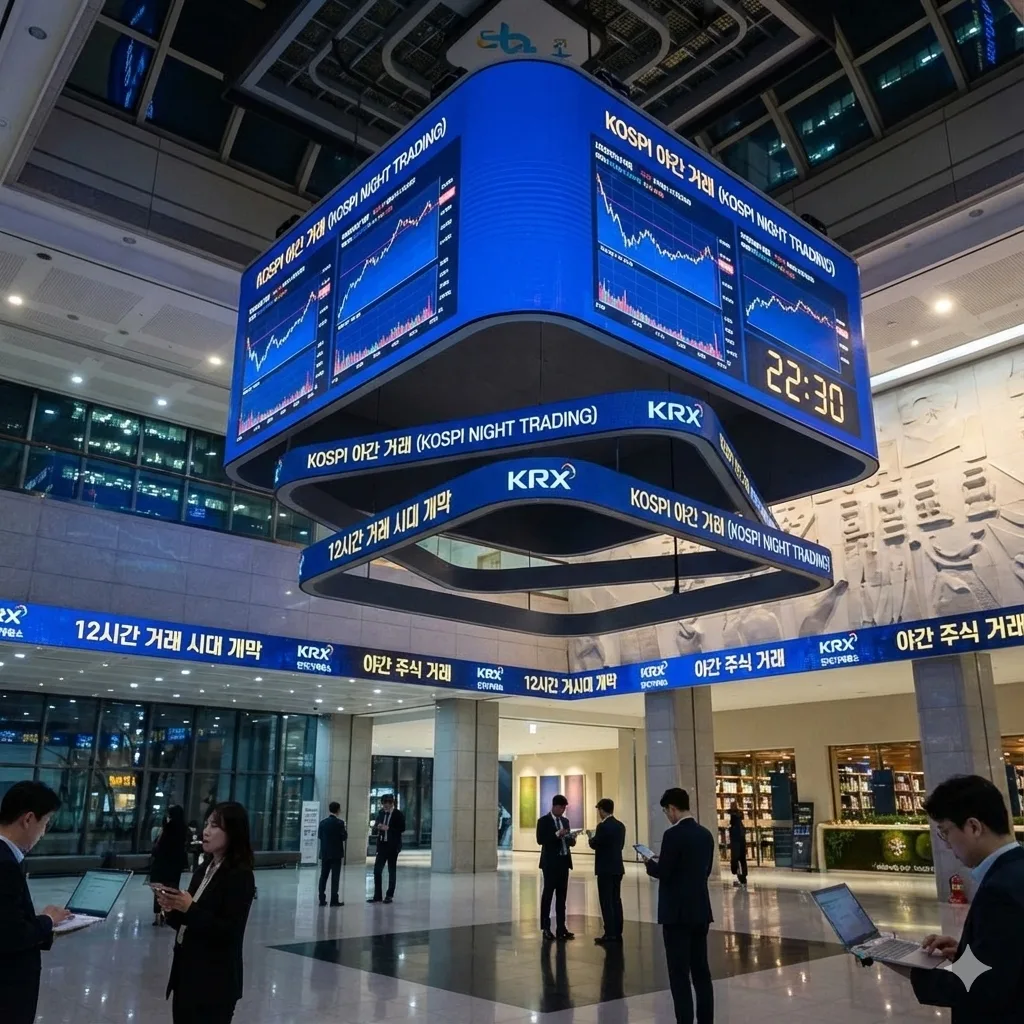
Korea Exchange plans to extend stock trading hours to 12 hours a day— and is pushing the plan in earnest.
Beyond the current regular session from 9 a.m. to 3:30 p.m., it is also considering introducing pre-market and after-market sessions.
On the surface, it is described as "more convenience for investors," but the heart of this issue is that the stock market is starting to resemble "the time structure of the crypto market"— that is where it lies.
1️⃣ Why change stock trading hours now?
Currently, Korea's stock market has
- a regular session: 9 a.m. to 3:30 p.m.
- Total trading time per day: 6 hours 30 minutes
This structure is short by global standards..
It does not overlap with U.S. and European market hours, so
- overseas news breaks at night
- and Korean investors must "wait" until the next morning.
As this repeats,
delayed price reflection → gap-ups and gap-downs → disadvantage for retail investorshas been a persistent problem.
2️⃣ How exactly would 12-hour trading work?
The core of the plan under discussion is as follows.
- In addition to the regular session:
- Pre-market (around 8 a.m.)
- After-market (after 3:30 p.m.)
- Maximum trading time per day: about 12 hours
- Possible operation alongside the ATS (alternative trading system) under review
In other words, **the regular session stays, with "trading hours added before and after it."**
It is not the 24-hour trading of the crypto market, but the direction is clear.
3️⃣ The real background: competition with "Nextrade"
Behind this overhaul is the launch of Nextrade, Korea's first alternative trading system.here.
- Nextrade: 8 a.m. to 8 p.m., 12-hour trading
- Longer trading hours than the existing Korea Exchange
- Competition on trading fees and systems heats up
In other words,
👉 Korea Exchange has entered a regulatory race to keep its "monopoly structure.".
Before investor protection, it is more about defending market leadership —that is how some interpret it.
4️⃣ Is it really good for investors? A cold assessment
Starting with the upsides:
- Global news can be reflected immediately
- Less gap volatility at the open and close
- Better access for office workers and retail investors
But the downsides are clear too.
- More trading hours = more volatility
- Liquidity could be spread thin
- Greater risk of "overtrading" by retail investors
In particular,
institutions and foreign investors respond with automated systems,but
individuals are exposed to the market for long hours, and fatigue and errors of judgmentcan grow.
5️⃣ A stock market that is starting to look like the crypto market
This change is not just a "time extension."
- Stocks: limited hours → expanding
- Crypto: 24-hour trading → a standardized structure
In the end, capital markets
are converging on the idea of "extending hours to speed up price discovery.".
One of the biggest differences between stocks and crypto,
"the wall of trading hours," is coming down.
🔍 BITPRESS Insight
Extending stock trading hours to 12 hours
is less an investor convenience than a signal of market competition and structural change.for experimenting with tokenized financial products.
Going forward, one question matters for investors:
"Just because I can trade for more hours,
can I make better decisions?"
The longer the hours, the more you need
**"standards" rather than "speed."**