
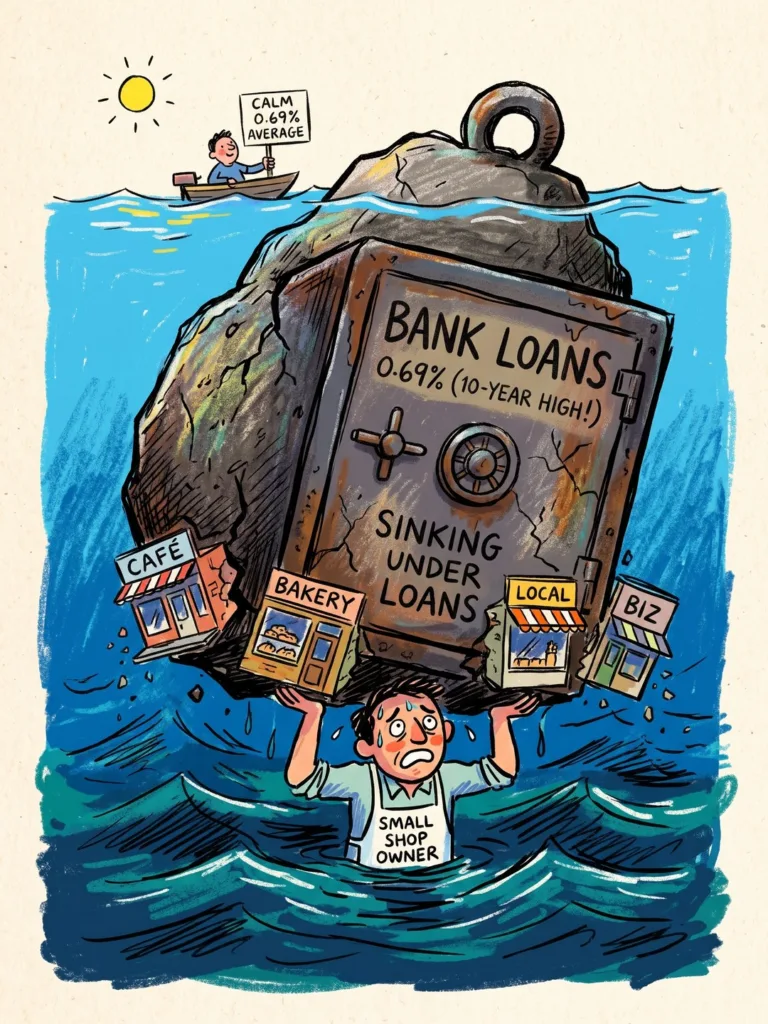
On Oct. 23, the Financial Supervisory Service (FSS, Korea's financial regulator) said the delinquency rate on Korean banks' won loans at the end of August was 0.69%. That is up 0.06 percentage points from the end of July (0.63%), and comparing August-end figures year by year, it is the highest in 10 years, since August 2016 (0.87%). In other words, every August-end figure in between was lower. The delinquency rate is the share of outstanding loans on which principal and interest are more than a month overdue. The FSS also said it will push banks to set aside more loan-loss reserves (money put aside to cover loans that may not be repaid).
The common take is "it's under 1%, so most borrowers are repaying fine." The FSS also said the rate is still below the 0.78% long-term average for the 10 years before COVID-19 (2010 to 2019), so it is manageable over the medium to long term. But the point is not the overall number. It is who has fallen behind. Break 0.69% apart, and delinquency is high among small companies, sole proprietors and non-mortgage household loans (credit loans and other household loans besides mortgages).
- What does 0.69% measure?
A delinquency rate of 0.69% means that for every $100,000 lent, about $690 is more than a month overdue. It rose for a second straight month, from 0.56% at the end of June to 0.63% at the end of July and 0.69% at the end of August, and is 0.08 percentage points above the same month last year (0.61%).
There is a reason the June figure was low. At the end of each quarter, banks clear overdue loans off their books by writing them off as losses (write-off) or selling them (sale). The 0.56% at the end of June is the figure after they stepped up that clean-up, and in July and August, mid-quarter, it rose again.
- Business loans pushed the rate up
The delinquency rate on business loans rose 0.08 percentage points in a month to 0.86%, while household loans rose just 0.03 percentage points to 0.45%. Within business loans, large companies are at 0.39%, but small and midsize companies moved up to 1.00%, into the 1% range.
The highest is small companies registered as corporations ("small corporations"). Their rate is 1.10%, up 0.10 percentage points in a month and 0.13 percentage points in a year, about 2.8 times the large-company rate. Loans to sole proprietors (people like shop and restaurant owners who run a business in their own name) are also up, to 0.86%, by 0.09 percentage points in a month and 0.08 percentage points in a year. Put simply, even among business loans, far more are overdue at small corporations and sole proprietors than at large companies.
- Among households, non-mortgage loans fell further behind
The delinquency rate on all household loans is the same as in the same month last year. But split it up and the picture changes. Mortgages, where the borrower puts up a home as collateral, are at 0.31%, while non-mortgage household loans are at 0.91%, about three times as high. The one-month rise was also bigger for non-mortgage loans (0.07 percentage points) than for mortgages (0.02 percentage points).
Per $100,000 lent, that works out to about $310 overdue for mortgages and about $910 for non-mortgage loans. Even within households, repayment is stalling more on loans that are not backed by a home.
- So why does the overall number look small?
The 0.69% is a blend of large-company loans (0.39%) and mortgages (0.31%), where delinquency is low, with small corporations and non-mortgage loans, where it is high. That is why a small-corporation rate above 1% does not show up in the overall number.
Think of a class average. Even if the average is 70 points, a few students in the back row may be failing. The difference from a test is that when someone falls behind on a loan, the bank that lent the money has to set money aside to cover the loss.
- Overdue loans piled up faster than banks cleared them
New delinquencies in August came to 3 trillion won (about $2.27 billion), down 200 billion won (about $151 million) from the previous month's 3.2 trillion won (about $2.42 billion). But over the same period banks cleared 1.5 trillion won (about $1.13 billion) of overdue loans. With new overdue money at twice the amount cleared, the total stock of overdue loans grew by 1.5 trillion won (about $1.13 billion) in a month.
Put simply, new delinquencies slowed a little, but the banks' clean-up could not keep pace. The new delinquency rate, which divides newly overdue loans by outstanding loans, was 0.12%, the same as the month before.
- Which overdue loans could grow from here?
The FSS said that, with economic uncertainty at home and abroad and market interest rates trending up, the delinquency rate could keep rising, led by vulnerable borrowers (borrowers with little capacity to repay their debts). The Bank of Korea raised its base rate in August as well as July, to 3.00% a year. When rates rise, the interest burden grows for people with floating-rate loans.
Financial institutions expect the same direction. In the Bank of Korea's survey of lending practices (a questionnaire for lending officers at financial institutions, conducted in June and released July 20), the officers in charge of lending at financial institutions said credit risk at small companies would rise by more than at large companies in the third quarter, and that credit risk in households would also rise as vulnerable borrowers' ability to repay weakened.
- BITPRESS Insight
The ones failing to repay are not households that borrowed against a home, but small corporations, sole proprietors and households with credit and other non-mortgage loans. At 1.10%, small corporations are at about 2.8 times the large-company rate (0.39%), and non-mortgage loans at 0.91% are about three times the mortgage rate (0.31%).
That gap can reach the wallets of the people who use those loans. With new delinquencies piling up faster than they are cleared, the FSS said it will push banks to set aside more reserves, and financial institutions expect credit risk at small companies to rise by more than at large ones. If banks handle high-delinquency loans more cautiously, those are the loans that could get harder to borrow first, even when the overall number stays below 1%.
Read delinquency news not by the overall number but by the number for the kind of loan you hold. If you have a credit loan or a business loan, your story is not 0.69% but 0.91%, 0.86% or 1.10%.
Sources
https://www.newspim.com/news/view/20261022001267
https://www.etoday.co.kr/news/view/2638959
https://www.smarttoday.co.kr/ko-kr/articles/110859
https://kbmaeil.com/article/20260720500556
Glossary
Delinquency rate — The share of outstanding loans on which principal and interest are more than a month overdue.
Small corporation — A small or midsize company registered as a corporation, as distinct from a sole proprietor who runs a business in their own name.
Write-off and sale — A bank clears an overdue loan it is unlikely to collect by writing it off as a loss (write-off) or selling it to another company (sale).
Loan-loss reserves — Money a bank sets aside from its profits in advance in case the money it lent is not repaid.
Vulnerable borrower — A borrower with low income or heavy debt who has little capacity to repay.
BITPRESS articles are information to help your investment decisions, not a recommendation to buy or sell any stock or coin. Investment decisions and their results are your own responsibility.