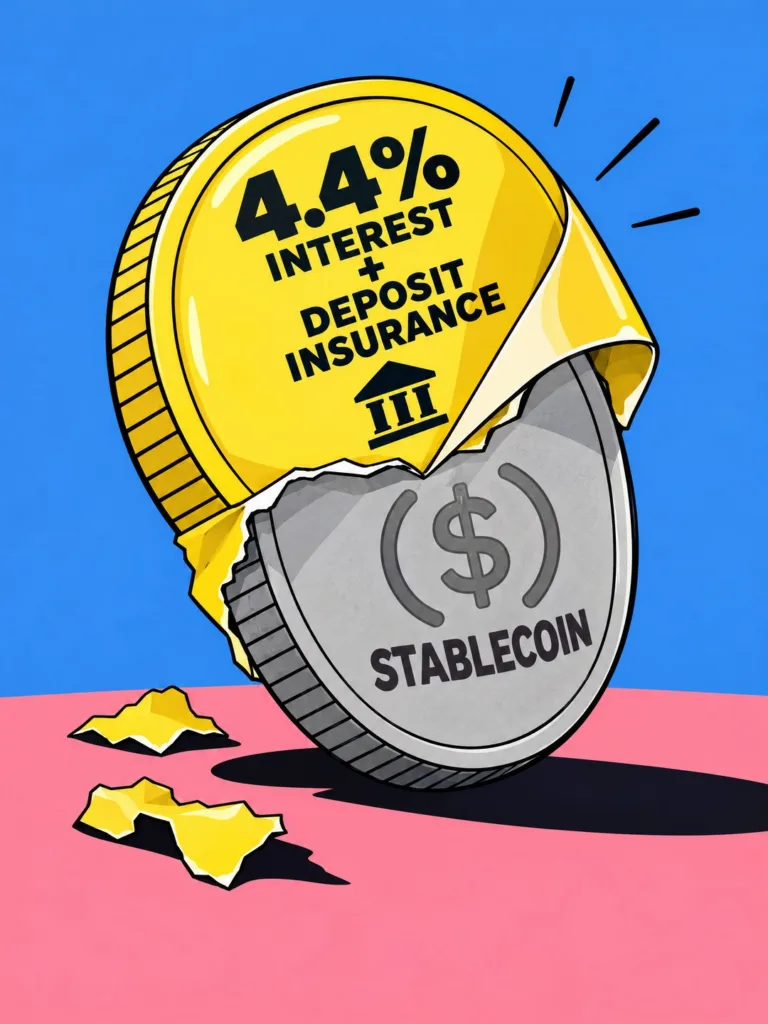
U.S. bank SoFi (a company that also lets customers trade more than 40 coins inside its banking app) launched a product called SoFi Earn on Oct. 22 that pays 4.4% a year. What customers receive is SOFIE, a tokenized deposit (a deposit made to move like a coin). Each one is worth $1 and is covered by FDIC deposit insurance (the FDIC is a U.S. government agency that repays bank deposits if a bank fails). SoFi said it is the first time a U.S. national bank has offered a product like this to individual customers.
The common take is "a bank has issued a stablecoin (a coin designed to stay worth $1)." But the real point is different. SOFIE is not a coin. It is a bank deposit dressed up as a coin.
SoFiUSD is SoFi's stablecoin. Here is the path the money takes: customer's money → SOFIE (a deposit, with interest and protection) → SoFiUSD (a stablecoin, with no interest or protection) → buying coins, or sending to an outside wallet (a crypto wallet outside the SoFi app).
- Why SOFIE is a deposit, not a coin
One SOFIE represents $1 deposited at SoFi Bank. Legally it is a deposit, so it is a debt the bank owes the customer, and FDIC deposit insurance covers up to $250,000 per depositor at one bank. There is no minimum balance. The interest rate is 4.4% a year, a variable rate that changes with market conditions.
Think of it as splitting your account balance into $1 slices and parking them next to the coin wallet in the app. The difference from an ordinary account is that you can pass a slice straight over to the coin side. If you put in $10,000 and the rate stays the same for a year, the interest comes to about $440.
- What disappears when you switch to a stablecoin
Customers can swap SOFIE for SoFiUSD one-for-one to buy coins, or send it to an outside wallet 24 hours a day. The catch comes next. Interest accrues only until you swap into SoFiUSD, and SoFiUSD, like other stablecoins, is not a deposit covered by deposit insurance.
It is like using a prepaid card instead of cash. It gets easier to spend, but the protection changes. Even though the same SoFi issued both and each is worth $1, the law protects them differently depending on whether the money is a deposit or a stablecoin.
- The law that blocked stablecoin interest, and what is at stake for banks
The U.S. stablecoin law (the GENIUS Act) bars issuers from paying holders interest simply for holding a stablecoin. The law takes effect in mid-January next year. What it bans is interest paid by stablecoin issuers.
Banks have their own concerns. The Congressional Research Service (CRS, an agency that prepares policy research for lawmakers) noted that banks fund loans with deposits, so if customers move deposits into stablecoins, lending could shrink, and since a stablecoin issued by a bank is not a deposit either, moving into that has the same effect. The banking industry has argued that large amounts of deposits could drain away if stablecoin interest were allowed. SoFi did not cite this as its own reason, but SOFIE, which keeps the deposit right next to the coin market, can be seen as a way around that worry.
- How much money is SoFi after?
Citing research from the U.S. central bank (the Fed), SoFi said $64 billion, about 21% of the stablecoin market, is sitting in forgotten or unused wallets. CEO Anthony Noto said, "There is too much idle money in the digital asset ecosystem," adding, "Money should keep working until the moment it is needed."
Put simply, the idea is to let dollars that were swapped in order to buy coins earn interest while they wait. SOFIE is the fifth coin-related product SoFi has launched in under a year.
- Where does the money end up?
While it is SOFIE, the money is a bank deposit. The customer earns 4.4% a year, and the money stays on the bank's books as a deposit in the meantime. The money leaves the bank only at the moment the customer swaps into SoFiUSD to buy coins or send it out.
The CRS noted that the GENIUS Act does not clearly bar an exchange from paying rewards on stablecoins held on that exchange (as of March 2026). It also noted that Circle, the issuer of USDC (a stablecoin), passes part of the interest on its reserves to Coinbase, a U.S. crypto exchange. An exchange's reward is paid on a stablecoin, whereas SOFIE's interest is interest on a deposit covered by deposit insurance.
- BITPRESS Insight
What SOFIE changes is where the money waiting on the sidelines of the coin market sits. If a bank pays deposit interest on that money, the waiting cash stays inside the bank and leaves only when it is used to buy coins. The customer collects the interest, and the bank is the one holding on to the deposits.
Interest and deposit protection come not from looking like a coin but from what the money is legally. The same $1 comes with interest and protection as a bank deposit, and loses both once it becomes a stablecoin.
When you see a dollar product that looks like a coin, ask three questions instead of judging by its look. Whose debt is this money, is the interest paid only while it is a deposit, and what is protected if something goes wrong?
Sources
https://www.theblock.co/news/business/2026-10-22-sofi-fdic-insured-tokenized-deposit-421916
https://decrypt.co/381174/sofi-launches-tokenized-deposit-that-earns-4-4-and-moves-like-a-stablecoin
https://cointelegraph.com/news/sofi-bank-issued-tokenized-deposit-yield-bearing-crypto-funds
https://www.everycrsreport.com/reports/IF13174.html
Glossary
Tokenized deposit — A bank deposit made into a digital token like a coin, but legally it is still a bank deposit.
Stablecoin — A coin built so its value does not move, pegged to a currency such as the dollar at $1.
FDIC (U.S. Federal Deposit Insurance Corporation) — A U.S. government agency that repays depositors if a bank fails, up to $250,000 per depositor at one bank.
GENIUS Act — A U.S. law setting rules for stablecoin issuers, which bars issuers from paying interest to holders.
BITPRESS articles are information to help your investment decisions, not a recommendation to buy or sell any stock or coin. Investment decisions and their results are your own responsibility.